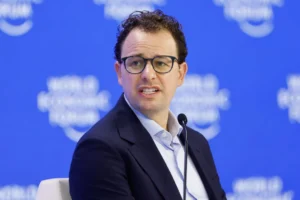
In a candid conversation at a bustling tech festival in Athens, venture capital luminary Neil Rimer, co-founder of the highly successful Index Ventures, issued a pronouncement that has resonated deeply within the technology and finance sectors: "I have a strong sense that there will be some sort of a redistribution." Rimer, known for his firm’s exceptional returns and his own growing presence in the Greek capital, articulated a belief that the immense wealth being generated by the artificial intelligence boom is destined to be redistributed, either through voluntary action or involuntary forces. He expressed a fervent hope that the former would prevail, positing that technology leaders themselves could play a pivotal role in guiding this inevitable shift.
While such a statement might sound like typical populist rhetoric from many quarters, coming from Rimer, it carries significant weight. Index Ventures has a formidable track record, having raised approximately $15 billion from investors since its inception. The firm’s recent successes, including the initial public offering of design platform Figma and the acquisition of cybersecurity firm Wiz by Google, reportedly netted Index Ventures a staggering $9 billion in the past year alone. Rimer’s personal wealth and influence in the venture capital landscape are undeniable, making his public contemplation of wealth redistribution a noteworthy departure from the often-guarded pronouncements of his peers.
Shifting Sands of Philanthropy Amidst Unprecedented Wealth Accumulation
Rimer’s pronouncement arrives at a time when traditional philanthropic models appear to be facing significant headwinds, despite record levels of charitable giving in the United States. The Giving Pledge, a decade-old initiative by Bill Gates and Warren Buffett encouraging billionaires to commit half their fortunes to charity, has seen a marked decline in new signatories. While 113 families signed in its first five years, this number dwindled to a mere four in 2024, according to a March report by The New York Times. This trend suggests a growing detachment from traditional charitable commitments among some of the wealthiest individuals, particularly within the tech industry, where figures like Elon Musk have publicly suggested that their business endeavors themselves constitute a form of philanthropy.
Beyond the Giving Pledge, broader data reveals a concerning trend. Total charitable giving in the U.S. reached a record $592.5 billion in 2024, yet the number of Americans actively donating has been on a downward trajectory for five consecutive years, with a 4.5% decrease in 2024 alone, according to the Stanford Social Innovation Review. The proportion of households contributing to charity has fallen from 66% in 2000 to approximately 50% currently. Even among affluent households, giving has seen a decline, dropping from 90% in 2017 to 81% last year, as indicated by data from Bank of America and the Lilly Family School of Philanthropy.
This broader shift is also observable within the portfolios of venture capital firms like Index Ventures. The firm’s investments include Anthropic, a leading artificial intelligence company. A recent inquiry by Business Insider with a financial planner serving newly wealthy clients, many of whom are employees of AI firms like Anthropic, revealed a focus on angel investing and entrepreneurship rather than large-scale philanthropic commitments. While Anthropic offers a matching program for employee donations of up to 25% of their equity, many clients, according to the planner, were not prioritizing philanthropy in their financial planning, opting instead for reinvestment in nascent ventures. This suggests a potential paradigm shift where wealth generated by cutting-edge technology is being channeled back into further innovation and business creation, rather than traditional charitable avenues.
The Growing Momentum for Involuntary Redistribution
The apparent decline in voluntary wealth redistribution has inevitably led to increased consideration of legislative measures aimed at achieving similar outcomes. In California, voters are set to decide on a proposed 5% one-time wealth tax targeting the state’s billionaires. This legislative push has already prompted some high-profile figures, including Google founders Sergey Brin and Larry Page, to relocate their primary residences to areas with more favorable tax policies, such as South Florida.
The impending IPO of OpenAI, reportedly slated for 2027, adds another layer of complexity. Cynics suggest that the timing of such a move might be influenced by the potential passage of the California wealth tax, as it would calculate net worth based on an individual’s global assets at the end of the current calendar year. This scenario highlights the potential for a preemptive response to anticipated tax liabilities.
However, such wealth redistribution measures face considerable opposition. Governor Gavin Newsom has expressed reservations, and a number of economists have pointed to historical precedents in other industrialized nations where similar wealth taxes have been repealed following the departure of wealthy residents. The argument often centers on the potential for capital flight and the unintended consequences of such policies on economic growth and investment.
Exploring Alternative Avenues: Equity Stakes and Public Participation
Beyond direct taxation, alternative proposals for wealth redistribution are also being explored. OpenAI has reportedly discussed the possibility of granting the federal government a 5% equity stake in the company. CEO Sam Altman has framed this as a mechanism for sharing the benefits of AI with the public. However, critics perceive this as an attempt to preemptively secure political favor and mitigate potential regulatory backlash in Washington. This proposition reflects a broader tension within Silicon Valley, which has historically been reluctant to involve government entities as direct stakeholders in its ventures. Veteran investor Roelof Botha has humorously, yet pointedly, remarked on the inherent skepticism towards government intervention, noting that "the most dangerous words in the world are: ‘I’m from the government, and I’m here to help.’"
A Historical Echo: The Gilded Age and the Seeds of Redistribution
Rimer’s observation about inevitable redistribution is not merely a contemporary commentary but also a reflection of historical patterns. The current concentration of wealth, particularly within the technology sector, bears striking resemblances to the Gilded Age of the late 19th and early 20th centuries. Forbes recently identified 45 new AI billionaires in its 2026 rankings alone, collectively worth $2.9 trillion, with this figure not yet accounting for the public offerings of Anthropic and OpenAI. The combined employees of these two AI giants are projected to hold enough wealth post-IPO to purchase nearly a third of all homes in the San Francisco metropolitan area.
While the share of wealth held by the top 1% of U.S. households has reached 31.7%, a record since 1989, this figure is still below the 45% commanded by the top 1% during the Gilded Age peak in 1916. However, when examining the very apex of wealth, the comparison becomes more stark. Renowned economist Gabriel Zucman calculates that at the height of the Gilded Age, the four largest fortunes accounted for approximately 4% of U.S. GDP. Today, a similar sliver of the population – now comprising 19 households – holds wealth equivalent to 14% of GDP.
This era of extreme wealth concentration has historically prompted two distinct responses, mirroring Rimer’s proposed dichotomy of voluntary versus involuntary redistribution. In 1889, at the peak of the first Gilded Age, Andrew Carnegie’s seminal essay, "The Gospel of Wealth," advocated for the wealthy to treat their fortunes as trusts for public good during their lifetime, deeming it a "disgrace to die wealthy." This essay became a foundational text for modern philanthropy and the intellectual precursor to the Giving Pledge.
However, voluntary efforts alone did not prevent the rise of more forceful redistribution. By the mid-1930s, Louisiana Senator Huey Long galvanized national support with his "Share Our Wealth" program, which proposed substantial taxes on the rich to fund a guaranteed income for all Americans. In response to Long’s growing popularity among the working class, President Franklin D. Roosevelt enacted what the press dubbed the "soak-the-rich tax," which raised the top marginal income tax rate to as high as 79%. While this legislation redistributed less wealth than Long envisioned, it remains a potent historical example of politically driven redistribution that emerged when voluntary giving failed to address the societal pressures of extreme wealth disparity.
The Shifting Moral Compass of the Tech Industry
Rimer’s perspective is informed by his extensive career in technology and his personal experiences. He traces his fascination with the "moral center of tech companies" back to his undergraduate days at Stanford in 1984, when Apple’s introduction of the Macintosh was seen as a heroic endeavor by founders like Steve Jobs, who were perceived as building something genuinely beneficial for the world. What troubles him now, he admits, is hearing his own children discuss certain tech companies with the same apprehension that a previous generation reserved for defense contractors or tobacco manufacturers.
It is important to acknowledge that Rimer, as an investor in companies like Anthropic, is a direct beneficiary of the very wealth accumulation he suggests will require redistribution. However, his public stance suggests a preference for a proactive, voluntary approach by his peers. He appears to be betting on the willingness of the tech elite to embrace the "easy way" – that is, to contribute back to society – before external forces dictate the terms of wealth redistribution, a scenario that carries the weight of historical precedent. The coming years will undoubtedly reveal whether the current generation of tech leaders will heed Rimer’s warning and choose a path of voluntary generosity, or whether the inexorable forces of societal pressure and legislative action will ultimately shape the future of wealth distribution in the age of artificial intelligence.