Digital asset management has rapidly evolved into one of the most resource-intensive operational requirements for contemporary web development and enterprise-scale cloud architecture. As modern web applications expand in scope, capability, and user reach, the volume of digital assets—ranging from high-resolution imagery and video streams to compiled application bundles and user-generated media—increases exponentially. This organic growth brings an inevitable escalation in operational overhead, highlighted by rising cloud storage expenditure and the operational friction associated with complex vendor ecosystems. For years, organizations have found themselves locked into legacy hyperscaler models, absorbing unpredictable egress fees and navigating labyrinthine pricing tiers. Within this challenging economic and technical climate, industry attention has shifted toward agile, specialized cloud infrastructure providers. Enter STRG, a modern cloud object storage platform designed specifically to deliver an affordable, fully S3-compatible alternative to traditional hyperscalers such as Amazon Web Services (AWS) S3, Google Cloud Storage, and Microsoft Azure Blob Storage.
The Economic Realities of Modern Cloud Storage and Vendor Lock-In
To understand the strategic value of emerging storage platforms like STRG, one must examine the broader macro-trends governing cloud computing over the past decade. Cloud object storage became the foundational bedrock of the modern internet, allowing organizations to decouple persistent data storage from compute infrastructure. However, as data lakes and digital repositories grew from gigabytes to petabytes, enterprises experienced significant cost inflation. Major public cloud providers historically leveraged proprietary ecosystems, cross-region data transfer fees, and complex API pricing structures that disincentivized multi-cloud architectures.
Industry analysts note that data egress fees—the cost incurred by an organization when moving its data out of a cloud provider’s network—have become a major pain point for engineering teams. These hidden or semi-predictable costs frequently distort annual IT budgets, forcing companies to reconsider their infrastructure strategies. Furthermore, vendor lock-in complicates disaster recovery planning and stifles competitive pricing negotiations. The introduction of S3-compatible alternatives represents a paradigm shift in the infrastructure market. By adhering to the established Simple Storage Service (S3) API standard popularized by AWS, alternative providers enable organizations to migrate workloads seamlessly without rewriting their underlying application code or adopting proprietary SDKs. This interoperability has lowered the barrier to entry for competitive storage vendors, allowing platforms like STRG to offer streamlined architectures focused on performance, predictability, and aggressive cost containment.
Core Architecture and Integration Mechanics of STRG
STRG enters the market by bridging the gap between enterprise-grade reliability and developer-friendly simplicity. Designed from the ground up to support standard S3 REST APIs, the platform allows development teams to integrate object storage into existing workflows with minimal friction. The onboarding process is structured to mirror familiar cloud management paradigms: upon registering for an account, administrators generate secure API keys and provision storage buckets tailored to their regional performance requirements.
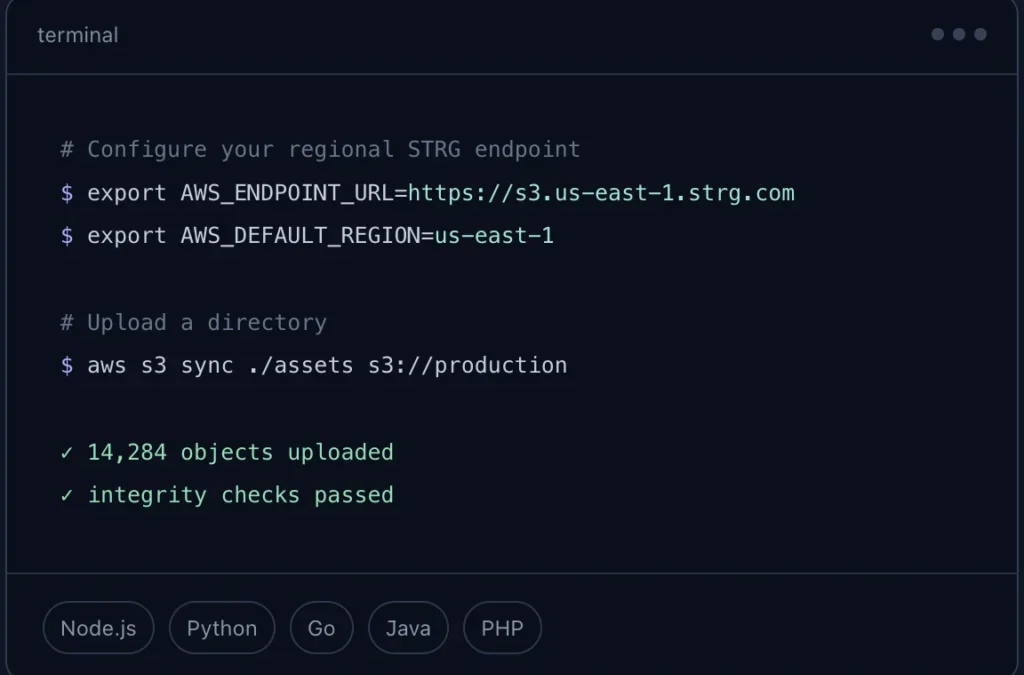
Integration can be executed through standard command-line interfaces, such as the AWS CLI, by configuring custom endpoints and credentials. For instance, developers can initialize a dedicated profile and execute foundational object lifecycle operations using standard commands:
# Configure your STRG upload settings
aws configure --profile strg

# Manage some assets!
aws s3 ls --profile strg --endpoint-url https://s3.eu-central-1.strg.com
aws s3 cp ./hello.txt s3://my-first-bucket/hello.txt --profile strg --endpoint-url https://s3.eu-central-1.strg.com
aws s3 ls s3://my-first-bucket/ --profile strg --endpoint-url https://s3.eu-central-1.strg.com
aws s3 cp s3://my-first-bucket/hello.txt ./hello-copy.txt --profile strg --endpoint-url https://s3.eu-central-1.strg.com
Beyond command-line utilities, native integration is supported across major programming languages through existing AWS Software Development Kits (SDKs). For JavaScript and TypeScript environments running on Node.js or modern edge runtimes, engineers can utilize the standard @aws-sdk/client-s3 package. By simply overriding the default endpoint URL to point to STRG’s regional infrastructure, applications can immediately perform asynchronous uploads, listing operations, and object retrievals:
import
  S3Client,
  PutObjectCommand,
  ListObjectsV2Command,
  GetObjectCommand,
 from "@aws-sdk/client-s3";

const s3 = new S3Client(
  endpoint: "https://s3.eu-central-1.strg.com",
  region: "eu-central-1",
);

await s3.send(
  new PutObjectCommand( Bucket: "my-first-bucket", Key: "hello.txt", Body: "Hello, STRG!" ),
);

const listing = await s3.send(new ListObjectsV2Command( Bucket: "my-first-bucket" ));
for (const object of listing.Contents ?? []) console.log(object.Key, object.Size);

const object = await s3.send(new GetObjectCommand( Bucket: "my-first-bucket", Key: "hello.txt" ));
console.log(await object.Body.transformToString());
This architectural compatibility ensures that development teams do not need to invest time in retraining staff or refactoring established codebase integration patterns. The underlying service delivers all essential primitives expected from mature storage solutions, including customizable lifecycle policies for automated data archiving and deletion, granular access control lists, Cross-Origin Resource Sharing (CORS) rules for web application safety, and object locking mechanisms to satisfy regulatory compliance and data immutability mandates.
Artificial Intelligence Integration and Model Context Protocol (MCP) Support
As software development increasingly incorporates autonomous coding assistants and generative AI agents, the interface between infrastructure management and artificial intelligence has become a focal point of engineering innovation. STRG has anticipated this shift by incorporating support for the Model Context Protocol (MCP), an open standard that facilitates secure, structured communication between AI models and local or remote tools.
By integrating an MCP server endpoint, organizations enable AI agents to interact directly with their storage buckets, executing operational tasks such as asset auditing, metadata tagging, and file retrieval within conversational development environments. Configuration is designed to be straightforward, typically executed through command-line client tooling:
claude mcp add --transport http strg https://mcp.strg.com/mcpSecurity remains a primary consideration in this automated paradigm. The operational scope of any AI agent interacting with STRG is strictly bound by the permissions assigned to the specific access key provided during initialization. Consequently, an autonomous agent can never execute administrative commands, modifications, or deletions exceeding the pre-configured authorization boundaries defined by the system administrator. This security-first design allows engineering teams to leverage AI-driven asset management without compromising the integrity or confidentiality of their core data repositories.
Industry Implications and Strategic Recommendations for Infrastructure Planning
The emergence of specialized, cost-optimized cloud storage providers underscores a broader decentralization trend within the cloud computing sector. As organizations face macroeconomic pressures to optimize operational expenditures, infrastructure leaders are increasingly auditing their software supply chains and cloud consumption models. Storing petabytes of static assets on premium, compute-optimized hyperscaler storage tiers is increasingly viewed as an inefficient allocation of capital.
For early-stage startups, mid-market enterprises, and large-scale digital publishers alike, selecting the appropriate storage foundation during the initial architectural phase has profound long-term implications. Retrofitting a storage backend after an application has scaled to millions of active users introduces substantial technical debt, migration risks, and potential service interruptions. Platforms like STRG provide a compelling alternative by combining enterprise-grade features—such as multi-region availability, low-latency data retrieval, and robust security controls—with predictable, transparent pricing models.
Ultimately, the maturation of S3-compatible alternatives signals a healthier, more competitive cloud marketplace. By lowering financial barriers and removing proprietary technical barriers, these platforms empower organizations to reclaim control over their data assets. As engineering teams continue to prioritize agility, cost efficiency, and seamless integration with modern development workflows, the adoption of specialized storage utilities is expected to accelerate, fundamentally reshaping how digital infrastructure is provisioned and managed in the years ahead.