
Prediction markets are rapidly gaining traction as innovative platforms where individuals can speculate on the outcomes of real-world events, effectively commodifying future uncertainties. Recent data highlights a dramatic surge in their popularity, with the two leading platforms, Polymarket and Kalshi, recording a combined monthly trading volume nearing an astonishing $24 billion as of April. This unprecedented growth underscores a pivotal moment for these nascent financial instruments, prompting deeper inquiry into the demographics and behaviors of their user base. To illuminate this evolving landscape, the Pew Research Center undertook a comprehensive analysis of nearly 12,000 Polymarket accounts, meticulously tracking their publicly available trading activity over a six-week period from May 7 to June 19, 2026. This extensive study aimed to move beyond aggregate market statistics, providing granular insights into how ordinary participants engage with these platforms, their trading frequencies, financial outcomes, and topical preferences.
The Ascent of Prediction Markets: A New Frontier in Information Aggregation
Prediction markets operate on the principle of information aggregation, leveraging the "wisdom of the crowds" to forecast future events. Participants buy and sell contracts whose value is tied to the probability of an event occurring. If a contract for "Event X will happen" is trading at $0.70, it implies the market believes there is a 70% chance of Event X occurring. These markets span a vast array of topics, from political elections and economic indicators to sports outcomes and cryptocurrency price movements. Unlike traditional gambling, proponents argue that prediction markets serve a vital function in synthesizing dispersed information and generating more accurate forecasts than traditional polling or expert analysis. This is particularly relevant in an age of information overload and rapidly shifting global dynamics, where precise foresight can be a significant advantage for businesses, policymakers, and the public.
The concept of prediction markets is not entirely new; early forms can be traced back to historical betting exchanges on elections. However, the advent of blockchain technology and decentralized finance (DeFi) has propelled platforms like Polymarket into the mainstream. Polymarket, built on a blockchain, offers enhanced transparency and accessibility, allowing users to trade with cryptocurrencies like USD Coin (USDC), a stablecoin pegged to the U.S. dollar. This technological underpinning contributes to the platform’s ability to handle high trading volumes and attract a diverse global user base, though its operations in the U.S. face distinct regulatory challenges compared to its international counterpart. Kalshi, another major player, operates under a different regulatory framework, having secured approval from the Commodity Futures Trading Commission (CFTC) to list event contracts for trading, primarily focusing on financial and economic events. The divergent regulatory paths of these platforms underscore the ongoing debate about whether prediction markets should be classified as innovative forecasting tools or speculative gambling instruments.
The dramatic increase in trading volume, from relatively niche activity to billions of dollars monthly, signifies a critical shift in public engagement. This growth can be attributed to several factors: increased awareness, the accessibility of online platforms, the allure of potential financial gains, and perhaps a desire for a more interactive way to engage with current events. The global nature of Polymarket, specifically, allows for participation from regions where traditional betting might be restricted, further fueling its expansion.
Pew Research Center’s Methodology and Objectives
Recognizing the burgeoning influence and public interest in prediction markets, the Pew Research Center initiated this study as part of its broader research into the prediction economy and public attitudes toward various forms of speculation, including sports betting and the morality of gambling. The Center’s objective was to provide an empirical foundation for understanding the behavioral patterns of individual users, moving beyond aggregated financial metrics to explore the "how" and "why" of participation.

The research focused specifically on Polymarket, due to the availability of its publicly accessible user activity API, which allowed for granular data collection. Kalshi, while a significant market, does not offer similar public data, thus precluding its inclusion in this specific behavioral analysis. The Pew team collected data by sampling user "wallets" in early May 2026. They identified 10 high-volume trading events across a diverse range of topics using other Polymarket API endpoints, collecting the 4,000 most recent trades for each event. This yielded a sample of 16,836 unique accounts. Over the subsequent six weeks, from May 7 to June 19, 2026, activity for these accounts was collected 15 times, ultimately providing data for 11,989 active wallets. This robust methodology allowed researchers to track trade frequency, value, profit/loss, and topical preferences with considerable detail. It is important to note that while the study refers to these as "traders" or "users," a single individual might operate multiple wallets, a common practice in the cryptocurrency space that could slightly skew individual-level interpretation but remains representative of account-level activity.
Unpacking the Typical Polymarket User: Engagement and Financial Outcomes
The Pew Research Center’s analysis paints a nuanced picture of the "typical" Polymarket user, revealing a blend of casual engagement and a significant contingent of highly active participants. Over the six-week study period, the median Polymarket user engaged in 46 trades across 10 distinct active trading days. This suggests that while many users are not trading daily, they exhibit consistent, albeit moderate, activity over time. The average value of each individual trade was a relatively modest $6.50, indicating that for a large segment of the user base, prediction market participation might be viewed more as an engaging hobby or a low-stakes intellectual exercise rather than a primary investment vehicle. This small average trade size stands in stark contrast to the multi-billion dollar monthly trading volumes, highlighting the sheer number of transactions occurring on the platform.
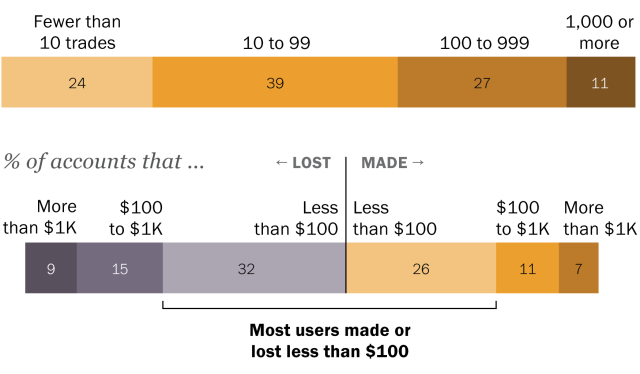
However, the aggregate figures mask considerable diversity in user behavior. The study found that roughly a quarter of the analyzed accounts (24%) were quite infrequent traders, placing fewer than 10 trades over the entire six-week period. These users might be experimenting with the platform, participating in a single event of personal interest, or simply dabbling. Conversely, a significant and influential segment, comprising 11% of all accounts, demonstrated exceptionally high activity, executing 1,000 trades or more within the same six-week timeframe. These "power users" likely contribute disproportionately to the overall trading volume and liquidity of the market, exhibiting behavior more akin to day traders or professional speculators. The remaining majority (39% between 10-99 trades, 27% between 100-999 trades) falls into a spectrum of moderate to active engagement.
When examining financial outcomes, the study revealed that the typical Polymarket user tended to break even during the six-week observation period. The average trader invested just over $600 on the site, experiencing a net loss of less than $2. This finding suggests that for the majority, the platform may not be a significant source of profit or loss, reinforcing the idea of participation as a form of entertainment or mild speculation. Over half of all traders (58%) fell into this category, with either gains or losses of less than $100. This demographic likely values the intellectual stimulation or entertainment value of predicting outcomes more than substantial financial returns.
Yet, as with trading frequency, there was a noticeable divergence in financial performance. While the median user broke even, a notable minority experienced significant financial shifts. Approximately 7% of accounts achieved a net profit exceeding $1,000 over the six-week period, demonstrating the potential for substantial returns for skilled or fortunate traders. Conversely, 9% of accounts incurred losses greater than $1,000, underscoring the inherent risks associated with speculative trading. These figures highlight the "fat tail" phenomenon common in financial markets, where a small percentage of participants experience outsized gains or losses, while the majority remain relatively close to their starting point.
Thematic Specialization: How Interests Shape Trading Patterns
Polymarket’s appeal lies in its diverse range of event categories, allowing users to specialize in areas aligning with their expertise or interests. The platform offers markets on virtually any verifiable future event, but traditionally, sports, politics, and cryptocurrency have consistently generated the vast majority of trading volume. Pew’s analysis confirmed a strong tendency for users to specialize, with the typical Polymarket user primarily focusing on a single topic. The median trader allocated approximately three-quarters of their total trades to one specific subject area, indicating a focused approach rather than broad diversification across topics. A significant 24% of users exclusively traded within a single category, further emphasizing this specialization.
The study further identified distinct behavioral patterns among traders based on their primary topic of interest (defined as 75% or more of their trades within that category):
- Sports Traders: These individuals demonstrated the highest activity levels, with a median of 69 trades over the six-week period. This higher frequency could be attributed to the rapid cadence of sports events, often occurring daily or weekly, providing continuous trading opportunities. Sports traders also tended to make slightly larger individual wagers, averaging $9 per trade, potentially reflecting a more traditional "betting" mindset or higher confidence in their sports knowledge.
- Cryptocurrency Traders: Users primarily focused on crypto markets placed a median of 59 trades. The inherent volatility and 24/7 nature of cryptocurrency markets likely contribute to this elevated activity. While frequent, their average trade value was the lowest among the categories, at less than $4. This might suggest a strategy of frequent, smaller trades to capitalize on minor price fluctuations or a willingness to experiment with minimal capital in a highly dynamic market.
- Politics Traders: In contrast to sports and crypto, politics traders were the least active, placing a median of just 13 trades. This lower frequency is understandable, given that major political events (elections, legislative decisions) typically have longer lead times and fewer immediate, high-frequency trading opportunities. Their average trade value was $6, falling between sports and crypto. This group might represent users with a keen interest in political outcomes, using the platform as a way to express their convictions or leverage their political insights over longer horizons.
These distinctions highlight how the nature of the underlying event category influences user engagement, risk appetite, and trading strategy. Sports and crypto markets, with their rapid cycles, foster more frequent, albeit sometimes smaller, engagements, while political markets attract more deliberate, less frequent participation.
The "Power Users": A Distinct Cohort
The 11% of Polymarket users who executed 1,000 or more trades during the six-week study period represent a distinct and highly influential segment of the user base. These "power users" significantly diverge from the median trader in several key aspects. While the original article does not detail their specific characteristics, it is logical to infer based on the broader data that they are likely to:
- Trade More Frequently: This is the defining characteristic, suggesting a dedication to monitoring markets and executing trades continuously. Their activity likely drives a substantial portion of the platform’s liquidity.
- Exhibit Higher Specialization (or conversely, extreme diversification): They might be hyper-specialized in a single, fast-moving market (like sports or crypto), or they might be professional arbitragers or market makers who trade across a wide array of markets to profit from small discrepancies.
- Have Larger Capital Allocations: To sustain such high trading volumes, especially if their average trade value is similar or higher than the median, these users likely have significantly more capital deployed on the platform.
- Experience More Pronounced Financial Outcomes: Given their high activity, these users are statistically more likely to be among the 7% who profit over $1,000 or the 9% who lose over $1,000. Their trading often reflects a more aggressive strategy aimed at substantial gains, inherently carrying higher risks.
- Potentially Influence Market Prices: Due to their volume, the collective actions of these power users can have a more significant impact on the price discovery mechanism of the prediction markets.
These highly active users are crucial for the health and efficiency of prediction markets, providing liquidity and ensuring that prices quickly reflect new information. Understanding their motivations and strategies is key to comprehending the overall dynamics of these platforms.
Broader Implications: Data, Regulation, and the Future of Forecasting
The findings from the Pew Research Center’s study carry significant implications for various stakeholders, from regulators and platform operators to the public and future researchers.
For Regulators: The data underscores the diverse ways individuals engage with prediction markets. While many participate casually with minimal financial impact, a segment engages in high-volume, potentially high-risk trading. This duality complicates regulatory efforts, which often struggle to differentiate between informational markets and gambling platforms. The CFTC’s cautious approach, exemplified by Kalshi’s regulated status contrasting with Polymarket’s decentralized model, reflects this challenge. Pew’s data provides empirical evidence that can inform future policy decisions, helping regulators tailor frameworks that protect consumers while fostering innovation in information aggregation. The observed prevalence of "break-even" users suggests that for many, the activity is not primarily about financial speculation, which could argue for a less stringent classification than pure gambling. However, the existence of significant winners and losers points to the need for consumer protection measures.

For Platform Operators: The insights into user behavior, particularly thematic specialization and the role of power users, can inform product development and market design. Understanding which topics drive engagement and what kind of trading behavior they foster can help platforms optimize event listings, improve user experience, and manage liquidity. The modest average trade value for most users suggests that platforms need to remain accessible and appealing to casual participants, while also catering to the needs of more sophisticated, high-volume traders.
For Market Efficiency and Forecasting: The study implicitly supports the idea that prediction markets, by attracting diverse participants with varying interests and levels of engagement, can indeed serve as effective information aggregation tools. The collective behavior of millions of trades, even small ones, can lead to surprisingly accurate forecasts. The specialization of traders suggests that expertise is being funneled into specific markets, potentially enhancing the accuracy of predictions within those niches.
Societal Impact: As prediction markets continue to grow, their role in public discourse and decision-making will likely expand. They offer a real-time barometer of collective sentiment and probability, which can be valuable for journalists, businesses, and political strategists. However, the potential for manipulation or the spread of misinformation also needs to be considered, especially if a small group of power users could disproportionately influence market prices. The ethical dimensions of profiting from real-world events, particularly those with significant human impact, will remain a subject of ongoing debate.
Conclusion
The Pew Research Center’s in-depth analysis of Polymarket user behavior offers invaluable insights into the burgeoning world of prediction markets. It reveals a landscape characterized by both casual engagement and intense, specialized trading, where a majority of users participate with modest stakes and largely break even, while a significant minority experiences more pronounced financial outcomes. The distinct trading patterns across topics like sports, cryptocurrency, and politics underscore the multifaceted appeal and utility of these platforms. As prediction markets continue their rapid ascent, this foundational research provides a critical lens through which to understand their participants, their economic implications, and their evolving role in the broader prediction economy. The future will undoubtedly bring further scrutiny and innovation to this dynamic space, and empirical studies such as this will be essential in navigating its complexities.