
The digital marketing landscape has been shaken by the decisive removal of PayPal Honey, one of the world’s most prominent affiliate publishers, from two of North America’s leading affiliate marketing networks, Rakuten Advertising and impact.com. Acquired by fintech giant PayPal six years ago for $4 billion, Honey built its massive user base through a popular browser extension that automatically applies coupon codes and cashback offers during online checkouts. However, recent public exposés, including a detailed video investigation by independent creator MegaLag and an in-depth analysis by researcher Ben Edelman, brought structural compliance issues to the forefront. This scrutiny culminated in swift enforcement actions by major network operators, signaling a potentially profound shift in how the partnership economy handles attribution rules, browser extensions, and affiliate compliance.
Chronology of Events and Network Enforcement
The enforcement actions against PayPal Honey unfolded over a single week in January, coinciding with the opening of the Affiliate Summit West conference in Las Vegas, a major annual gathering for the performance marketing industry.
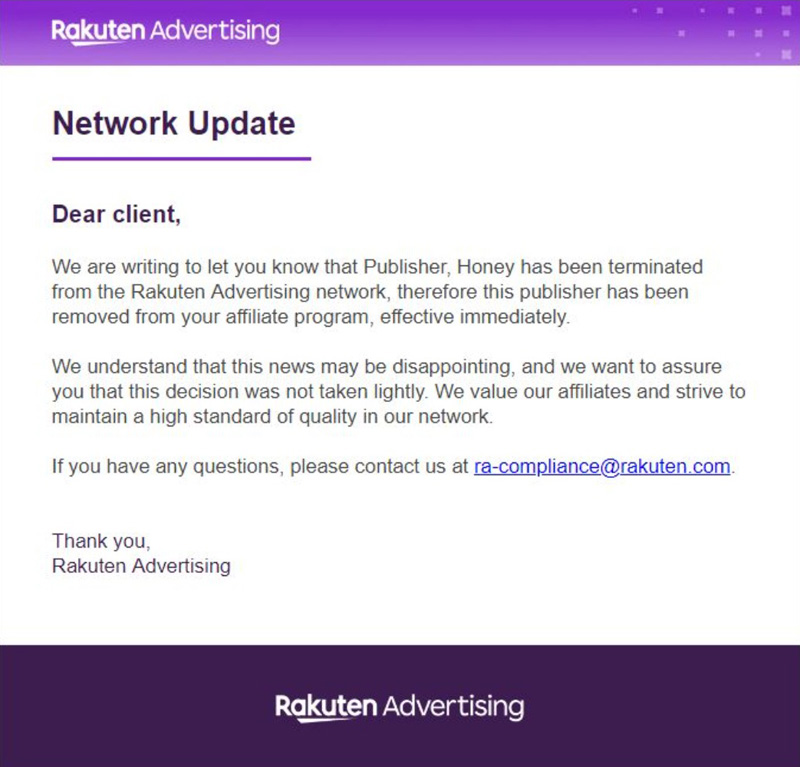
On Monday, January 12, Rakuten Advertising became the first major network to act. The company announced that Honey had been formally terminated from its network. In its official statement, Rakuten framed the decision as a necessary step to maintain high quality standards across its ecosystem. This announcement immediately dominated discussions at Affiliate Summit West and triggered widespread commentary across professional social media networks.
Days later, on Friday, January 16, impact.com took similar regulatory action. The platform determined that Honey was out of compliance with its established platform policies. Unlike Rakuten’s permanent termination, impact.com opted for a temporary suspension of Honey from its Discovery Marketplace. Nevertheless, the underlying rationale remained consistent across both networks: safeguarding the integrity of the partnership economy against manipulative attribution practices.
Core Allegations: Attribution Manipulation and Stand-Down Violations
The actions taken by Rakuten Advertising and impact.com were not arbitrary; they directly targeted specific technical practices related to affiliate clickstreams and conversion attribution. Most modern affiliate programs operate on a last-touch attribution model, meaning that the final publisher whose link or cookie interacts with a consumer before a purchase receives credit—and subsequent commission—for the entire transaction.

Investigations by industry experts revealed that certain downloadable software publishers (DSPs), including browser extensions like Honey, frequently bypassed established "stand-down" rules. These rules dictate that browser-based utilities must stand down and refrain from injecting their affiliate cookies if a consumer already arrived at a merchant’s site via a different, upstream affiliate partner, such as a content publisher, review site, or influencer.
By allegedly violating these protocols and concealing the overwriting of prior referral cookies, Honey and similar tools could claim credit for conversions they did not genuinely generate. Industry leaders characterized this behavior as attribution manipulation. David A. Yovanno, CEO of impact.com, explicitly noted that the suspension was enacted to protect trust within the partnership ecosystem, emphasizing that platforms must actively police practices that undermine fair compensation for diverse publisher types.
Industry Implications and Strategic Lessons for Affiliate Managers
The high-profile suspension of a multi-billion-dollar publisher has forced brand advertisers and affiliate program managers to re-evaluate how they monitor compliance, structure partner agreements, and manage risk. Industry analysts have highlighted several key operational takeaways for managing modern affiliate programs effectively in light of the Honey controversy.
First, the presence of non-compliant partners can actively harm a program’s broader recruitment efforts. High-value, rule-abiding affiliates—such as premier content creators, top-tier media outlets, and specialized reviewers—frequently audit a brand’s existing partner roster before joining. If a program tolerates aggressive cookie-droppers or publishers accused of link hijacking, quality affiliates often choose to withhold their promotional efforts, effectively starving the brand of diverse, high-intent traffic.
Second, brands are increasingly advised to conduct independent policing rather than relying solely on network compliance departments. While affiliate networks maintain broad terms of service, their internal monitoring teams primarily enforce network-wide rules rather than brand-specific agreements. Because an individual brand’s reputation and bottom line are directly at stake, proactive program managers must establish robust internal auditing procedures to detect unauthorized traffic patterns, abnormal conversion spikes, and cookie-stuffing behaviors.
Third, industry bodies are pushing for greater transparency regarding technology classifications. Recent independent audits—such as a comprehensive 24-page study published by the UK-based Affiliate & Partner Marketing Association (APMA), which evaluated attribution rules across multiple networks—demonstrate the technical complexity separating compliant early-funnel tools from predatory software. Program managers must familiarize themselves with these distinctions to avoid broad-brush generalizations that unfairly penalize legitimate browser extensions, loyalty platforms, or reward programs.
The Imperative of Affiliate Program Diversification
Beyond compliance and policing, the removal of PayPal Honey serves as a stark reminder of the risks associated with revenue concentration. Audits of corporate affiliate programs consistently reveal that a disproportionate share of total revenue—frequently 80% or more—is driven by a handful of individual partners, often concentrated within a single category, such as coupon aggregation or generic cashback sites.
When a dominant player like Honey is abruptly removed or suspended, programs that rely too heavily on a single traffic source face immediate, severe revenue contractions. To build resilient, sustainable marketing channels, industry experts strongly advocate for aggressive affiliate diversification. Modern brands are encouraged to expand their recruitment efforts across a broad spectrum of partner categories, ranging from card-linked offers and Connected TV (CTV) advertising to niche content producers, micro-influencers, closed user group (CUG) loyalty platforms, and post-checkout solutions.
Conclusion and Future Outlook
The removal of PayPal Honey from Rakuten Advertising and impact.com marks a watershed moment for the performance marketing industry. By drawing a hard line against attribution manipulation and concealed stand-down violations, major networks and platforms have signaled a renewed commitment to transparency and fair compensation.
As brands navigate the aftermath of these suspensions, the focus has shifted toward rigorous internal oversight, nuanced policy enforcement, and balanced publisher portfolios. Ultimately, the incident underscores a fundamental truth of digital partnerships: maintaining long-term consumer and merchant trust requires constant vigilance, clear rules, and a diversified ecosystem where all participating publishers can compete fairly.