The rapid proliferation of generative artificial intelligence tools has fundamentally transformed the digital publishing landscape, presenting content creators with both unprecedented efficiency and the distinct challenge of avoiding homogenous, low-quality output. While nearly 80 percent of marketers now incorporate AI into their content workflows, industry studies indicate that over 62 percent of professionals believe modern brands require increasingly unique, human-centered content to effectively capture audience attention in heavily saturated markets. This tension between production volume and editorial distinction has sparked widespread industry dialogue regarding the proper application of technology in professional writing.

Industry analysts and search engine operators alike emphasize that generative models function most effectively as supporting mechanisms rather than autonomous creators. According to technical documentation from major search providers such as Google, automated systems excel at tasks like structuring documents, conducting preliminary research, and synthesizing large volumes of information. However, because generative models rely on statistical probability to predict word sequences rather than retrieving verified facts, they remain susceptible to factual inaccuracies—commonly referred to as hallucinations or confabulations. Consequently, publishers face mounting pressure to implement rigorous human-review checkpoints to maintain credibility, factual integrity, and brand distinction.
Defining the Challenge of Content Saturation
The widespread accessibility of generative writing tools has inadvertently given rise to a colloquial industry term: "AI slop." This descriptor refers to mass-produced digital material generated with minimal human intervention, creative thought, or editorial oversight. As organizations leverage AI to scale output rapidly, digital channels have experienced an influx of formulaic articles characterized by predictable structures, generic phrasing, and a lack of lived experience.

Market research indicates that more than half of marketing professionals struggle to make their content stand out amidst this vast accumulation of automated text. Beyond the aesthetic and engagement concerns, relying heavily on unedited AI output introduces significant operational risks, including potential copyright complications, data privacy vulnerabilities, and reputational damage. Legal frameworks, including recent guidelines from the United States Copyright Office, stipulate that purely automated works generally do not qualify for traditional copyright protection unless a human author contributes sufficient expressive elements and creative modification.
A Five-Step Editorial Workflow for Hybrid Content Creation
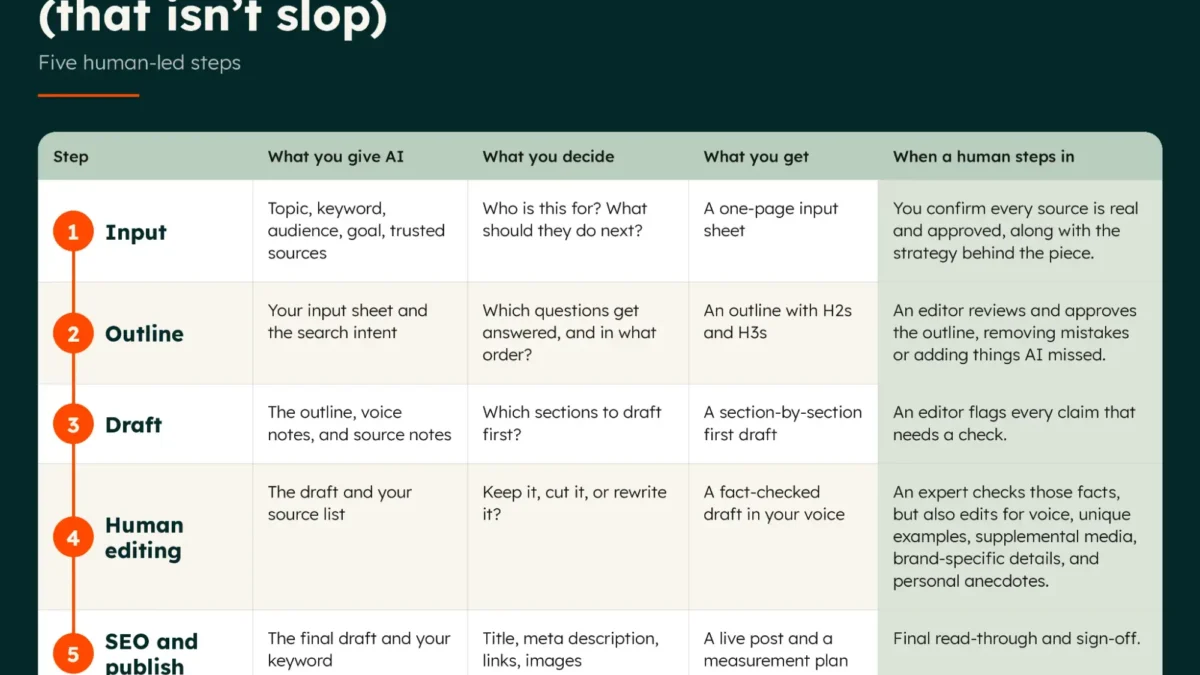
To mitigate these risks while capitalizing on the efficiency of modern technology, leading digital publishers have adopted structured, collaborative workflows that treat artificial intelligence as a digital intern rather than a replacement for human judgment. Successfully navigating this transition involves a methodical five-step process designed to preserve brand voice and ensure rigorous quality assurance.

Step 1: Comprehensive Input Gathering and Brief Creation
Before initiating any drafting process, creators must supply the tool with a comprehensive creative brief. High-performing prompts require precise contextual inputs, including the target audience profile, specific campaign goals, approved source materials, and a defined brand voice guide. Incorporating data privacy protocols is equally critical, as enterprise organizations must ensure proprietary information or sensitive consumer data is not improperly shared or utilized to train third-party models.
Step 2: Structured Outline Generation
Jumping straight into full-article generation frequently results in disorganized narratives that wander off-topic. A more effective methodology involves tasking the AI with generating a detailed outline derived from the initial brief. Each heading should directly address a specific user question and be anchored to a verified source, ensuring the structural foundation remains tightly aligned with the intended content strategy.

Step 3: Section-by-Section Drafting
Rather than requesting an entire long-form article in a single prompt, writers achieve superior results by drafting content in discrete, manageable chunks. This incremental approach allows editors to evaluate the logical flow, tone, and factual accuracy of individual sections before proceeding. By reviewing copy paragraph by paragraph, content teams can proactively intercept potential errors, remove repetitive phrasing, and inject original insights at every stage of the writing process.
Step 4: Rigorous Human Review and Fact-Checking
The editing phase serves as the primary safeguard for quality, originality, and trust. Human editors must meticulously verify every statistical claim, historical date, quoted statement, and product feature against primary sources. Furthermore, editing for brand voice ensures that the finalized text remains consistent with established corporate perspectives, organizational values, and stylistic guidelines. Eliminating common AI stylistic markers—such as overused transitional phrases and generic adjectives—helps restore an authentic, human-centric tone to the narrative.

Step 5: Optimization for Search and Answer Engines
Modern content optimization requires addressing both traditional search algorithms and emerging answer engine optimization (AEO) frameworks. Because AI-driven search features are fundamentally built upon core quality and ranking systems, publications must prioritize clarity, skimmability, and structured formatting. Utilizing descriptive headings, bulleted lists, and concise summaries enhances readability for both human audiences and automated crawlers alike.
Broader Implications for the Digital Publishing Ecosystem
The integration of artificial intelligence into editorial pipelines represents a permanent shift in how organizations conceptualize content strategy. As search engines and regulatory bodies continue to refine their policies regarding automated text—such as the transparency mandates outlined in the European Union’s Artificial Intelligence Act—organizations are compelled to adopt transparent attribution practices and rigorous editorial controls.

Ultimately, the future of digital publishing hinges on the symbiotic relationship between human expertise and machine efficiency. While technology can accelerate the mechanical aspects of research, outlining, and drafting, the core elements of storytelling—empathy, original research, nuanced perspective, and lived experience—remain uniquely human domains. By anchoring AI usage within disciplined, human-led workflows, publishers can scale their operations while safeguarding the quality and trust essential for long-term audience engagement.