The global imperative to accelerate the build-out of solar energy infrastructure, a critical component in achieving energy independence and combating climate change, is encountering a significant bottleneck: a burgeoning labor shortage. As countries and companies worldwide race to deploy solar panels and battery storage systems, the demand for skilled installation workers is outstripping supply. This growing chasm in the workforce presents a formidable challenge, but a nascent technology sector, leveraging the advancements in artificial intelligence and robotics, is emerging as a potential solution. Gritt, a startup founded by two Carnegie Mellon-trained roboticists, is at the forefront of this technological wave, aiming to dramatically increase the speed and efficiency of infrastructure construction through intelligent automation.
The company announced its substantial $26 million Series A funding round on Tuesday morning, signaling strong investor confidence in its innovative approach. The round was led by Obvious Ventures, with significant participation from Union Square Ventures and Active Impact Investment. This latest infusion of capital brings Gritt’s total funding to an impressive $34 million, building upon an earlier seed round backed by prominent venture capital firms including First Round Capital, Climactic, Congruent Ventures, and VSC Ventures. Gritt’s ambitious mission, as articulated by its CEO Puneet Puri, is to "help civilization build infrastructure faster."
The Genesis of Gritt: Addressing a Critical Labor Gap
The foundational principle driving Gritt’s development is the recognition that current construction methods, particularly for large-scale infrastructure projects like solar farms, are inherently limited by human capacity and the challenges of the outdoor, often unpredictable, work environment. "Our thesis is that if we truly want to speed up construction," Puri explained in an interview, "you need an intelligence which can work in the outdoor, chaotic environments of these construction sites, and it has to be generalizable enough that it can work in these varied environments."
Historically, industrial robots have excelled in controlled, structured settings such as manufacturing assembly lines. However, their deployment in the dynamic and often unstructured environments of construction sites has been a persistent challenge. The latest generation of AI models, particularly in the realm of machine vision and complex decision-making, appears to be bridging this gap, enabling robots to perceive, adapt, and operate with unprecedented dexterity in real-world conditions.
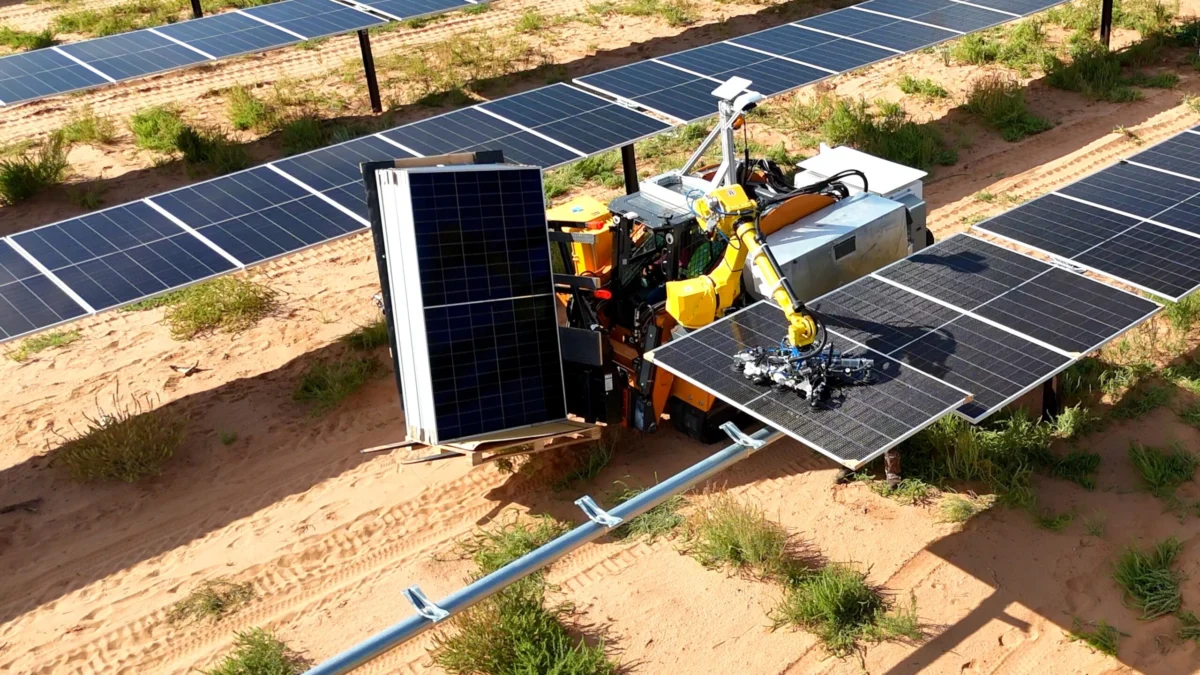
Gritt’s strategy diverges from that of some competitors by focusing on leveraging existing, readily available hardware rather than developing proprietary robotic platforms from scratch. This "off-the-shelf" approach allows the company to concentrate its resources on its core competency: developing sophisticated AI and machine learning algorithms that control and orchestrate these robotic systems. To date, Gritt has utilized rented equipment such as skidders and robotic arms manufactured by established companies like Kawasaki. These platforms are then integrated with Gritt’s proprietary AI models, transforming them into intelligent construction tools.
Initial Applications: Revolutionizing Solar Panel Installation
The initial focus of Gritt’s intelligent systems is the labor-intensive and precision-critical task of solar panel installation. The process involves robots unloading large, heavy glass solar panels, transporting them to their designated locations on metal frames, and then precisely positioning them with sub-millimeter accuracy. This high level of precision is crucial, enabling human workers to then efficiently and safely fasten the panels into place.
This approach is seen as a significant step forward in automating a process that is both physically demanding and time-consuming. The sheer scale of solar energy deployment required to meet global climate goals necessitates a substantial increase in installation capacity. Gritt’s technology aims to directly address this by augmenting human capabilities and significantly reducing the manual labor involved.
Andrew Beebe, a partner at Obvious Ventures who spearheaded Gritt’s Series A investment, highlighted the unique entrepreneurial spirit behind the company. "There are people who used to build rockets that went into space and had infinite budget for the smallest little part, and then there are people who know what it means to get into dirty, dull, and dangerous jobs and scale them like mad," Beebe commented. "These guys are in the second camp, and that’s a special kind of entrepreneur that has the technical chops, the AI, and the machine vision skills to make it work." This sentiment underscores the investors’ belief in Gritt’s ability to tackle practical, real-world challenges with cutting-edge technology.
Tangible Results: Quantifiable Improvements in Productivity
The impact of Gritt’s technology is already being demonstrated in the field. The company currently has two systems deployed in active construction sites, with the data collected from these operations continuously used to refine and improve the AI’s performance. The results are striking. According to Puri, a typical eight-person construction crew can install approximately 800 solar panels per day. However, when augmented with Gritt’s robotic systems, the same crew can dramatically increase their output, installing between 3,000 and 4,000 panels daily. This represents a quadrupling of productivity, a testament to the transformative potential of AI-driven automation in this sector.
This significant leap in efficiency has garnered considerable attention from industry leaders. Gritt has announced contracts to facilitate the installation of 2.8 gigawatts of solar panels over the next 18 months. Among its clientele are three of the top 10 solar construction companies in the United States, indicating widespread adoption and trust in the technology. The company has ambitious expansion plans, aiming to have 48 of its intelligent systems operational within the next six months, a rapid scaling of its deployment capabilities.
Customer Validation and Safety Implications
The enthusiasm for Gritt’s technology is echoed by its customers. One client, who preferred to remain anonymous due to competitive considerations, expressed strong optimism about the system’s ability to enhance their operations. A key benefit highlighted is the potential to ease workforce challenges in remote locations, where attracting and retaining labor can be difficult. Furthermore, the reduction of physical strain and the potential decrease in workplace injuries are significant advantages. Repeatedly lifting heavy solar panels overhead is a common cause of musculoskeletal injuries in the industry. By automating this strenuous task, Gritt’s systems can contribute to a safer and more sustainable work environment.
Competitive Landscape and Gritt’s Differentiated Approach
Gritt is not alone in seeking to automate solar panel installation. The market includes companies developing their own specialized hardware for this purpose, such as Luminous Robotics and Cosmic in the United States, and Trinabot in China. However, Gritt’s strategic decision to focus on AI and software integration with off-the-shelf hardware positions it uniquely. This approach could potentially lead to a leaner cost structure and faster scalability compared to companies that bear the full burden of in-house hardware development. As the demand for solar infrastructure continues to surge globally, the economic viability and speed of deployment will be critical differentiating factors.
Expanding Capabilities: Beyond Panel Installation
Gritt’s vision extends far beyond the initial task of solar panel installation. The company is actively developing its system to incorporate new manipulation tasks, aiming to automate the fastening of panels, drilling of support posts, and even the construction of the racks that hold the panels. This gradual expansion of capabilities reflects a broader strategy to become a comprehensive automation solution for labor-intensive construction processes.
Looking further ahead, Gritt aspires to tackle other common and demanding construction tasks. One significant area of interest is the process of tying rebar, a critical step in reinforced concrete construction, which is both physically demanding and requires a high degree of dexterity. Automating such tasks could unlock substantial efficiencies across a wider spectrum of the construction industry.
The AI Revolution: Enabling Generalizable Robotics
The rapid advancements in artificial intelligence models are the primary enablers of Gritt’s ambitious vision. The founders emphasize that while specialized automation was achievable to some extent years ago, the current generation of AI allows for a much higher degree of generalizability. This means that the same underlying software pipeline can be reused and improved across a variety of tasks, significantly accelerating development and deployment.
Puri provided a compelling example of this progress: "Making a system for one solution was still possible to some extent five years ago, right?" he stated. "But now, AI is making that work generalizable." He noted that training a system to stack cinder blocks, a task that previously might have taken weeks, could now be achieved in a matter of days for a similar demonstration involving rebar tying, using the same foundational software. This ability to quickly adapt and learn new tasks is a game-changer for the robotics industry, particularly in dynamic fields like construction.
A New Layer of Intelligence on the Worksites
Gritt’s ambitions are not limited to automating physical labor. The company envisions its systems, equipped with a suite of sensors and advanced intelligence, acting as a valuable data-gathering and decision-support layer on construction sites. This "physical AI" could proactively identify potential issues and alert human teams, thereby improving project management and mitigating risks.
For instance, a Gritt system might detect an open trench during a sudden storm’s approach and promptly notify workers to cover it before rain can damage components or cause safety hazards. It could also flag issues such as missing inventory or deviations from construction plans. In this capacity, Gritt aims to become an indispensable asset for site managers, providing real-time insights and enabling more informed and proactive decision-making.
"Gritt becomes now this layer of physical AI, which is doing this dextrous, labor-intensive task, plus it can help you take decisions on the site," Puri concluded, highlighting the dual role of its technology as both a physical executor and an intelligent advisor. This comprehensive approach positions Gritt not just as a robotics company, but as a platform for enhancing the overall intelligence and efficiency of infrastructure development.
Broader Implications for the Energy Transition
The success and scalability of companies like Gritt have profound implications for the global energy transition. The accelerated deployment of solar and renewable energy is a critical component of international climate strategies, aiming to decarbonize economies and mitigate the impacts of global warming. The International Energy Agency (IEA) has consistently highlighted the need for significant increases in renewable energy capacity. For example, the IEA’s Net Zero by 2050 roadmap emphasizes a rapid scale-up of solar PV installations, requiring a near-sixfold increase by 2030 compared to 2020 levels.
Challenges such as land acquisition, grid integration, and workforce availability have been identified as key hurdles to achieving these ambitious targets. By addressing the workforce challenge through automation, Gritt and similar innovators can play a crucial role in removing these barriers. A faster and more efficient installation process can lead to reduced project costs, making solar energy even more competitive and accessible.
Moreover, the integration of AI and robotics into construction can lead to higher quality installations, potentially increasing the longevity and performance of solar assets. The data analytics capabilities envisioned by Gritt could also enable predictive maintenance and optimize the operational efficiency of solar farms, further enhancing their economic and environmental benefits.
As the world grapples with the urgent need to transition to cleaner energy sources, technological advancements that can expedite this process are of paramount importance. Gritt’s focus on practical, AI-driven solutions for a critical labor-intensive sector demonstrates a clear pathway towards overcoming some of the most significant challenges in scaling renewable energy infrastructure. The substantial investment secured by Gritt underscores the market’s recognition of this potential, positioning the company as a key player in shaping the future of infrastructure construction and the global energy transition.