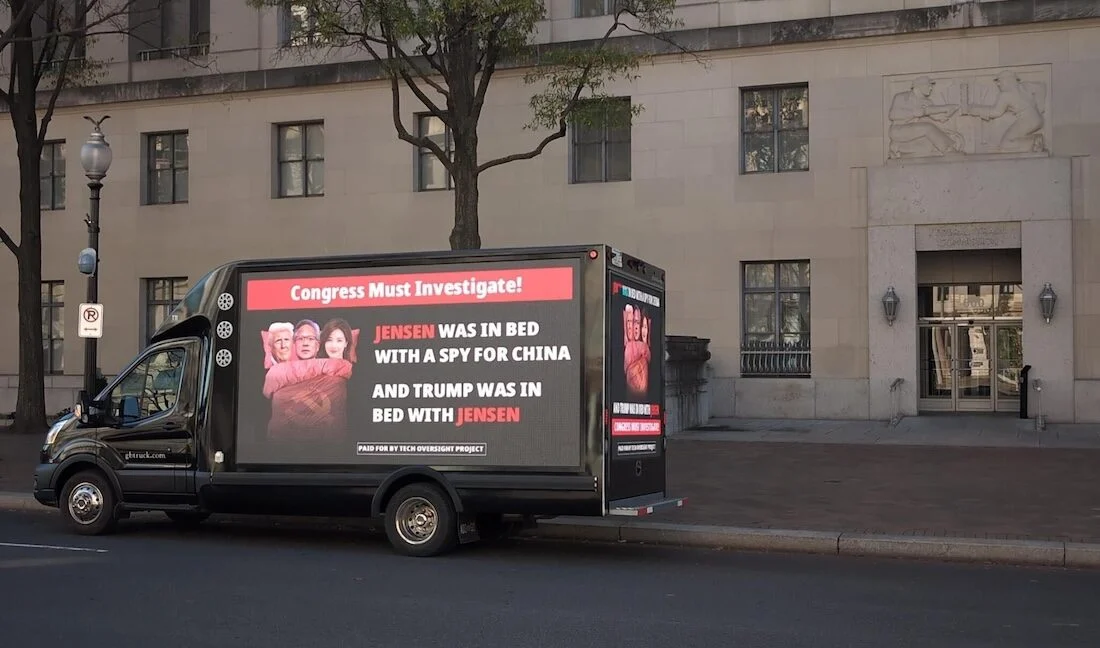
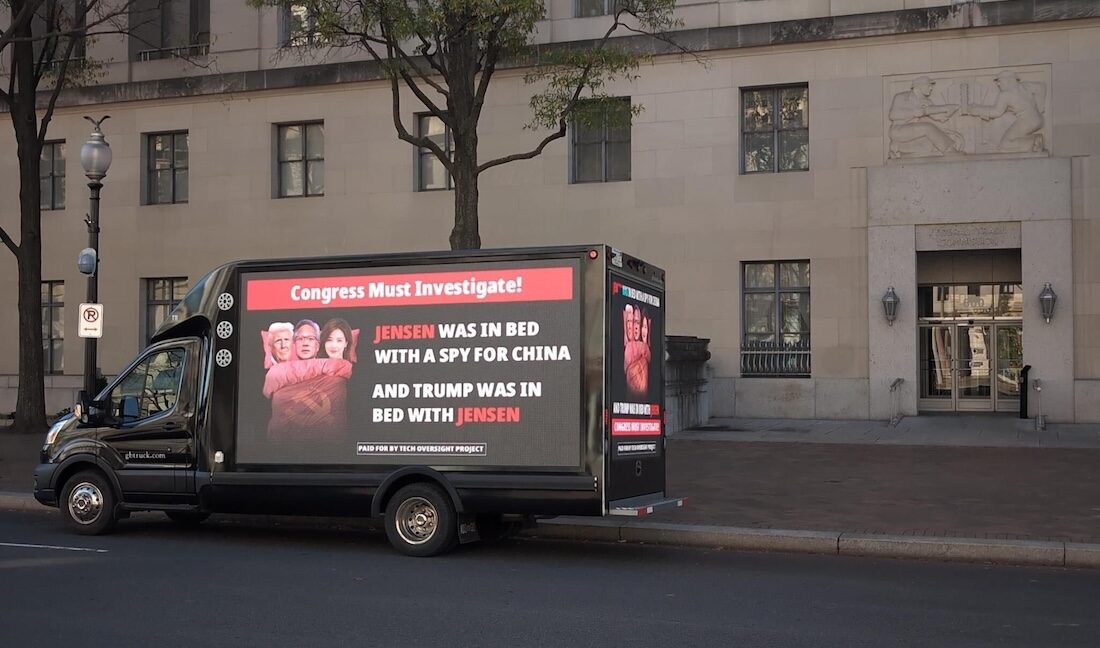
The corporate future of former Nvidia CEO Jensen Huang remains shrouded in uncertainty as a deepening controversy surrounding his alleged proximity to Chinese espionage and his administration-sanctioned business dealings with China brings his potential return to the helm of the semiconductor giant into question. On Monday, the Tech Oversight Project (TOP), a nonprofit organization focused on technology accountability, launched a mobile billboard campaign throughout Washington, D.C., explicitly calling for a formal congressional investigation into the ties between Donald Trump’s administration and the ousted tech executive.
The billboards, which circled the Capitol and various federal buildings, featured stark messaging: "Jensen was in bed with a spy from China. Trump was in bed with Jensen." This public pressure campaign serves as a physical manifestation of the growing bipartisan frustration in Congress regarding Nvidia’s export practices and the former president’s personal involvement with the company during his term.
A Chronology of Escalating Tensions
The crisis surrounding Huang’s tenure and his relationship with the Trump administration did not emerge in a vacuum; it is the culmination of a months-long breakdown in trust between the White House, the tech sector, and national security intelligence agencies.
In early 2026, reports surfaced that internal intelligence assessments had identified potential vulnerabilities in Nvidia’s supply chain, specifically regarding the unauthorized diversion of advanced AI hardware to Chinese military-affiliated labs. Despite these warnings, Huang’s influence within the Trump administration appeared to grow. By the spring of 2026, intelligence briefings suggested that high-level officials were aware of potential espionage risks associated with the company’s expansion into the Chinese market.
By mid-2026, the situation moved from boardroom concern to public scandal. In September, allegations surfaced regarding an extramarital affair between Huang and the former CEO of Megaspeed, Alice Huang, a connection that critics argue created a vector for sensitive trade secrets to reach prohibited entities in China. By October, the White House’s continued support for Huang—culminating in his receipt of the National Medal of Science—prompted widespread outcry from both chambers of Congress. The current standoff reached its apex this week as the Nvidia board of directors confirmed that any potential reinstatement of Huang remains off the table while an exhaustive internal investigation continues.
The Financial Nexus and Conflict of Interest
The core of the congressional inquiry focuses on the intersection of national security policy and private financial gain. The Tech Oversight Project’s recent report highlights the roles of former White House AI Czar David Sacks and Commerce Secretary Howard Lutnick as pivotal figures in this unfolding drama.
Data indicates that during their tenure, both Sacks and Lutnick oversaw a significant relaxation of export controls on AI chips, specifically those destined for markets that previously faced strict bans under the Biden administration. Critics, including Senator Richard Blumenthal, have pointed to the potential for "astronomical" personal profit derived from these policy shifts.
For instance, documents analyzed by the Wall Street Journal suggest that Donald Trump’s own investment portfolio saw significant growth tied to Nvidia stock during his 2025–2026 term. Meanwhile, Howard Lutnick’s firm, Cantor Fitzgerald, reportedly maintained substantial financial ties to Nvidia, arranging billions of dollars in financing for the company’s expansion projects, including a $3.4 billion agreement with the Australian-based cloud provider IREN, an Nvidia partner. The optics of these financial entanglements—coupled with the administration’s refusal to fully disclose communications between the President and Huang—have fueled accusations of systemic corruption.
The National Security Dimension: The Blackwell Problem
The technical heart of the scandal involves the distribution of Nvidia’s flagship Blackwell AI processors. Although the United States government implemented stringent export controls to prevent these high-end chips from reaching China, evidence suggests that they remain "indispensable" to China’s pursuit of frontier artificial intelligence.
Andrew Yoon, head of research at CivAI, notes that the strategic value of these chips cannot be overstated. "Jensen Huang has been at the absolute forefront of lobbying to be able to sell chips to China," Yoon remarked. "He has leveraged his deep relationships with the government to sell as many units as he can get away with. If he could be selling Blackwell chips to China, I am certain he would be."
The concern among national security experts is that these chips are being utilized to train military-grade AI models, effectively allowing a geopolitical rival to leapfrog US technological advantages. The failure of the Commerce Department, under Lutnick’s leadership, to enforce tighter controls on third-party smuggling routes has led to calls for a total overhaul of export oversight.
Official Responses and the "Honored to Return" Statement
On Tuesday, in a move widely interpreted as an attempt to control the narrative, Jensen Huang issued a public statement addressing his desire to return to Nvidia. He emphasized his status as a naturalized citizen and his deep-seated patriotism, stating, "Nowhere but in America could a company like Nvidia be possible. I love our country, and I love Nvidia."
However, the response from the Nvidia board of directors was conspicuously cold. In a brief statement, the board affirmed that they remain committed to the ongoing internal investigation and that the question of leadership succession is not currently under consideration. This silence suggests that, despite Huang’s public overtures and his perceived "alignment" with American interests, the legal and reputational risks posed by his past actions have rendered him a liability in the eyes of the board.
Broader Economic and Geopolitical Implications
The fallout from this scandal extends far beyond the C-suite of a single company. Global markets are observing the situation with anxiety, as Nvidia’s dominance in the GPU market is tied to the stability of the entire AI ecosystem. According to reporting from The Information, major clients and customers are already beginning to hedge their bets, moving toward competitors like Google and AMD to ensure a more stable and less politically compromised supply chain.

The implications for the U.S. government are equally severe. Should the upcoming congressional investigations reveal that the White House was willfully ignorant of, or complicit in, the compromise of American intelligence, it could lead to a constitutional crisis regarding executive accountability. Senator Blumenthal’s call for a "penetrating, comprehensive investigation" into the administration’s handling of these matters underscores the gravity of the situation.
Furthermore, the scandal forces a broader reckoning regarding the role of private sector leaders in federal policy-making. The "revolving door" between Silicon Valley leadership and government advisory roles has long been a point of debate, but the alleged conflicts of interest involving Sacks and Lutnick have turned abstract concerns into a concrete policy demand for stricter divestment and disclosure requirements.
Conclusion: A Path Toward Accountability
As the 48-hour window for potential political movement closes, the focus shifts to the legislative branch. With a new session of Congress approaching, the committees tasked with investigating the Trump administration’s interactions with Nvidia are expected to issue subpoenas for internal communications and financial records.
Whether Huang can survive this storm remains the primary question for investors and industry analysts. While he has framed his potential return as a continuation of his "life’s work," the weight of the evidence suggests a much rockier road ahead. If the current allegations of bribery, corruption, or gross negligence regarding national security are substantiated, it is unlikely that the private sector or the public will allow a return to the status quo.
The Tech Oversight Project’s campaign serves as a reminder that in an era of AI-driven global competition, the line between corporate profit and national security is becoming increasingly blurred. The final resolution of the "Huang affair" will likely serve as a benchmark for how the United States handles corporate malfeasance and conflicts of interest in the high-stakes world of artificial intelligence for years to come.