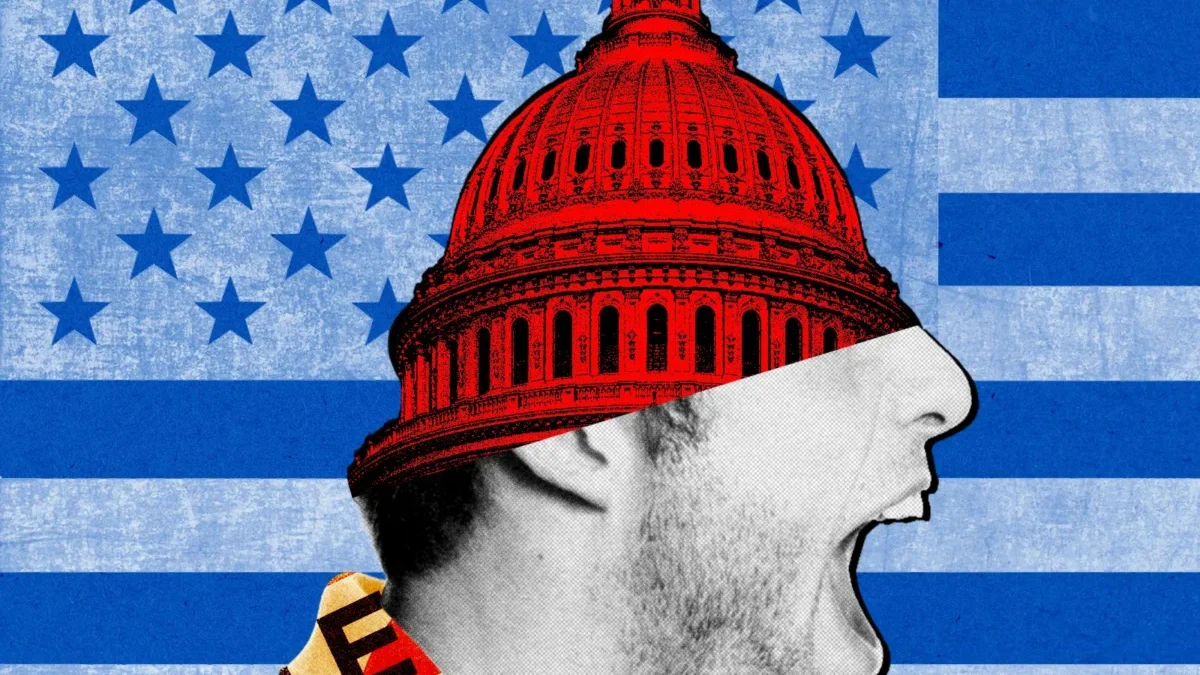
The political landscape of the United States experienced a profound shock during last week’s midterm elections, culminating in a sweeping Democratic victory across multiple key legislative races and state contests. While mainstream political analysts spent the days following the election dissecting voter turnout, economic anxieties, and campaign strategies, a darker narrative was unfolding across fringe digital platforms. White supremacists, Christian nationalists, and prominent far-right agitators quickly moved to claim ownership of the election results, framing the Democratic sweep not as a defeat for conservatism, but as a strategic opening for a hostile takeover of the Republican Party from within.
Prominent white nationalist Nick Fuentes took to social media on Election Day to urge his followers to cast ballots for Democratic candidates, a post that rapidly accumulated over 12 million views. Following the definitive Democratic gains, Fuentes publicly boasted about the outcome on encrypted messaging channels, dubbing the phenomenon the "Groyper Effect" after the cartoon frog mascot associated with his followers. In subsequent livestreams, Fuentes argued that allowing Democrats to govern would inevitably trigger public frustration, driving disillusioned citizens into the arms of the radical right and forcing a restructuring of mainstream conservative politics.
This opportunistic stance was echoed across numerous extremist echo chambers. Monitoring organizations, civil rights watchdogs, and research groups tracking online radicalization noted a uniform sentiment among white-supremacist and Christian-nationalist networks: Donald Trump and the current GOP establishment have failed to fiercely prioritize white Christian nationalist values. Consequently, these extremist factions view the sudden shift in legislative power as a catalytic event that validates their criticisms and creates a vacuum they intend to fill.
The Chronology of Radical Opportunism and Digital Posturing
The timeline of the far-right response began moments after the initial exit polls indicated a strong Democratic performance.
On Election Day, Fuentes’ directive to vote Democratic served as an accelerant for online coordination. By Wednesday morning, as the scale of the Democratic sweep became mathematically evident, figures within the "America First" movement and associated white supremacist circles shifted from tactical voting advice to strategic grandstanding.
By late last week, extremist leaders were actively broadcasting their blueprints for institutional infiltration. Warren Balogh, a known white supremacist from Pittsburgh who participated in the infamous 2017 "Unite the Right" rally in Charlottesville, Virginia, explicitly called upon nationalists via Telegram to target local Republican committees. Balogh urged his adherents to organize systematically and execute a hostile takeover of regional GOP apparatuses.
Concurrently, extremist street-fighting organizations like the Proud Boys seized on the moment to validate their longstanding grievances against moderate conservatism. The Cape Fear chapter of the Proud Boys published statements on Telegram describing the electoral results as a long-overdue rebuke of the traditional Republican establishment. They argued that citizens taking matters into their own hands via successful ballot initiatives proved the current leadership was entirely obsolete.
Data and Electoral Realities: The Paradox of Extremist Success
While the national narrative focused on the broader Democratic victories, a granular examination of the electoral map reveals a complex reality regarding extreme-right candidates and policy measures.
Research compiled by the Institute for Research and Education on Human Rights (IREHR) offers sobering statistical insight. Tracking 535 candidates in statewide races who maintained documented memberships in far-right or extremist Facebook groups, researchers found that by the Friday following the election, 476 of those races had been officially called. Out of those, 338 candidates emerged victorious, representing a staggering 71 percent win rate. However, researchers noted that the vast majority of these successes occurred in safe districts where incumbent Republicans comfortably retained pre-existing seats.
Nevertheless, specific local races highlighted the persistence of radical figures within the broader ecosystem. In Florida’s 10th District State House race, Marshall Rawson—a 34-year-old citrus farmer who was documented participating in the 2017 Charlottesville demonstrations—easily defeated his Democratic opponent, illustrating that localized radical ties do not automatically preclude electoral viability.
Furthermore, several high-profile ballot measures championed by conservative hardliners passed across multiple states, providing extremist groups with tangible ideological wins. Voters in Arizona, Colorado, Nebraska, and Washington approved strict bans preventing transgender athletes from competing in female sports categories. Analysts from civil rights and research organizations emphasized the draconian enforcement mechanisms accompanying some of these measures, such as mandatory physical verifications for youth athletes in Washington state. Additional approvals of onerous voter identification statutes and aggressive anti-immigrant policies were broadly celebrated by fringe groups as proof that the grassroots populace desired policies the traditional GOP leadership had failed to deliver.
The Strategy of Internal Infiltration Versus Direct Confrontation
As extremist factions assess the wreckage of the midterms, two distinct strategic philosophies are emerging regarding how to capture American political institutions.
The first strategy relies on institutional entryism: a patient, methodical campaign to infiltrate local and state Republican Party structures. Jared Holt, a senior researcher at Open Measures, highlighted that extremist influencers are actively exploiting widespread voter dissatisfaction to frame the MAGA movement’s setbacks as a definitive death knell for moderate conservatism. By convincing disaffected voters that the current party apparatus is irredeemably weak, these actors hope to steer conservative infrastructure toward overt white nationalist platforms.
The second strategy discards traditional democratic processes in favor of ideological radicalization and aggressive confrontation. During a post-election broadcast, Christian nationalist pastor Joel Webbon openly dismissed the necessity of winning power exclusively through democratic norms, declaring to his audience that their primary objective was simply to win by any means necessary.
This rhetoric converges with upcoming high-profile gatherings. A conference scheduled in Texas brings together radical pastors, ideological influencers, and prominent conspiracy theorists like Alex Jones. Agendas for the summit explicitly feature workshops and panel discussions outlining "battle plans" for Christian nationalists seeking to seize structural power in the United States.
Implications for the Upcoming Congressional Certification and National Security
Looking ahead, law enforcement, congressional leaders, and extremist-monitoring organizations are closely watching the calendar for potential flashpoints. Civil society researchers report that while explicit calls for mass physical violence have remained relatively muted compared to previous election cycles, key agitators are already turning their attention to January 3, the date when the newly elected Congress is constitutionally mandated to convene and certify the midterm results.
Jake Lang, a far-right activist and pardoned January 6 participant, has begun organizing a demonstration in Washington, D.C., coinciding with the certification proceedings. Although Lang recently made headlines for disrupting an unrelated event in the capital, his ongoing efforts to mobilize a national network of followers underscore the persistent threat posed by actors seeking to leverage parliamentary procedures for disruptive political theater.
The implications of these developments for the future of American democracy are profound. The intersection of institutional electoral victories at the local level, the passage of exclusionary state-level ballot measures, and the deliberate infiltration strategies articulated by white supremacist and Christian nationalist leaders point to an escalating crisis within conservative politics. As extremist groups increasingly view the mainstream Republican Party as vulnerable, the struggle for the ideological soul of the American right has entered a volatile and defining new phase.