The web development landscape is continually evolving, with developers constantly seeking innovative ways to enhance user experience and streamline design processes. One significant area of advancement has been the dynamic manipulation of CSS properties, historically a realm heavily reliant on JavaScript for real-time updates. However, a new tool, dubbed "Prop For That," is emerging, promising to bridge the gap between JavaScript’s data-driven capabilities and CSS’s styling power in a more integrated fashion. Developed by Adam, also known for his contributions to the widely adopted Open Props library, Prop For That aims to make dynamic CSS properties, or "live props," accessible and manageable with a simpler workflow.
This new utility builds upon the foundational concept of CSS custom properties, also known as CSS variables, which have revolutionized how developers manage styles. Open Props, released by Adam previously, provided a comprehensive set of pre-configured variables for a multitude of design elements, including color palettes, shadow effects, sizing scales, and typographic systems. This library offered a standardized and efficient way to maintain design consistency across projects. Prop For That, while sharing the spirit of providing pre-defined, reusable styling components, takes a significant leap forward by enabling CSS to directly respond to data points that are typically only accessible to JavaScript.
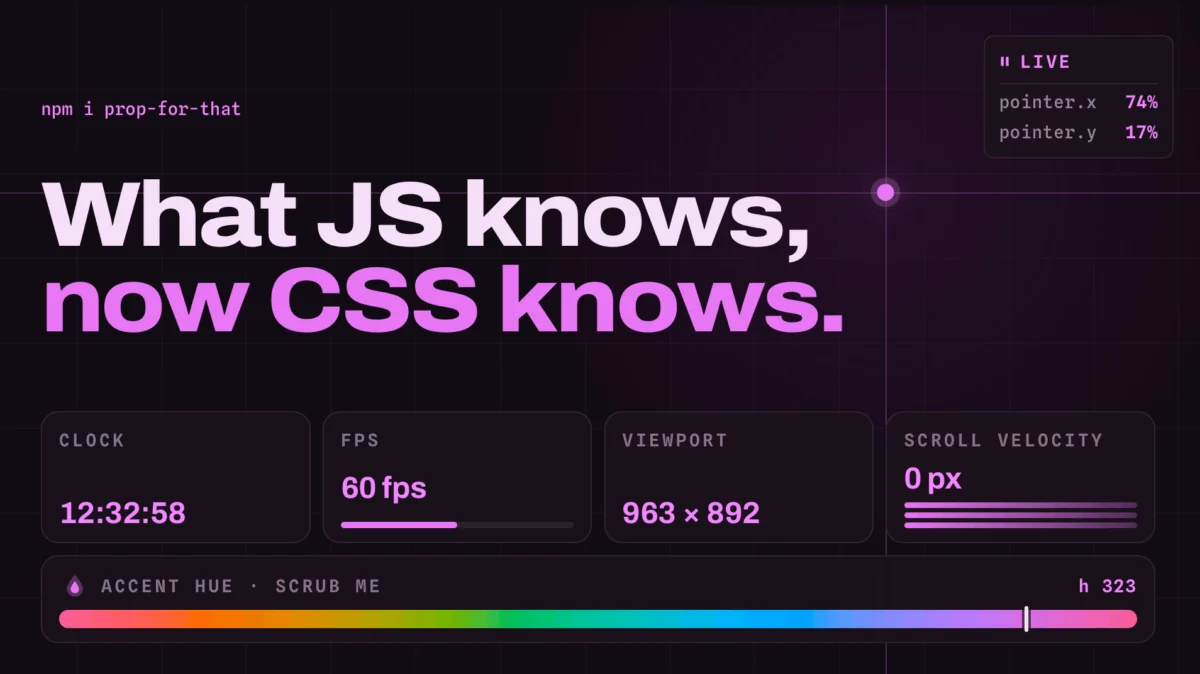
The core innovation of Prop For That lies in its ability to expose browser-generated data, such as cursor position, progress indicators, specific form element states, the current time, and even scroll velocity, directly to CSS. Traditionally, achieving such dynamic styling required JavaScript to actively listen for these events, capture the relevant data, and then update CSS custom properties or directly manipulate DOM elements. Prop For That aims to abstract away much of this JavaScript boilerplate, allowing developers to declare these live props using data attributes in their HTML and then style them using standard CSS syntax.
The Mechanics of Live Props
The underlying principle of Prop For That, as understood from its documentation and demonstrations, involves a background script that continuously monitors and collects various browser-specific data points. Once the library is imported and its functionality is declared within the HTML structure, these collected data points are exposed as CSS custom properties. Developers then need only to import the library, register its presence in their HTML, and subsequently style their elements using these newly available live CSS variables.
To illustrate this, consider a scenario where a developer wishes to track the user’s cursor position to dynamically move an element on the screen. In the past, this would typically involve a JavaScript snippet similar to the one demonstrated by Chris on CSS-Tricks, where custom properties were registered in JavaScript to track cursor coordinates. This involved event listeners for mousemove and manual updates to CSS variables.
Prop For That simplifies this process significantly. The library provides a mechanism to achieve the same result with a more declarative approach. Instead of writing explicit JavaScript event handlers, a developer would mark an HTML element with a specific data attribute, such as data-props-for="pointer". This attribute signals to Prop For That that this element should be linked to pointer (cursor) tracking.
Following this HTML declaration, the associated CSS can then directly reference variables like --live-pointer-x and --live-pointer-y. For example, an element intended to follow the cursor might be styled as follows:
<div class="mover" data-props-for="pointer">...</div>.mover
aspect-ratio: 1;
width: 50px;
background: red;
position: absolute;
left: calc(var(--live-pointer-x, 0) * 1px);
top: calc(var(--live-pointer-y, 0) * 1px);
In this example, the data-props-for="pointer" attribute on the .mover div tells Prop For That to enable pointer tracking for this element. The CSS then uses calc() to interpret the --live-pointer-x and --live-pointer-y variables, multiplying them by 1px to convert the raw coordinate values into pixel units for positioning. The 0 within the var() function serves as a fallback value, ensuring that if the live variable is not yet available, the element defaults to a position of 0,0. This approach effectively removes the need for explicit JavaScript code to manage cursor position updates in CSS, allowing developers to focus more on the visual presentation.
Expanding the Horizon of Live CSS Data
The potential applications of Prop For That extend far beyond cursor tracking. The library is designed to be modular, with different "plugins" for various types of live data. These plugins can expose information about:
- Progress Values: This could be used for dynamically styling elements based on the progress of a video playback, a file upload, or even a user’s scroll position within a long page. Imagine a progress bar that isn’t just a static element but a dynamic indicator whose visual properties change based on real-time progress, all managed through CSS variables.
- Form States: Certain form elements have inherent states that are difficult to style directly with CSS without JavaScript intervention. Prop For That aims to expose these states, such as whether a checkbox is checked, an input field is focused, or a select element has a chosen option, allowing for more sophisticated and responsive form styling.
- Current Time: The ability to access the current time directly in CSS opens up possibilities for time-based animations, scheduled visual changes, or even dynamic visual displays that update with the clock. This could range from subtle color shifts throughout the day to more complex, time-sensitive animations.
- Scroll Velocity: Understanding how quickly a user is scrolling can be invaluable for creating parallax effects, adaptive animations, or responsive layouts that react to the speed of navigation. Prop For That can expose this velocity as a CSS variable, enabling developers to create more engaging scrolling experiences.
The availability of such dynamic data points in CSS through a simplified interface represents a significant shift in how interactive web elements can be designed and implemented. It allows for a more declarative and arguably more maintainable approach to complex dynamic styling, potentially reducing the cognitive load on developers who would otherwise need to juggle JavaScript logic with CSS rules.
The Demos: A Testament to Design Excellence
The official documentation and demos for Prop For That are frequently highlighted as a strong suit of the project. These examples serve not only to showcase the technical capabilities of the tool but also to inspire developers with the aesthetic possibilities. The emphasis on "classy work" in the original description suggests that Adam and his collaborators have put considerable effort into creating demonstrations that are both functional and visually appealing, providing tangible proof of concept and design inspiration.
The website, prop-for-that.netlify.app, is the central hub for accessing these demos, documentation, and the library itself. Users are encouraged to explore these resources to understand the full scope of Prop For That’s features and to see firsthand how it can be integrated into real-world projects. The availability of direct links to explore these demos further underscores the project’s commitment to transparency and developer accessibility.
Context and Implications
The emergence of Prop For That can be viewed within the broader trend of "design systems" and "utility-first CSS" frameworks. Libraries like Open Props and Tailwind CSS have paved the way for more systematic and efficient styling. Prop For That builds on this by adding a layer of dynamic interactivity that was previously more challenging to achieve.
Background Context: The development of Prop For That is rooted in the ongoing pursuit of performance and developer experience in front-end web development. Historically, dynamic styling often involved extensive JavaScript, which could lead to performance bottlenecks if not optimized carefully. By moving some of this dynamic behavior into CSS, albeit indirectly through a JavaScript-driven library, developers can potentially achieve more performant and cleaner code. The use of data attributes is a well-established pattern in web development for attaching custom behavior and data to HTML elements, making Prop For That’s approach intuitive for experienced developers.
Timeline and Chronology (Inferred): While a precise timeline for Prop For That’s development is not provided, its release follows the established success of Open Props. This suggests a period of research, development, and testing, likely building upon the lessons learned from the previous project. The progression from static design variables (Open Props) to dynamic, live variables (Prop For That) indicates a natural evolution in addressing the complexities of modern web design.
Supporting Data: The effectiveness of Prop For That will ultimately be measured by its adoption and the tangible benefits it provides. As more developers experiment with the library, data on its performance impact, ease of use, and the types of innovative UIs it enables will emerge. Early adoption by developers who prioritize performance and elegant solutions for dynamic styling will be a key indicator of its success. The increasing complexity of web applications and the demand for highly interactive user interfaces create a fertile ground for tools that simplify the implementation of such features.
Statements or Reactions from Related Parties (Inferred): While no direct quotes are available, the developer community’s response to Open Props offers a strong indication of the potential reception for Prop For That. Open Props has been widely praised for its utility and the consistency it brings to projects. It is reasonable to infer that developers who have benefited from Open Props will be keenly interested in Prop For That’s ability to introduce live, dynamic styling with a similar ease of use. Feedback from early adopters and contributors to the project will be crucial in shaping its future development.
Fact-Based Analysis of Implications:
- Enhanced Interactivity with Reduced JavaScript Complexity: Prop For That promises to simplify the creation of interactive elements. By abstracting JavaScript event handling and data manipulation for CSS, it allows developers to focus more on the visual design and less on the intricate scripting required to connect data to styles. This could lead to cleaner codebases and faster development cycles for features like animated progress indicators, responsive layouts that react to scroll speed, or visually dynamic form elements.
- Improved Performance Potential: While the library itself relies on JavaScript in the background, the declarative nature of its integration in CSS can lead to more optimized rendering. Instead of JavaScript directly manipulating DOM styles on every frame (which can be performance-intensive), CSS variables can be updated more efficiently by the browser’s rendering engine. This shift can potentially lead to smoother animations and a more responsive user experience, especially in complex UIs.
- Democratization of Advanced Styling Techniques: By providing a more accessible interface for dynamic styling, Prop For That can empower a broader range of developers, including those who may not have extensive JavaScript expertise. This can lead to more creative and sophisticated user interfaces being implemented across a wider array of projects, from small personal websites to large-scale enterprise applications.
- Potential for New Design Paradigms: The ability to directly influence CSS with real-time browser data opens up new avenues for design innovation. Developers can explore novel ways to create adaptive interfaces, engaging micro-interactions, and data-driven visual experiences that were previously difficult or cumbersome to implement. This could lead to a new wave of design patterns that leverage these live CSS capabilities.
- Ecosystem Integration and Future Growth: As an open-source project, Prop For That has the potential to become a significant part of the front-end development ecosystem. Its success will depend on community engagement, ongoing development, and its ability to integrate seamlessly with existing tools and frameworks. The modular design suggests that its capabilities can be expanded over time with new plugins and features, further solidifying its utility.
In conclusion, Adam’s Prop For That represents a compelling advancement in the field of CSS styling, offering a novel approach to integrating dynamic, real-time browser data directly into the styling process. By abstracting complex JavaScript logic into a declarative, data-attribute-driven system, it empowers developers to create more interactive, responsive, and visually engaging web experiences with greater ease and potentially improved performance. As the web continues its trajectory towards richer and more dynamic user interfaces, tools like Prop For That are poised to play an increasingly vital role in shaping its future.