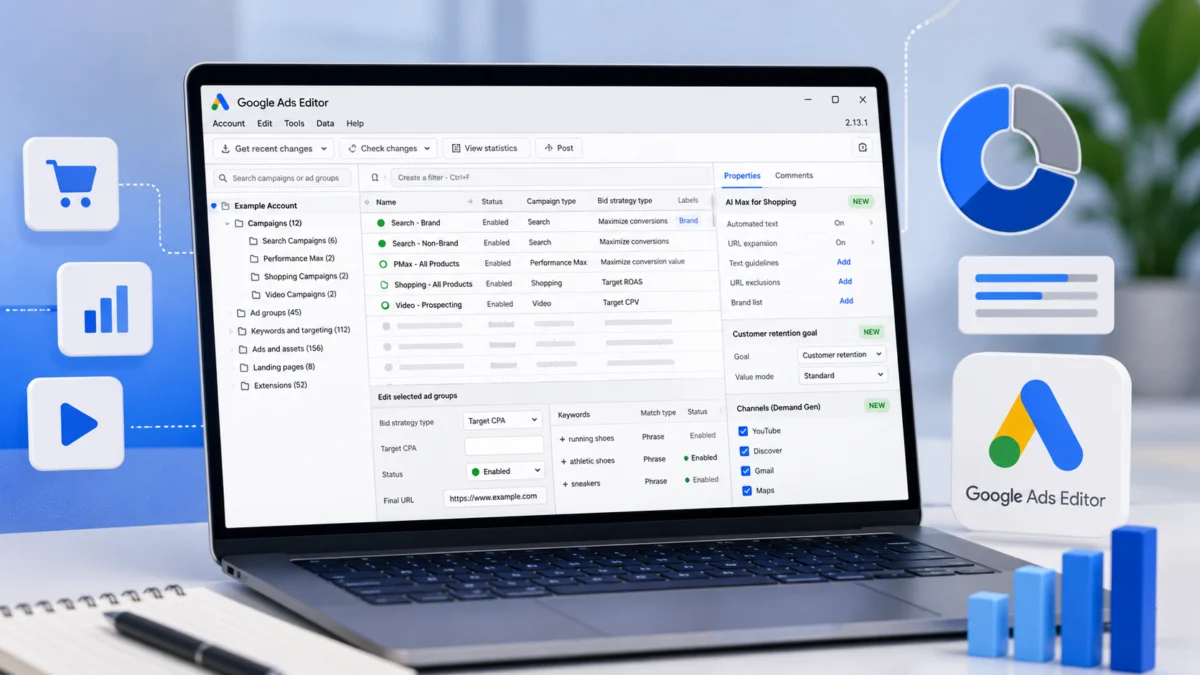
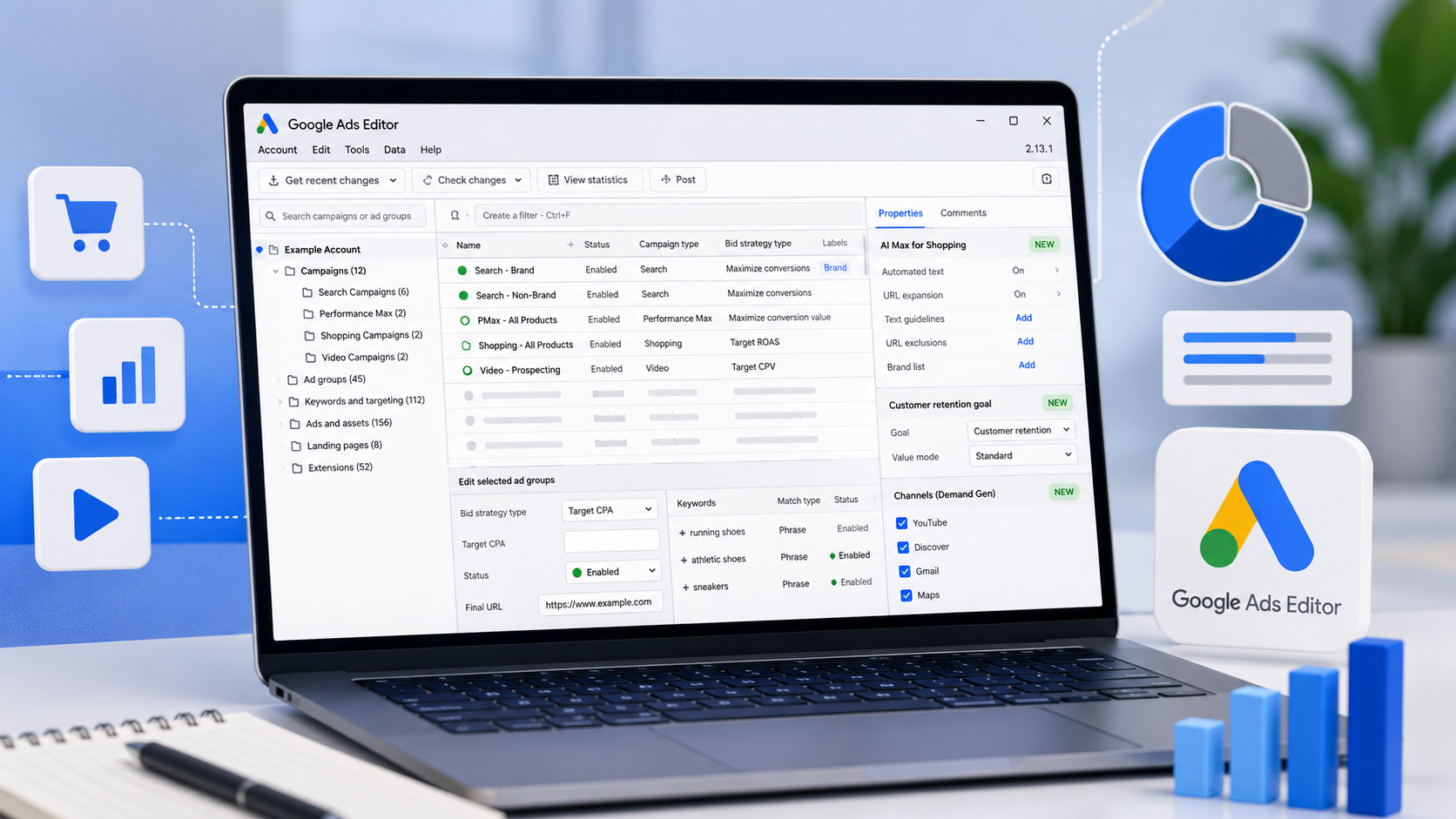
The latest iteration of Google Ads Editor, version 2.13, has commenced its global rollout, delivering a substantial suite of enhancements designed to align the offline campaign management tool more closely with the rapidly evolving, AI-driven capabilities of the Google Ads online platform. Foremost among these updates is the integration of AI Max support for Shopping campaigns, marking a significant step towards feature parity across Google’s core advertising verticals within the Editor environment. This version also introduces new Performance Max retention goals, expands existing Demand Gen features, and incorporates several crucial workflow improvements, directly addressing the needs of advertisers managing extensive campaign portfolios.
Beyond these headline features, the update bolsters reporting functionalities and introduces AI compliance tools, reflecting the growing regulatory and ethical considerations surrounding artificial intelligence in advertising. Concurrently, Google has signaled a strategic shift by retiring support for the creation of new Video Action campaigns, a move indicative of the platform’s ongoing consolidation and simplification of campaign types under newer, more versatile formats. This comprehensive update solidifies Google Ads Editor’s position as an indispensable tool for advanced advertisers and agencies, enabling them to leverage Google’s cutting-edge AI innovations with greater efficiency and control.
The Rise of AI Max in Shopping Campaigns: A Paradigm Shift
The introduction of AI Max for Shopping campaigns within Google Ads Editor 2.13 represents a pivotal moment for e-commerce advertisers. Historically, Shopping campaigns have been a cornerstone of retail advertising on Google, offering product-specific visibility and direct conversion pathways. However, managing these campaigns, particularly at scale, has often involved intricate manual optimization of bids, product groups, and negative keywords. AI Max is Google’s overarching strategy to infuse artificial intelligence into campaign management, automating and optimizing various elements to maximize performance against advertiser-defined goals.
By extending AI Max support to Shopping campaigns in the Editor, Google is providing advertisers with the ability to configure and manage these advanced, AI-powered features offline. This means that large-scale product feeds, complex bid strategies driven by machine learning, and dynamic targeting adjustments can now be implemented and modified in a bulk, streamlined fashion, without the necessity of navigating the web interface for every change. This integration bridges a crucial gap, offering the same level of sophisticated, AI-driven optimization previously available in Search and Performance Max campaigns directly within the Editor’s robust environment.
For advertisers, particularly those managing thousands or even millions of product SKUs, this enhancement promises a significant reduction in manual effort and a potential uplift in campaign performance. The AI is designed to analyze vast datasets – including user behavior, product attributes, market trends, and competitive signals – to make real-time adjustments that humans simply cannot replicate at scale. This shift requires advertisers to move from micro-managing individual elements to strategically guiding the AI, focusing on providing high-quality data inputs, compelling creative assets, and clear business objectives. The immediate implication is a more efficient workflow for bulk operations, allowing marketers to dedicate more time to strategic planning and less to repetitive tactical adjustments.
Performance Max Evolution: Focusing on Retention and Full-Funnel Strategy
Another noteworthy addition in Google Ads Editor 2.13 is the introduction of new Performance Max retention goals. Performance Max, Google’s fully automated, AI-driven campaign type, has rapidly gained prominence since its introduction, primarily focusing on driving conversions across all Google channels (Search, Display, YouTube, Gmail, Discover). While initially geared heavily towards new customer acquisition, the inclusion of retention goals signals a maturation of the platform, recognizing the critical importance of customer lifetime value (CLV) and repeat business.
In an increasingly competitive digital landscape, retaining existing customers is often more cost-effective than acquiring new ones. These new retention goals allow advertisers to specifically target and re-engage segments of their existing customer base, leveraging Google’s AI to deliver personalized messages and offers across various touchpoints. This functionality is crucial for brands looking to build loyalty, encourage repeat purchases, and maximize the long-term value of their customer relationships. The integration into Editor means that advertisers can now set up and manage these sophisticated retention strategies as part of their broader campaign structure offline, ensuring consistency and scalability across their Performance Max campaigns.
This development reflects a broader industry trend towards a full-funnel marketing approach, where advertising efforts span awareness, consideration, acquisition, and retention. By empowering Performance Max with retention capabilities, Google is positioning it as an even more comprehensive solution for businesses aiming to optimize their entire customer journey, rather than just the initial conversion point. This enhances the strategic utility of Performance Max, allowing it to serve as a versatile tool for various business objectives, from aggressive growth to sustainable customer nurturing.
Expanded Demand Gen Features and the Phasing Out of Legacy Formats
The update also brings expanded features for Demand Gen campaigns within Google Ads Editor. Demand Gen is Google’s newer, AI-powered campaign type designed to capture consumer interest and drive demand across YouTube, Gmail, and Discover feeds. It evolved from and largely replaced older formats like Discovery campaigns and, significantly, is now the primary destination for functionalities previously offered by Video Action campaigns.
The enhanced support for Demand Gen in Editor 2.13 underscores Google’s commitment to this unified, AI-driven approach to demand generation. Advertisers can now more fully manage their Demand Gen strategies offline, including asset management, audience targeting, and bidding configurations. This is particularly relevant as Google has officially retired support for creating new Video Action campaigns, funneling advertisers towards the more comprehensive and AI-optimized Demand Gen format.
This transition is not merely a name change but a strategic consolidation. Video Action campaigns, while effective for driving conversions with video, were a more specialized format. Demand Gen campaigns, powered by Google’s sophisticated AI, aim to provide a broader reach and more integrated performance across multiple surfaces, leveraging a wider array of creative assets including images and text alongside video. The move away from creating new Video Action campaigns signifies Google’s ongoing effort to streamline its ad offerings, reduce complexity for advertisers, and concentrate its AI development efforts on fewer, more powerful campaign types. For advertisers, this means adapting to the new framework, understanding how to best leverage Demand Gen’s capabilities, and migrating any existing strategies to this unified platform. The implication is a necessary shift in strategy and creative development, focusing on versatile assets that perform well across various placements.
Workflow Improvements and AI Compliance Tools
Beyond the major feature integrations, Google Ads Editor 2.13 introduces several practical workflow enhancements that improve the day-to-day experience for advertisers. These include new best-practice warnings for video campaigns, which help ensure that video assets are optimized for performance and compliance. Improved column management offers greater flexibility in customizing data views, allowing advertisers to quickly access and analyze the most relevant metrics for their campaigns. Resume download support is a significant quality-of-life improvement, especially for users with unstable internet connections or those managing extremely large accounts, as it prevents the loss of progress during lengthy data downloads. Updates to bidding strategy management also provide more granular control and flexibility over automated bidding.
Crucially, the update also adds new AI compliance tools. As AI becomes more deeply embedded in advertising, questions around data privacy, ad transparency, and the potential for bias or misinformation become increasingly pertinent. While the specific functionalities of these compliance tools are yet to be fully detailed, their inclusion signals Google’s recognition of these challenges. Such tools could encompass features for monitoring AI-generated ad copy for brand safety, ensuring adherence to advertising standards, or providing greater transparency into AI decision-making processes. For advertisers, this means an added layer of protection and guidance, helping them navigate the complex regulatory landscape surrounding AI-powered marketing and maintain brand integrity. The evolving regulatory environment, particularly with initiatives like the EU’s AI Act, makes these compliance tools increasingly vital for global advertisers.
Background and Chronology: The Evolution of Google Ads Editor
Google Ads Editor has evolved significantly since its inception. Launched over a decade ago, it began as a relatively simple desktop application designed to facilitate bulk changes and offline management of Google Ads campaigns. Its primary value proposition was efficiency: allowing advertisers to make large-scale modifications, copy campaigns, and manage bids without the constant need for an internet connection or the slower, click-intensive web interface. This was particularly beneficial for agencies and large organizations managing hundreds or thousands of campaigns.
Over the years, Editor has steadily expanded its capabilities, mirroring the growth of the Google Ads platform itself. Early versions focused on core Search and Display network functionalities. As new campaign types like Shopping, Video, and eventually Performance Max emerged, Editor gradually incorporated support for these, albeit often with a delay compared to their rollout in the web interface.
The current update, 2.13, can be seen as a culmination of Google’s long-term strategy to bring Editor into full parity with its online counterpart, especially concerning the platform’s "AI-first" mandate. The timeline of Google’s AI integration into Ads can be traced back several years, with Smart Bidding, then Responsive Search Ads, and eventually Performance Max, all leveraging machine learning to optimize campaigns. The integration of AI Max for Shopping and enhanced Performance Max features in Editor now means that the most advanced AI capabilities are accessible offline, reducing the friction for large-scale adoption.
The deprecation of Video Action campaigns and the emphasis on Demand Gen also fit into a broader chronological pattern of Google streamlining its ad products. Over the last few years, Google has consistently worked to consolidate campaign types, moving towards more comprehensive, AI-driven solutions that simplify the advertiser’s choice while maximizing the platform’s optimization potential. This iterative process aims to make the Google Ads ecosystem more intuitive and powerful, leveraging AI to handle much of the complexity behind the scenes.
Broader Impact and Implications for the Advertising Ecosystem
The Google Ads Editor 2.13 update carries profound implications for the entire digital advertising ecosystem, particularly for professional marketers, agencies, and large enterprises.
Impact on Advertiser Workflows: For many advertisers, especially those managing a high volume of accounts or complex structures, Google Ads Editor is an indispensable tool. The ability to manage AI Max for Shopping and enhanced Performance Max retention goals offline means a substantial improvement in workflow efficiency. Instead of constantly toggling between the Editor and the web interface to configure or adjust AI-driven features, advertisers can now execute comprehensive campaign strategies entirely within the Editor. This saves time, reduces errors, and allows for more systematic, bulk modifications, which is crucial for scalability. This efficiency gain can free up valuable resources, allowing marketing teams to focus on higher-level strategy, creative development, and performance analysis rather than manual data entry.
Strategic Shifts in Campaign Management: The deepening integration of AI across Google Ads, now fully accessible in Editor, necessitates a strategic shift for advertisers. The role of the advertiser is evolving from a hands-on operator to a strategic guide for the AI. This means a greater emphasis on providing clear business objectives, high-quality first-party data, and compelling creative assets. The AI thrives on good inputs; therefore, advertisers must become adept at structuring their data, defining their audiences, and crafting engaging messages that the AI can then optimize for delivery. The shift away from legacy campaign types like Video Action also means marketers must adapt to new frameworks like Demand Gen, understanding their unique strengths and how to best leverage them for different marketing objectives.
Skillset Evolution for PPC Professionals: The increasing reliance on AI in Google Ads demands a corresponding evolution in the skillsets of PPC professionals. While traditional skills in keyword research, bid management, and ad copy creation remain valuable, there is a growing need for expertise in data analysis, understanding AI models, prompt engineering (for AI-generated content), and strategic oversight of automated systems. Professionals will need to understand how to interpret AI’s performance insights, diagnose issues, and provide feedback to the algorithms to continuously improve campaign effectiveness. The update to Editor facilitates this by making these AI tools more accessible, but the underlying strategic understanding remains paramount.
Market Context and Google’s Dominance: Google Ads holds a dominant position in the digital advertising market, commanding a significant share of global ad spend. By consistently enhancing its platform with cutting-edge AI features and providing robust tools like Google Ads Editor, Google reinforces its market leadership. The seamless integration of advanced AI into Editor ensures that even the largest advertisers, who rely heavily on offline management tools, can fully leverage Google’s latest innovations. This continued investment in advertiser tools and AI capabilities is critical for Google to maintain its competitive edge against other advertising platforms.
Challenges and Considerations: While the update brings significant advantages, it also presents challenges. Advertisers must invest time in learning the new features and understanding how to best work with AI-driven campaigns. The "black box" nature of some AI optimizations can be a concern for some, requiring a leap of faith and a focus on measurable outcomes rather than granular control over every variable. Data privacy and compliance will also remain critical considerations, requiring advertisers to stay informed about regulatory changes and best practices.
Official Responses and Industry Outlook
While Google typically does not issue specific "statements" from product managers for Editor updates beyond official release notes, the ongoing development reflects a clear strategic direction from the company. The emphasis on AI, the consolidation of campaign types, and the drive towards full-funnel marketing are consistent themes articulated by Google executives, including CEO Sundar Pichai, who has repeatedly stressed Google’s "AI-first" approach. The updates to Editor are an operational manifestation of this overarching corporate strategy, aimed at making AI-powered advertising accessible and efficient for its user base.
Industry experts and PPC professionals have largely welcomed the update, particularly the AI Max for Shopping integration. Anu Adegbola, Paid Media Editor of Search Engine Land and founder of PPC Live, has often highlighted the importance of efficiency tools for agencies and the evolving role of AI in paid media. The sentiment across the PPC community suggests that these integrations are necessary to keep pace with Google’s rapid innovation in AI. Many view Editor as the backbone for managing scale, and ensuring it keeps feature parity with the web interface is crucial for large-scale advertisers. The general consensus is that these updates are not just about new features but about fundamentally changing how advertisers interact with the Google Ads platform, pushing them towards a more strategic, AI-assisted approach.
Conclusion
Google Ads Editor 2.13 stands as one of the most substantial updates in recent memory, solidifying its role as a powerful conduit for advertisers to harness Google’s latest advancements in artificial intelligence. The integration of AI Max for Shopping campaigns, alongside enhanced Performance Max retention goals and expanded Demand Gen features, underscores Google’s commitment to an AI-first, streamlined advertising ecosystem. By providing robust offline management capabilities for these cutting-edge features, Google empowers advertisers to manage campaigns with unprecedented efficiency and scale. As Google continues its strategic migration away from legacy campaign types towards unified, AI-driven solutions, this update ensures that Google Ads Editor remains an indispensable tool, enabling marketers to navigate the complexities of modern digital advertising and maximize their campaign performance in an increasingly automated landscape. The future of Google Ads is undeniably AI-driven, and Editor 2.13 ensures that advertisers are equipped to lead that charge.