The operational landscape of corporate communications and digital marketing has shifted dramatically, forcing organizations to rethink how they structure, staff, and manage their social media operations. As social channels mature from mere promotional megaphones into core revenue-generating assets, customer service hubs, and primary intelligence networks, building a resilient social media team is no longer a luxury. It is a fundamental requirement for modern enterprise survival.

Recent industry data underscores this evolution. Global spending on social media advertising continues to climb aggressively, projected to surpass $338 billion, while influencer marketing budgets in the United States alone have blasted past the $10 billion threshold. This massive influx of capital requires sophisticated oversight, specialized skill sets, and meticulous structural planning. Organizations can no longer rely on a single, overworked generalist to handle strategy, graphic design, copywriting, video production, community management, and data analytics.
Navigating the complexities of team design requires a clear understanding of organizational models, specific role definitions, compensation benchmarks, and the transformative impact of artificial intelligence on day-to-day workflows.

Defining the Core Mandate of Modern Social Media Teams
Historically viewed as an entry-level task assigned to junior marketing staff, managing a brand’s digital presence now involves orchestrating a complex web of responsibilities. A contemporary social media team is responsible for planning, creating, publishing, and managing a brand’s community presence across an expanding matrix of platforms.
Beyond daily publishing and community management, a high-performing social team serves as the connective tissue between a brand and its audience, tying social metrics directly to overarching business goals such as customer retention, brand awareness, lead generation, and direct sales. In larger, more mature organizations, the team’s remit extends deep into cross-functional territory. Social teams routinely own strategic functions that other departments depend on, including competitive intelligence gathering, consumer sentiment tracking, crisis communication detection, and direct revenue attribution.
Furthermore, these teams act as the frontline defense for brand reputation. They monitor digital conversations in real-time, synthesize risk signals, and feed actionable market intelligence back into product, PR, and executive leadership teams.
Structural Models: Choosing the Right Framework for Your Organization
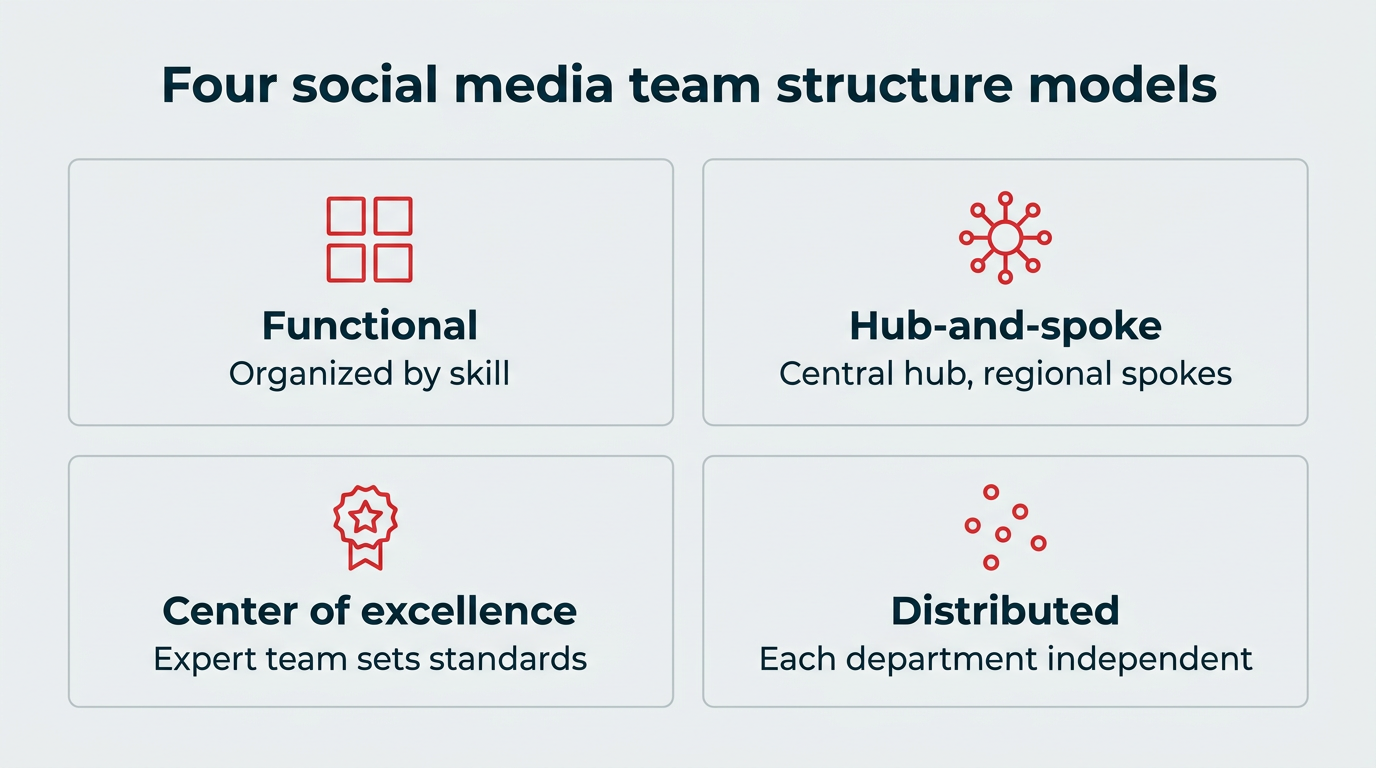
Before recruiting new talent, leadership must determine how the social media department will be organized. An organization’s structure shapes strategy ownership, content velocity, and brand consistency across diverse regional and global markets. Industry experts generally categorize social media team architectures into four distinct models:
-
The Functional Structure: Organized entirely by skill, this model assigns distinct owners to content creation, community engagement, analytics, and paid social advertising. It is highly effective for mid-sized organizations with a dedicated social team and a single core brand. While it fosters deep domain expertise and clear lines of accountability, it risks creating operational silos if a unifying strategist does not tie the specialized efforts back to a centralized business objective.
-
The Hub-and-Spoke Model: In this architecture, a central "hub" team establishes overarching brand voice, governance guidelines, and high-level strategy, while regional or business-unit "spokes" handle localized execution. This model is ideal for multi-brand or multi-region enterprises that must balance global brand integrity with local relevance. Success in this model relies heavily on shared asset libraries, unified content calendars, and rigorous approval workflows.
-
The Center of Excellence: Highly decentralized organizations often utilize a center of excellence model. A small, elite team of strategists builds playbooks, establishes brand standards, and provides advanced tooling for social practitioners embedded across various business units, such as human resources, public relations, and customer care. This approach scales efficiently but demands strict governance to prevent the brand narrative from fracturing.
-
The Distributed Structure: In this decentralized framework, individual departments manage their own social media accounts independently without a central governing body. While this allows for maximum operational speed, it is inherently risky, often leading to inconsistent brand messaging, compliance failures, and duplicated efforts. Most growing companies eventually transition away from this model toward a hub-and-spoke or center of excellence approach.

Key Roles, Responsibilities, and Compensation Benchmarks
Building an effective team requires balancing generalist capabilities with specialized expertise. The following eight roles represent the backbone of a mature corporate social media department, complete with average U.S. compensation benchmarks based on recent labor market data.
Social Media Strategist
- Primary Focus: Overarching program direction, KPI definition, channel investment, and executive reporting.
- Responsibilities: Aligns social initiatives with company-wide business objectives, determines where capital should be deployed, and reports high-level ROI to the Chief Marketing Officer.
- Average Salary: Varies significantly by market and organizational scale.
Social Media Manager
- Primary Focus: Day-to-day operational execution and campaign planning.
- Responsibilities: Acts as the generalist backbone of the team, translating high-level strategy into actionable execution plans and working cross-functionally to ensure content ships on time.
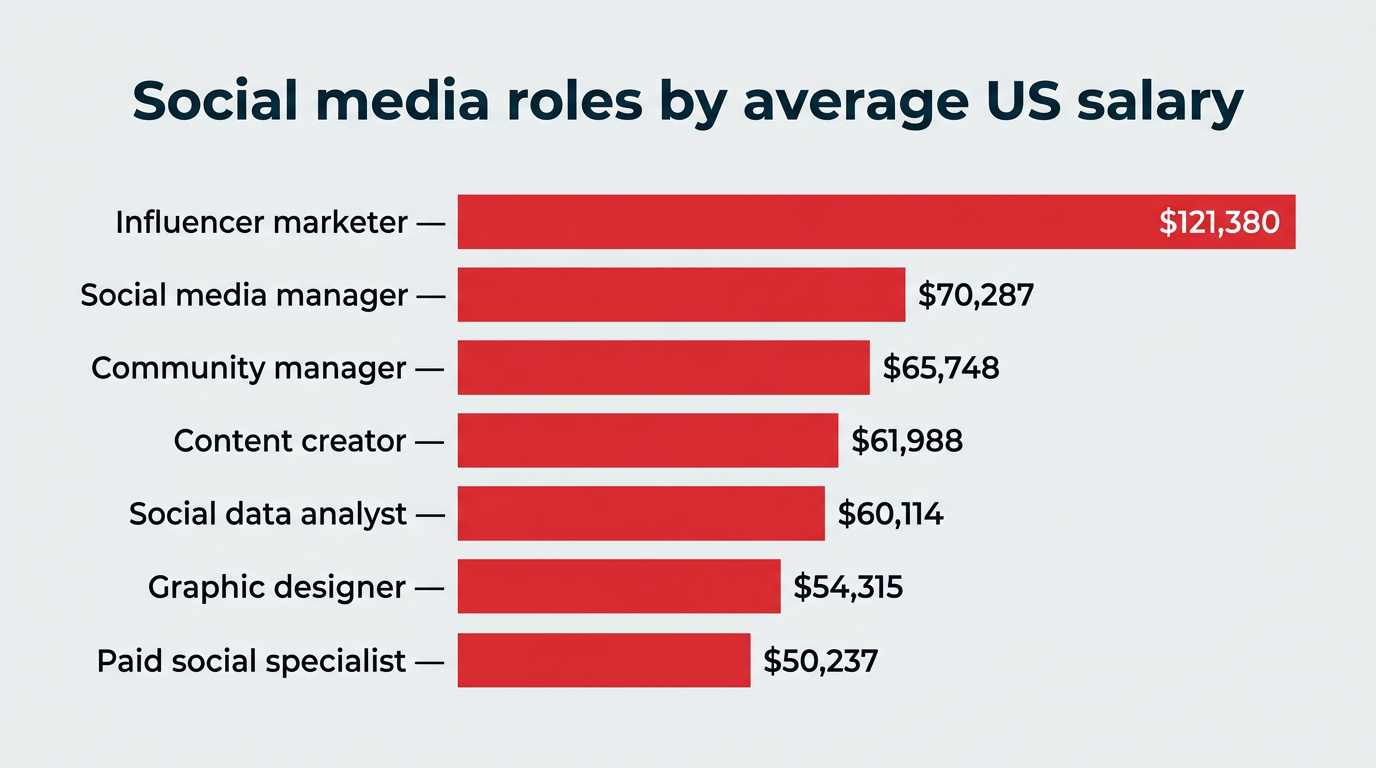
- Average Salary: $70,287
Content Creator
- Primary Focus: Production of multimedia assets, including short-form video, photography, graphics, and written copy.
- Responsibilities: Serves as the creative engine of the channel, mastering the brand voice to produce engaging content tailored to specific platform algorithms (such as TikTok, Instagram Reels, and YouTube Shorts).
- Average Salary: $61,988
Community Manager
- Primary Focus: Audience engagement and relationship building.
- Responsibilities: Acts as the primary public voice of the brand in comment sections, direct messages, and specialized communities like Facebook Groups or Slack channels, ensuring no customer mention goes unaddressed.
- Average Salary: $65,748
Paid Social Media Specialist
- Primary Focus: Management and optimization of social advertising campaigns.
- Responsibilities: Manages multi-million-dollar ad budgets, executes granular audience targeting, runs A/B testing, and scales high-performing ad sets to maximize return on ad spend.
- Average Salary: $50,237
Social Data Analyst
- Primary Focus: Performance measurement, attribution, and reporting.
- Responsibilities: Analyzes audience behavior across campaigns, builds data visualizations, tracks key performance indicators, and translates raw metrics into strategic recommendations for leadership.
- Average Salary: $60,114
Graphic Designer
- Primary Focus: Visual brand identity and asset generation.
- Responsibilities: Creates high-end static graphics, infographics, and campaign branding that elevate the visual presentation of the company across social feeds.
- Average Salary: $54,315
Influencer Marketer
- Primary Focus: Creator partnerships and influencer campaign execution.
- Responsibilities: Identifies, vets, negotiates, and manages long-term relationships with external creators and industry influencers to drive authentic brand advocacy at scale.
- Average Salary: $121,380
The Impact of Artificial Intelligence on Team Dynamics
Artificial intelligence has fundamentally altered the mathematics of social media staffing. Rather than replacing human professionals, AI tools are automating the "work about work"—such as initial content drafting, metadata tagging, sentiment sorting, and baseline reporting.
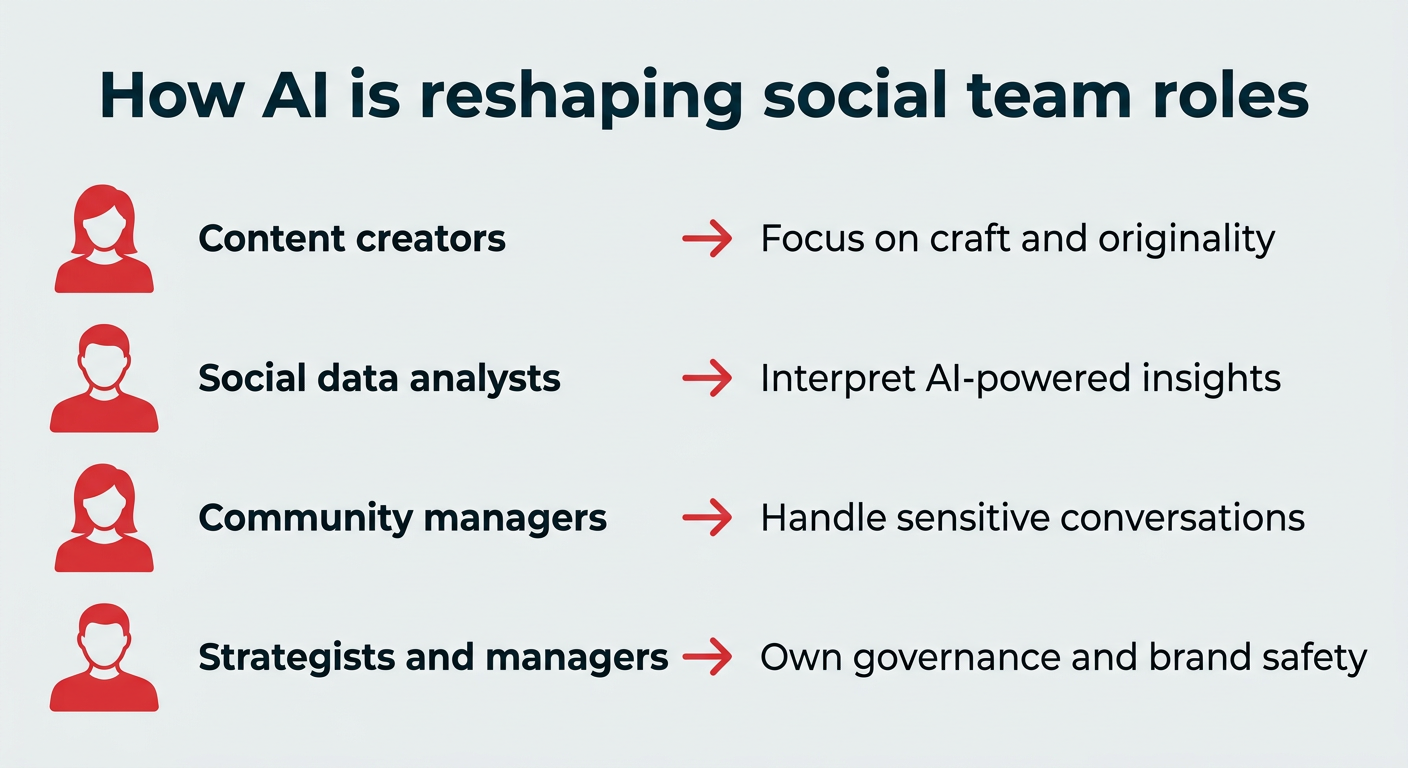
Consequently, smaller teams can now cover considerably more ground than was possible just a few years ago. This technological shift places a premium on strategic oversight and governance. While generative AI accelerates production, human professionals must provide the empathy, ethical guardrails, and creative direction necessary to protect brand reputation. Modern social professionals increasingly require proficiency in prompt engineering, data interpretation, and AI governance.
A Five-Step Blueprint for Building Your Team
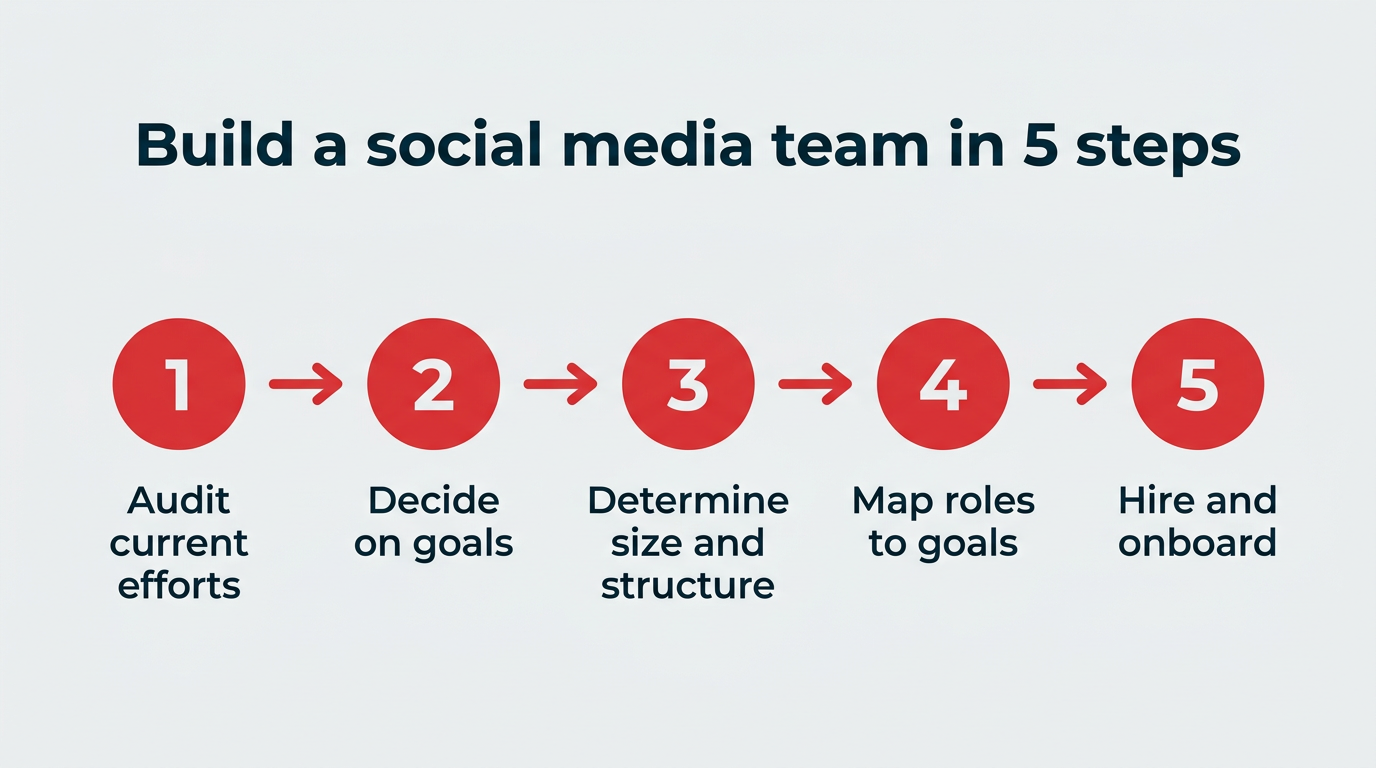
Organizations looking to establish or expand their social media departments should follow a disciplined, five-step implementation process:

- Audit Current Efforts: Evaluate existing content performance, channel ROI, and current budget constraints to identify operational gaps.
- Define Concrete Goals: Align hiring priorities with specific business outcomes. If the objective is community building, prioritize a community manager; if the goal is direct revenue acquisition, focus on paid social and analytics talent.
- Determine Team Size and Structure: Size the department based on organizational maturity. Lean startups typically deploy a 1-to-3 person generalist team, mid-market brands utilize a 4-to-6 person cross-functional unit, and enterprises scale to 7 or more dedicated specialists.
- Map Roles to Objectives: Create explicit accountability matrices ensuring every business goal has a direct operational owner.
- Hire and Onboard: Utilize practical, paid test projects during the interview process to evaluate candidates’ real-world execution capabilities. Provide robust brand guidelines, tone-of-voice documentation, and compliance playbooks upon arrival.
By treating social media as a disciplined, data-driven business function rather than an afterthought, organizations can transform their digital presence into a powerful engine for long-term commercial success.