The world of 3D graphics on the web is abuzz with anticipation as the very first Three.js Conference is set to convene in Paris this September. This landmark event marks a significant milestone for a technology that has, for nearly fifteen years, been the cornerstone of countless creative projects, from immersive portfolio sites and interactive installations to cutting-edge games and indispensable open-source tools. Three.js has empowered a generation of developers to push the boundaries of what’s visually possible in a browser, and now, for the first time, this vibrant community will converge to share knowledge, celebrate achievements, and collectively shape the future of web-based 3D.
A Long-Awaited Gathering for a Transformative Technology

The genesis of the Three.js Conference stems from the organic growth and profound impact of the Three.js library itself. Developed by Ricardo Cabello (Mr.doob) and maintained by a dedicated community, Three.js has democratized the creation of complex 3D scenes within web browsers. Its accessibility, combined with its robust feature set, has led to its widespread adoption across diverse industries, including gaming, architecture, design, education, and e-commerce. The decision to host a dedicated conference reflects the maturing ecosystem and the increasing need for a centralized platform for its practitioners.
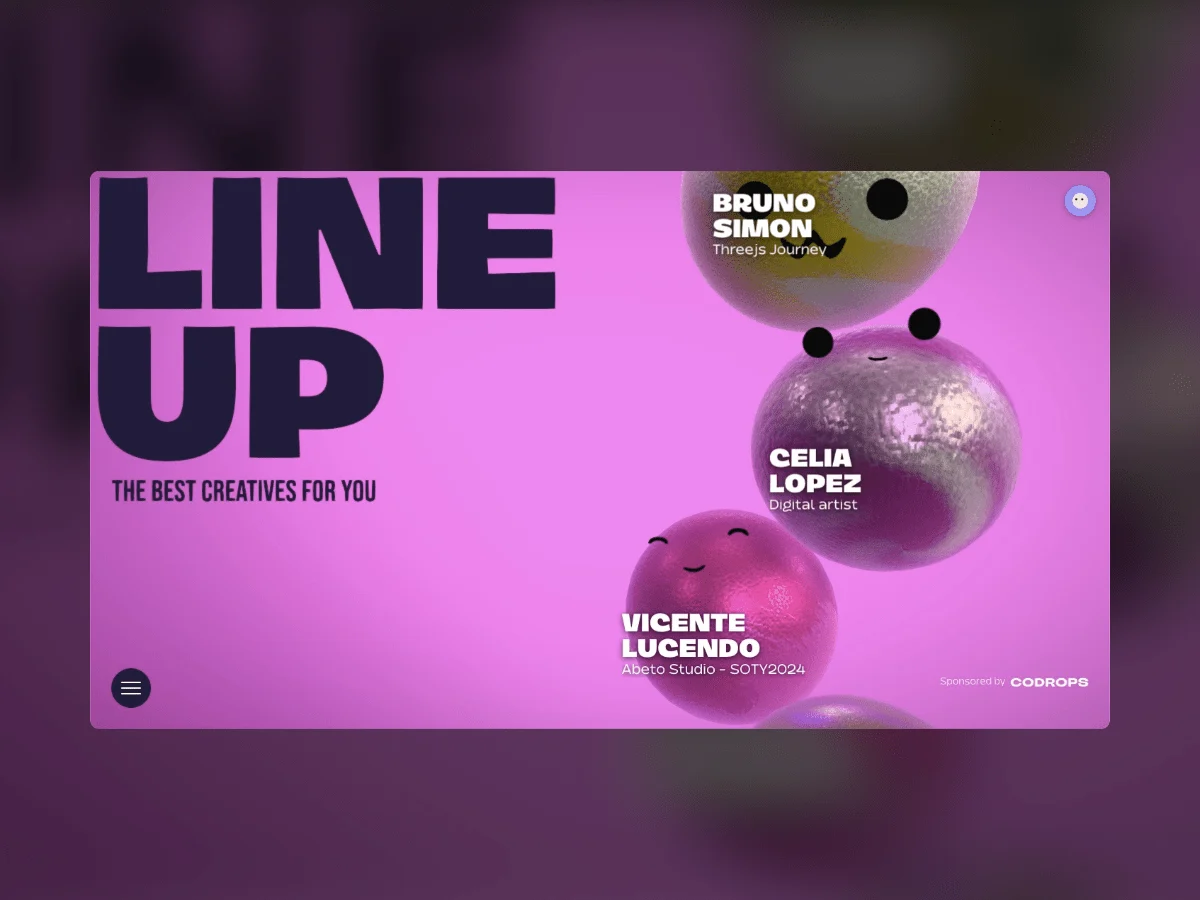
The lineup for the inaugural event, featuring a constellation of leading figures in the Three.js and broader WebGL community, speaks volumes about the conference’s significance. Attendees can expect insights from pioneers and innovators who have not only contributed to the library’s development but have also spearheaded groundbreaking applications. The roster includes luminaries such as Bruno Simon, Célia Lopez, Daniel Beauchamp, Anderson Mancini, Natalia Markoborodova, Thomas Nattestad, Patrick Heng, Justine Soulie, Robin Payot, Julie Marting, Vicente Lucendo, and Jean Carlo Deconto (sunag), among others. This gathering promises to be an unparalleled opportunity for learning and networking.
Exclusive Offer for Codrops Readers

In recognition of the strong ties between the Three.js community and influential design platforms like Codrops, a special discount is being offered to its readers. By using the code CODROPS at checkout, attendees can secure a 15% discount on conference tickets. This initiative underscores the collaborative spirit that has defined the growth of Three.js, encouraging broader participation in this pivotal event. Interested parties are urged to secure their tickets promptly to take advantage of this offer.
Behind the Scenes: The Conference Website as a Community Canvas
Prior to the event, a detailed look into the creation of the conference website offered a compelling glimpse into the philosophy driving the event. Organizer David Ronai revealed how a concept of bouncing spheres evolved into a visual metaphor for the community itself, celebrating the collective energy and interconnectedness of Three.js developers. This approach highlights the conference’s commitment to not just technical discourse but also to fostering a sense of belonging and shared purpose.

A Glimpse into the Minds of the Speakers
As the conference draws nearer, many of the featured speakers are sharing their current obsessions, recent projects, and what they are most eager to impart to the Parisian audience. Their insights offer a preview of the diverse and innovative topics that will be explored.
Bruno Simon: Pushing the Frontiers of WebGPU and Physics
Bruno Simon, renowned for his comprehensive Three.js Journey course, has been deeply immersed in the world of WebGPU. His current undertaking involves a substantial update to his course, integrating the latest advancements in WebGPU. Simon describes this endeavor as an "adventure" that has grown in scope, admitting it’s "so huge that I can’t seem to see the end of it." He humorously questions whether he will have sufficient time to finalize his conference talk amidst this ambitious project.

Simon’s dedication to teaching has led him to rebuild his entire portfolio as a dynamic laboratory for experiments. One particular experiment, a set of glowing spheres driven by real-time physics that convert kinetic energy into heat, has become an obsession. This project, shared on X (formerly Twitter), evolved from a simple concept into a complex demonstration of physical principles rendered in real-time. He describes these creations as "just some nerd stuff that makes me smile." For his Paris presentation, Simon has teased his topic with a single emoji: ⚛️, hinting at explorations into physics or perhaps the fundamental building blocks of graphical computation.
Célia Lopez: AI, Texture Optimization, and the Tangible World
Célia Lopez, a 3D designer specializing in WebGL at OFF+BRAND, approaches her work with a profound sense of curiosity. Her recent explorations have led her into the realm of Artificial Intelligence, investigating techniques for non-linear texture optimization and the seamless transfer of textures from AI-generated models with complex topology onto clean, production-ready meshes. Her goal is to integrate AI-generated assets into high-fidelity real-time 3D experiences.
Lopez’s curiosity extends beyond the digital sphere; she is launching her own ceramics brand, infusing her creative process with a new rhythm through pottery classes. She has also been actively sharing her AI experiments within the community, including a lightning talk at a Paris Design Meetup where she detailed a refined workflow for leveraging AI in design. For her conference talk, Lopez promises "a little part might be unexpected," but more importantly, she expresses a deep fulfillment derived from WebGL conferences. She values "learning new technical workflows from talented people, being surrounded by peers who share the same passion, and spending time exchanging ideas. It’s also about dancing, laughing, and meeting interesting people in moments that feel completely outside of everyday life."

Daniel Beauchamp: Personalizing E-commerce and AI-Driven Storytelling
Daniel Beauchamp’s current focus is divided between two seemingly disparate yet interconnected domains: interactive product customization for e-commerce and the creation of AI-generated commercials and brand films. Both avenues are driven by a shared inquiry into how digital experiences can be made more personal, expressive, and memorable.
This exploratory drive has manifested in two new ventures. Beauchamp is developing a Shopify app designed to integrate interactive product customization for merchants using Rive technology. Simultaneously, he is venturing into AI-powered commercial video production as a service. Regardless of the medium, his overarching objective is to craft experiences that encourage active engagement rather than passive consumption. In Paris, Beauchamp plans to elucidate how interactive product experiences can elevate customization into a tangible user journey, exploring "how an interface can carry emotion and feeling, and turn customization into something people actually experience, where they get to know a product before buying it, wrapped in a beautiful interaction." His core philosophy for creative work is a continuous cycle of building, exploring, learning, and re-examining both the process and the outcomes, emphasizing that "movement and curiosity are often the most valuable tools in any developer’s toolbox."
Anderson Mancini: Redefining Real-Time Rendering with WebGPU
Anderson Mancini views WebGPU not merely as an upgrade but as a transformative opportunity to reimagine the capabilities of browser-based 3D rendering. He is revisiting ambitious projects that were previously constrained by real-time performance limitations, leveraging advanced rendering techniques to achieve superior visual fidelity and enhance accessibility.

His recent work has centered on the synergistic application of Screen Space Global Illumination (SSGI) and Screen Space Reflections (SSR) for architectural visualization, aiming to deliver high-quality real-time rendering solutions to the real estate sector. Complementing his rendering research, Mancini has released r3f-webgpu-perf, a performance monitoring tool specifically for React Three Fiber (R3F). This tool transcends mere data display, providing developers with actionable insights into scene performance and real-time optimization guidance, distilling years of experience into an intuitive mentorship tool. In Paris, Mancini will delve into two recent projects, Lumen Decor Studio and CerealBNB, detailing the underlying techniques and the valuable lessons learned from his extensive experience in game development. Attendees can anticipate practical strategies for building high-performance Three.js applications without compromising on creative ambition.
Natalia Markoborodova & Thomas Nattestad: Pioneering HTML-in-Canvas for the Web’s Future
At Google Chrome, Thomas Nattestad and Natalia Markoborodova are actively shaping the future of the web, with a particular focus on the innovative HTML-in-Canvas API. Nattestad perceives immense creative potential within this API, balanced by the pragmatic challenges of establishing new web standards. He navigates the landscape of "unbelievable excitement" from developer adoption with the imperative of advancing browser capabilities while upholding essential principles of privacy, security, and interoperability. He has also been instrumental in introducing the HTML-in-Canvas API through Chrome for Developers sessions at Google I/O, demonstrating how semantic HTML can be rendered interactively and accessibly within a canvas element.
Markoborodova, meanwhile, is meticulously exploring the intricacies of the platform, delving into color spaces, display rendering, and cross-platform testing of HTML-in-Canvas to refine the API. She has been utilizing tools such as a color space comparison demo to illustrate how HTML elements render across various display configurations. Markoborodova shares that some of the most significant discoveries often arise unexpectedly, noting, "I simply embedded a video, and its colors seemed off." This seemingly minor observation propelled her into an in-depth investigation of color formats and browser rendering behavior. In their joint presentation, they will approach HTML-in-Canvas from complementary viewpoints. Nattestad will explore its potential to fundamentally expand the web’s creative horizons, aiming to inject "a heavy amount of whimsy." Markoborodova will highlight the API’s dual nature as both "FUN & FUNctional!," showcasing the harmonious coexistence of playful interactions and robust engineering.

Patrick Heng & Justine Soulie: Intertwining Illustration, Interaction, and Real-Time Graphics
Patrick Heng and Justine Soulie draw their inspiration from the web itself, consistently seeking out individuals who are pushing the medium in novel directions and creating works driven by pure creative curiosity. This ethos permeates their own work, which skillfully merges interactivity, technical innovation, and illustration to produce engaging and playful experiences.
Their creative collaboration has evolved into a dynamic dialogue, transforming Soulie’s illustrations into miniature interactive games. They are further enhancing these immersive worlds by experimenting with MediaPipe and hand tracking, aiming to imbue them with a more tactile and lifelike quality. The duo emphasizes that a particularly rewarding aspect of their process is the continuous creative exchange between illustration and development, where "a sketch can inspire an interaction, and an interaction can inspire a new visual idea." In Paris, Heng and Soulie will offer an in-depth look at their interactive WebGL comic, Ponpon Mania, detailing how illustration, narrative, and real-time graphics converged to bring the experience to life. Their presentation will serve as both a creative case study and a technical deep dive, illustrating the synergy that arises when distinct disciplines mutually inspire each other.
Robin Payot: Navigating the Intersection of AI, Three.js, and Parenthood
Robin Payot’s recent life has been shaped by two significant forces: the profound joy of welcoming his six-week-old daughter and the rapid evolution of AI in web development. He eagerly anticipates sharing the world with his child and experiencing her first words. Concurrently, he observes AI assistants becoming integral to design workflows, a development that "would have seemed unimaginable" just two years ago. However, Payot stresses the enduring importance of foundational knowledge, stating, "You still need to have a solid understanding of the web’s limitations and, at the very least, understand how the code works and what it does."

This fascination recently culminated in a personal project at his company: a Three.js animation that dynamically responds in real-time to the voice of an AI assistant. Developed using R3F and "a little help from AI," the project allowed him to engage in literal conversations with a chatbot while observing his shaders react to diverse voices, accents, and speaking styles. In Paris, Payot will present how AI, Three.js, and elements inspired by the Zelda game series converged in his latest personal endeavor. His AI experiments have also yielded memorable lessons, including a particularly challenging session with Claude that underscored the irreplaceable value of manual bug resolution.
Julie Marting: Exploring Physical and Digital Spaces Through AI
Julie Marting’s recent reflections have spanned both the physical and digital realms, influenced by decorating a new apartment and experimenting with AI tools for design. She has been contemplating the nature of "spaces," both tangible and virtual. Her current explorations involve leveraging AI to prototype ideas and imbue her designs with a sense of vitality, approaching this unfamiliar territory with an open and curious mindset.
This curiosity recently led her to experiment with an AI-powered tool for generating real-time 3D videos for social media. Marting acknowledges the initial counter-intuitiveness of such a tool, but it was precisely this novelty that made the exploration engaging. In Paris, Marting will provide an insider’s perspective on the design and art direction of the Three.js Conference website, sharing the strategic decisions, creative techniques, and subtle nuances that contributed to its distinctive playful identity. A recurring lesson she emphasizes is the inherent value of mistakes: "Making mistakes and discovering new ideas or techniques as a result of those mistakes is almost part of our weekly routine as designers. It encourages us to constantly learn and try new things we hadn’t thought of before."

Vicente Lucendo: Capturing Motion and Emotion in Design
Vicente Lucendo finds inspiration in unconventional sources. He has been studying the dynamic panel compositions of manga artist Yusuke Murata, fascinated by the conveyance of motion within static imagery. He is equally captivated by the atmospheric qualities of aged structures juxtaposed with modern architecture and everyday life.
This keen eye for movement has extended into his technological pursuits. Lucendo has been experimenting with various physics engines, with Jolt emerging as a standout. He expresses a strong conviction that "it should be more popular!" In Paris, Lucendo will guide attendees through the creative process behind his project Messenger, illustrating how such ambitious undertakings are rarely linear. He advocates for emotion as the primary compass, dictating every technical and creative decision. This philosophy also shapes his personal workflow: "I make a conscious effort to regularly view my work with fresh eyes," he states, emphasizing the value of seeking feedback or stepping away from a project to gain new perspectives and uncover solutions.
Jean Carlo Deconto (sunag): Demystifying TSL and Advancing Rendering Pipelines
Jean Carlo Deconto, known as sunag, is deeply engaged with the Three.js Shader Language (TSL). He has undertaken a comprehensive review of TSL documentation and syntax to create "Tour of TSL," a guide aimed at enhancing developers’ understanding of the language and its expanding ecosystem. Through this process, he aims to refine TSL’s syntax and implementation in anticipation of his Paris presentation.

His recent explorations span the most dynamic frontiers of the Three.js landscape, including enhancements to the Three.js Inspector, nanite-style rendering, fire simulation using voxel grids, and deferred rendering for an upcoming Three.js release. Deconto is continuously investigating the evolving capabilities of the rendering pipeline. In Paris, he will lead attendees on his "Tour of TSL," highlighting the language’s advantages for contemporary Three.js development. His engineering philosophy is rooted in a commitment to modularity: "One of the most important things for me is trying to separate the responsibilities of each part of the software to build systems that can be extended individually."
A Landmark Event for the Web Graphics Community
The inaugural Three.js Conference in Paris promises to be a pivotal moment for the global community of developers, designers, and enthusiasts dedicated to advancing the art and science of 3D graphics on the web. Over two days, attendees will engage in a rich exchange of ideas, witness groundbreaking demos, explore technical deep dives, celebrate serendipitous discoveries, and perhaps even dissect the lessons learned from challenging bugs. This gathering represents more than just a conference; it is a testament to the enduring innovation and collaborative spirit that has propelled Three.js to the forefront of web technology. The event offers an unparalleled opportunity to connect with peers, learn from industry leaders, and contribute to the ongoing evolution of immersive digital experiences.