The rapid proliferation of automated license plate readers (ALPRs) has fundamentally altered the landscape of public safety and personal privacy in the United States. At the center of this technological surge is Flock Safety, a private company founded in 2017 that has become the dominant vendor in the law enforcement surveillance market. These high-speed camera systems, which capture and analyze vehicle movements in real-time, have moved from niche investigative tools to a ubiquitous feature of the American streetscape. While proponents argue that the technology provides an essential force multiplier for law enforcement, a growing chorus of critics, lawmakers, and civil liberties advocates are raising urgent questions about data retention, the potential for systemic abuse, and the lack of comprehensive federal oversight.
A Technological Evolution: From Terrorism to Neighborhood Watch
The roots of automated license plate recognition date back to the mid-1970s in the United Kingdom. Originally developed as a specialized instrument to identify vehicles associated with paramilitary groups during the Troubles, the technology was designed for high-stakes intelligence gathering. For decades, the hardware was cumbersome, expensive, and limited to high-level government use.
The entry of Flock Safety into the market in 2017 marked a paradigm shift. By leveraging cloud-based software, machine learning, and a subscription-based "Camera-as-a-Service" model, the company effectively democratized access to mass surveillance. Instead of relying on stationary, expensive police-owned cameras, local law enforcement agencies and even private homeowners’ associations could deploy thousands of interconnected, solar-powered devices. By 2025, the company estimated that its network played a critical role in more than 1 million law enforcement investigations. This evolution represents a transition from reactive policing—where cameras were checked only after a crime occurred—to a proactive, persistent surveillance net capable of reconstructing a vehicle’s historical movements across entire regions.
The Geography of Surveillance: Where the Cameras Reside
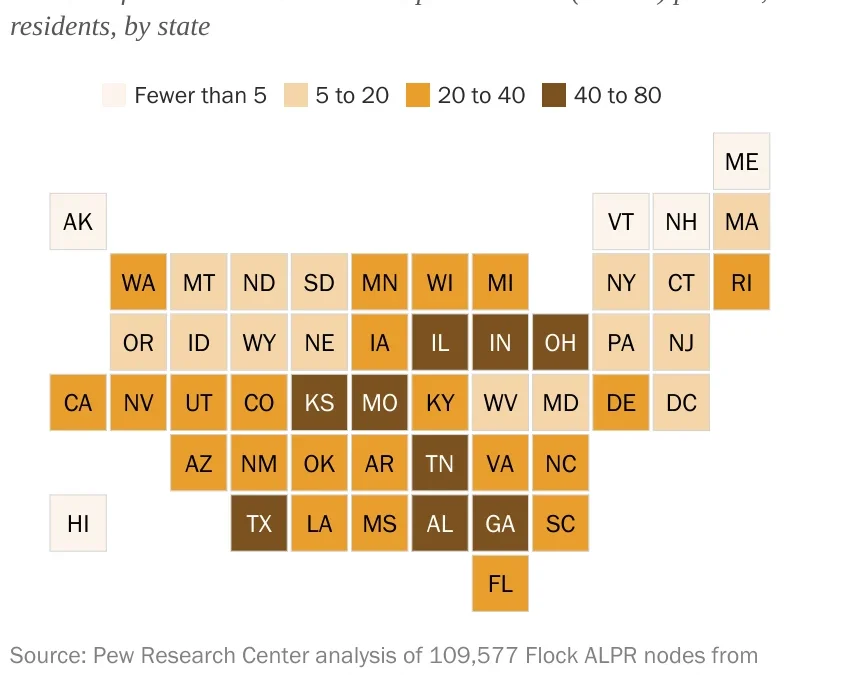
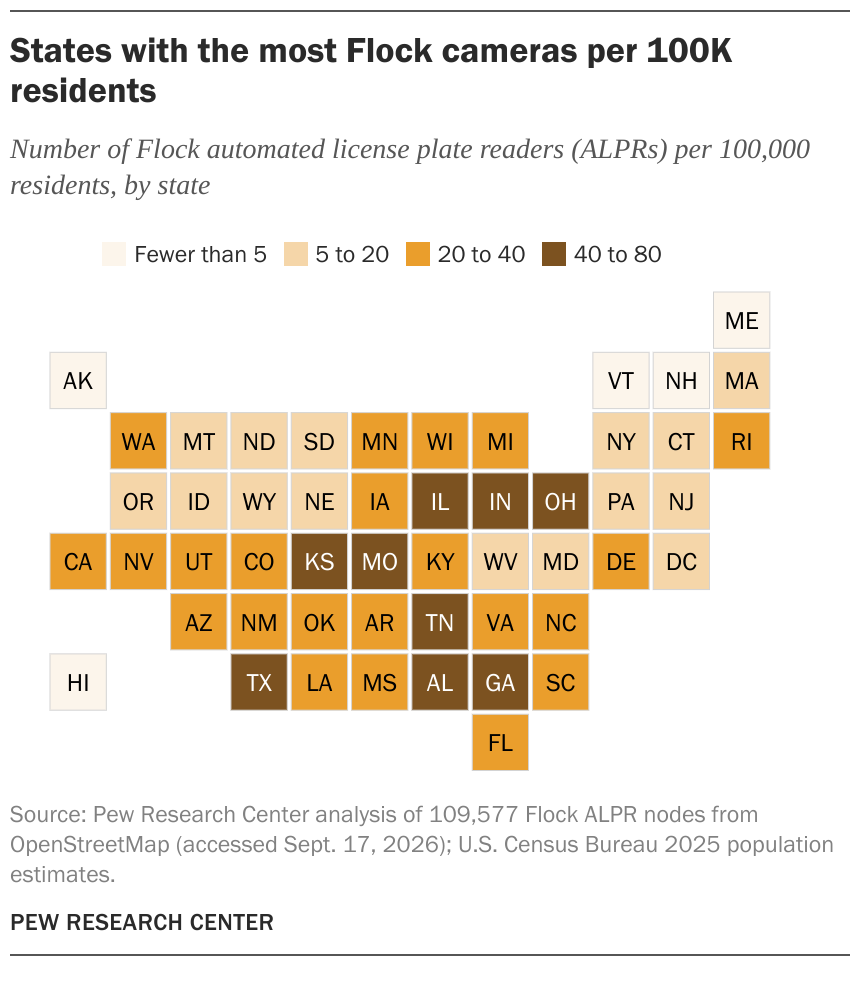
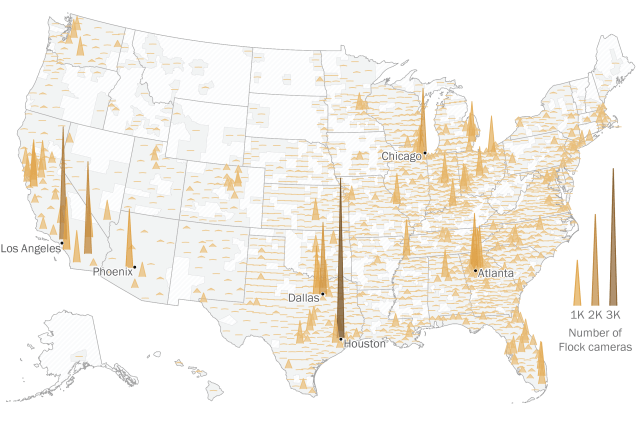
Pew Research Center’s recent analysis, utilizing data from the crowdsourced OpenStreetMap project, reveals a highly concentrated deployment of these devices. As of September 2026, over 109,000 Flock camera nodes were identified across the United States. The distribution is far from uniform; nearly half of all identified cameras are concentrated within just five states: California, Texas, Georgia, Florida, and Ohio.
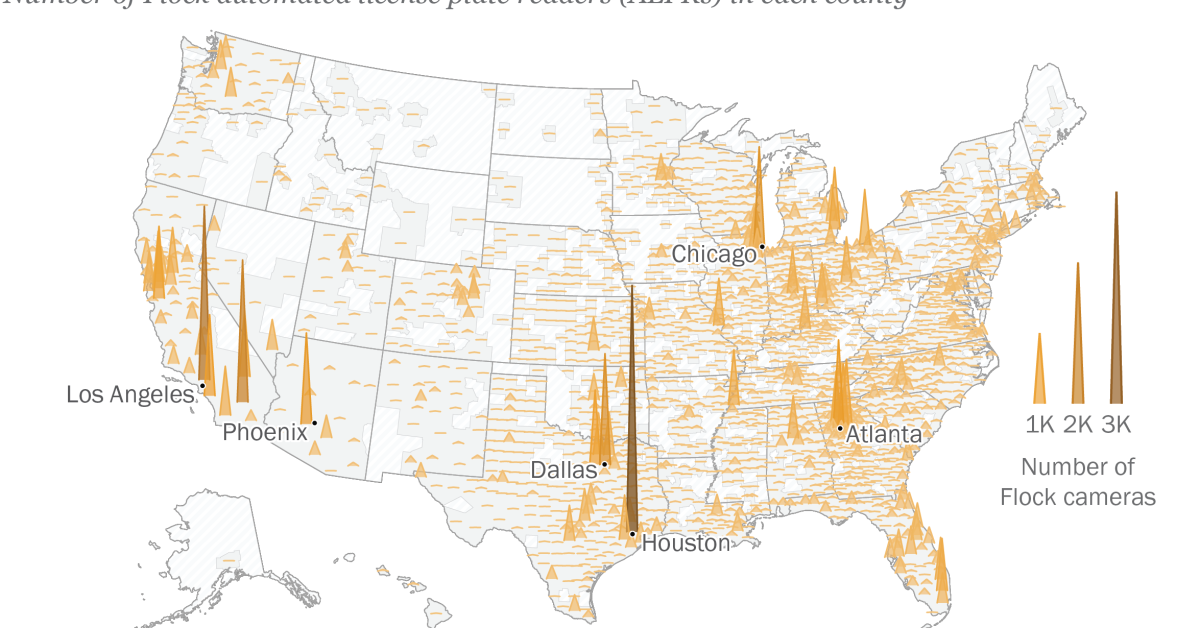
This geographic clustering suggests that the adoption of ALPR technology is driven heavily by urban density and regional law enforcement priorities. In states like Georgia, the density of cameras reaches 80 per 100,000 residents, a figure that dwarfs the per-capita usage in states like Alaska or New Hampshire, where the technology has yet to gain significant traction. Furthermore, approximately 80% of all Flock units are situated in urban centers. Major metropolitan areas such as Atlanta, Houston, Los Angeles, and Chicago function as the primary hubs for this network, with some counties hosting thousands of individual cameras.
While the data shows that these devices are slightly more likely to be found in lower-income neighborhoods, the discrepancy is relatively modest. The ubiquity of the technology suggests that its deployment is less about specific demographic targeting and more about securing arterial roadways, entry points to residential communities, and high-traffic commercial corridors.
The Transparency Gap: A Murky Regulatory Environment
Despite the sheer volume of data being collected, there is no centralized, public registry of every camera’s location or ownership status. Flock Safety provides "transparency portals" for its clients, allowing agencies to voluntarily disclose their policies on data retention and usage. However, these portals are entirely opt-in, creating a patchwork of accountability.
According to data compiled by EyesOnFlock, an independent monitoring project, only 1,517 agencies had active public transparency portals as of September 2026. This accounts for only a fraction of the total cameras in operation. In states like Pennsylvania, transparency is remarkably low, with only 2% of observed cameras accounted for in official portals. This lack of disclosure creates a significant blind spot for the public; in many jurisdictions, citizens have no way of knowing who owns the camera capturing their daily commute, how long that data is being stored, or which third-party organizations have access to it.
Even where transparency exists, the quality of disclosure varies. While most agencies disclose their camera counts and data retention policies—the median retention period being 30 days, though some agencies have moved to shorter, seven-day windows—other critical information remains hidden. Only half of the agencies with portals provide any detail regarding individual search logs, and many remain silent on the specifics of their data-sharing agreements with other law enforcement entities.
Official Responses and the Spectre of Misconduct
The power of the Flock network is inherently tied to the behavior of the humans operating it. The technology has been embroiled in controversy following high-profile incidents of abuse, including reports of law enforcement officers using the network to track the movements of romantic partners or to engage in unauthorized surveillance.
These incidents have triggered a legislative response. In Congress, lawmakers have introduced bipartisan legislation aimed at imposing federal guardrails on the use of AI-powered surveillance. Proposals range from the "Stop Flock Abuse Act," which seeks to mandate strict privacy safeguards and audit trails for all ALPR data, to more radical calls from some representatives to place an outright ban on the use of private-vendor, mass-surveillance networks in public policing.
Flock Safety has attempted to mitigate these concerns by modifying its platform. The company recently moved to replace open-text search fields—which allowed officers to justify searches with vague, subjective language—with standardized drop-down menus. Additionally, the company has pledged to require a formal case number for all non-emergency searches by the end of 2026. Critics, however, argue that these are cosmetic fixes that fail to address the core issue: the existence of a massive, searchable database of private citizens’ movements in the hands of a private, for-profit corporation.
The Scale of Data Usage: A National Snapshot
The sheer volume of searching conducted on these platforms is staggering. A comprehensive investigation by USA Today spanning three-and-a-half years of logs from 120 agencies revealed that over 200,000 authorized users had performed 75 million searches, involving nearly 4 million unique license plates. This equates to an average of roughly 59,000 searches per day.
This level of activity raises profound questions about the Fourth Amendment and the concept of "reasonable expectation of privacy." When a single license plate can be tracked across city, county, and state lines, the traditional definition of a "public movement" becomes blurred. In states like Florida and Ohio, the infrastructure allows for massive, interstate data-sharing, meaning that a citizen’s vehicle movements can be tracked across a multi-state region, often without the citizen ever having committed a crime or being under formal investigation.
Broader Implications for a Surveillance-Heavy Future
As the United States moves further into the late 2020s, the debate over Flock cameras serves as a microcosm for the broader conflict between the desire for public safety and the fundamental right to anonymity in public spaces. Proponents highlight the role of ALPRs in solving violent crimes, recovering stolen vehicles, and finding missing persons. The ability to instantly match a plate against a "hot list" of wanted vehicles is a tool that local law enforcement agencies are unlikely to relinquish easily.
However, the rapid, largely unregulated adoption of this technology has outpaced the development of legal frameworks designed to prevent misuse. The shift from human-patrolled streets to algorithmically monitored transit corridors represents a permanent change in the relationship between the state and the individual.
Moving forward, the primary challenge for policymakers will be to establish a standard of "digital due process." This would likely include federal mandates for data expiration, strict prohibitions on the sale of movement data to third-party brokers, and universal requirements for independent, third-party audits of search logs. Without such measures, the network of 100,000-plus cameras will continue to grow, not only as a tool for public safety but as a permanent, searchable archive of the American public’s daily life—a scenario that many constitutional scholars argue is fundamentally incompatible with the principles of a free and open society.
The data currently available is only a starting point. As transparency portals continue to evolve and as more, albeit limited, data is released by both vendors and agencies, the public will be better positioned to assess whether the benefits of this ubiquitous surveillance justify the erosion of the privacy it consumes. For now, however, the cameras remain, watching and recording, while the debate over their place in a democratic society is only just beginning.