The digital advertising landscape has undergone a profound transformation, marked heavily by the pervasive integration of artificial intelligence, shifting global privacy frameworks, and an increasing demand for cross-channel consolidation. For modern marketing teams, navigating this complex ecosystem requires moving far beyond native interfaces to leverage specialized software that streamlines creation, optimizes ad delivery, and accurately measures return on investment (ROI). With Meta’s end-to-end AI campaigns hitting an astonishing $60 billion annual run rate in 2025, advertisers are no longer treating automation as an experimental tactic; it has firmly established itself as the operational baseline.

Understanding Facebook Ad Tools in the Modern Ecosystem
Facebook ad tools comprise a diverse ecosystem of software platforms designed to help organizations create, manage, optimize, report on, and scale advertising campaigns across Meta’s sprawling application network, which includes Facebook, Instagram, Messenger, and WhatsApp. While native solutions such as Meta Ads Manager and the public Ad Library provide fundamental capabilities, a robust market of third-party applications has emerged. These external tools connect seamlessly through Meta’s official API to fill critical operational gaps, offering advanced creative generation, cross-platform performance modeling, and granular automated rule enforcement.

The necessity for these tools has escalated dramatically in recent years. Advertising delivery is now heavily automated, strict global privacy regulations have complicated traditional data measurement, and the vast majority of marketing teams manage campaigns concurrently across multiple distinct social and search networks. Consequently, specialized tools allow marketing departments to maintain high campaign velocity and sophisticated execution without expanding headcount.
Evaluating and Choosing the Right Advertising Toolkit
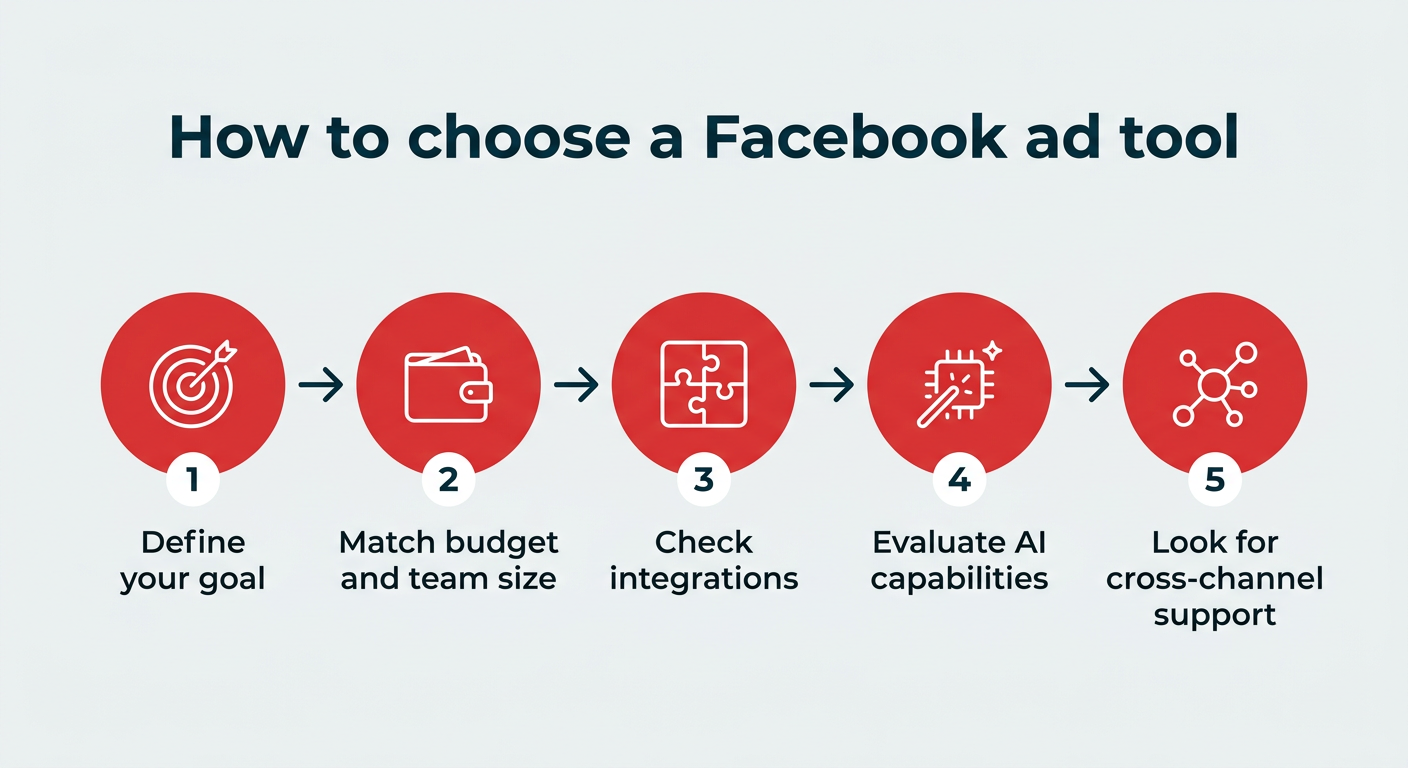
With countless software options available on the market, marketing leaders frequently fall into the trap of purchasing overlapping solutions based solely on extensive feature lists rather than addressing operational deficiencies. Industry experts recommend a structured, sequential approach to selecting the right ad tool:
- Identify the core operational bottleneck or data gap currently hindering campaign performance.
- Evaluate integration capabilities with existing technology stacks, prioritizing software that consolidates workflows and reduces the number of active browser tabs.
- Assess the learning curve and technical requirements for team adoption.
- Analyze pricing structures, determining whether costs scale predictably with ad spend or remain fixed per user.
- Review data privacy compliance frameworks, ensuring alignment with regional regulations such as GDPR and CCPA.
By filtering software choices through these stringent criteria, organizations can avoid redundant subscriptions and build a streamlined, highly efficient advertising stack.
Comprehensive Comparison of Leading Facebook Advertising Solutions
To assist marketing executives and media buyers in navigating the crowded software market, industry analysts have categorized the top-performing Facebook ad tools based on their primary use cases, pricing structures, and unique differentiators.
| Tool | Best for | Starting price | Free plan? | Key differentiator |
|---|---|---|---|---|
| Meta Ads Manager | Everyone running Facebook ads | Free | Yes | Native campaign setup plus Advantage+ AI |
| Hootsuite Social OS | Managing paid and organic together | $99/user/month | Free trial | Paid and organic in one connected system |
| Madgicx | Performance optimization | Varies by ad spend | Free trial | AI recommendations tied to your ad account |
| Customers.ai | Website visitor retargeting | Paid plans only | Free trial | Identifies site visitors for audience building |
| AdCreative.ai | AI ad creative at volume | $39/month | Free trial | Creative scored before you spend |
| TapClicks | Multi-source marketing reporting | Contact for pricing | No | Connects channels well beyond social |
| Funnel | Flexible cross-platform data modeling | $300/month, billed annually | No | Normalizes mismatched field names |
| Wisdom by Hootsuite | Ad copy and repurposing | Included in Hootsuite plans | Free trial | Repurposes top organic posts into ads |
| ChatGPT | Brainstorming and copy variations | Free tier | Yes | Fast, flexible general-purpose drafting |
| Facebook Ad Library | Competitive ad research | Free | Yes | Searchable database of live ads |
| Canva | Ad design and brand consistency | Free plan | Yes | Templates plus Magic Studio AI tools |
| Smartly.io | Creative automation at scale | Custom pricing | No | Dynamic creative built for large advertisers |
| RevealBot | Rule-based campaign automation | Varies by ad spend | No | Highly customizable automation rules |
| Adzooma | Multi-network campaign management | Paid plans only | Free trial | Opportunity alerts across Meta and Google |
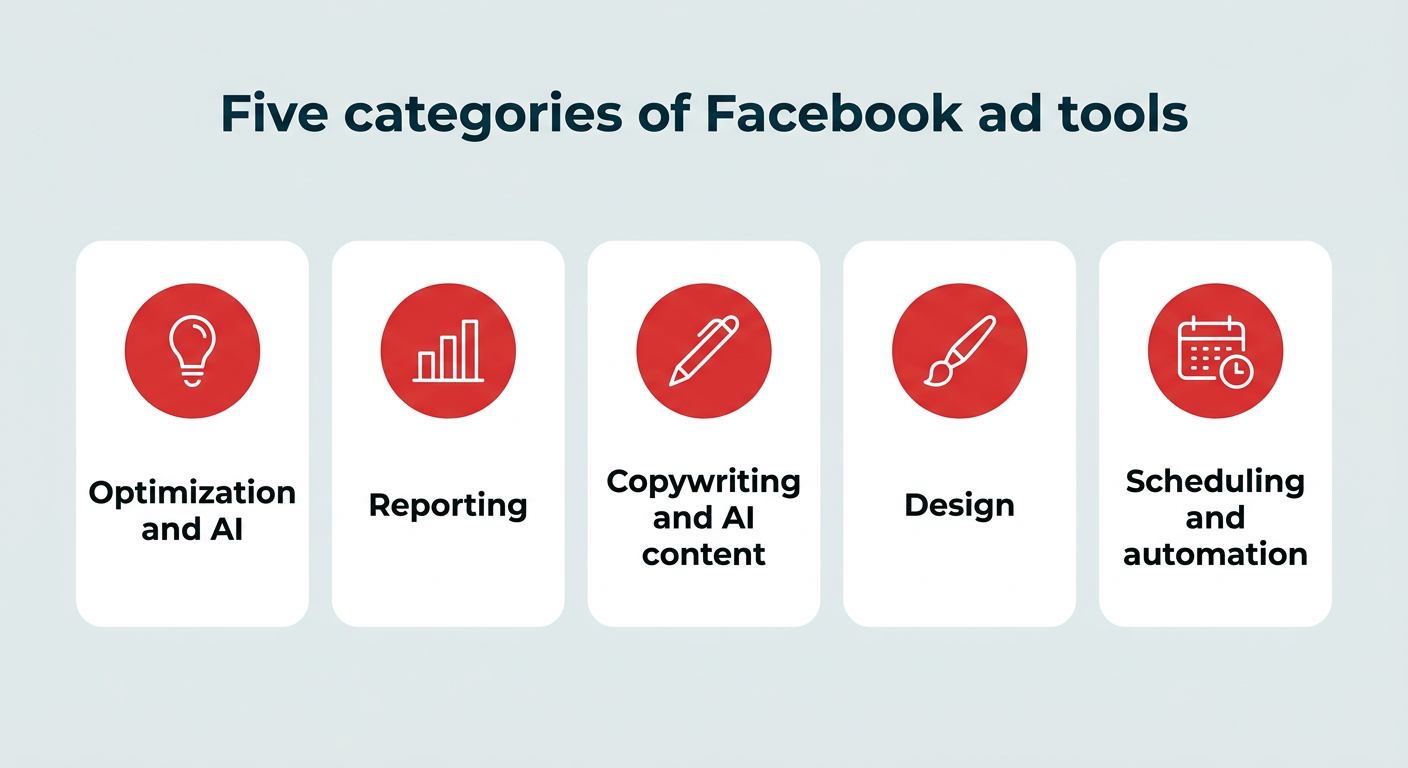
Optimization and Artificial Intelligence Platforms
Artificial intelligence has fundamentally redefined how performance marketers optimize ad delivery. Modern AI tools identify strategic opportunities to enhance creative assets, refine target audiences, and automate routine management tasks.

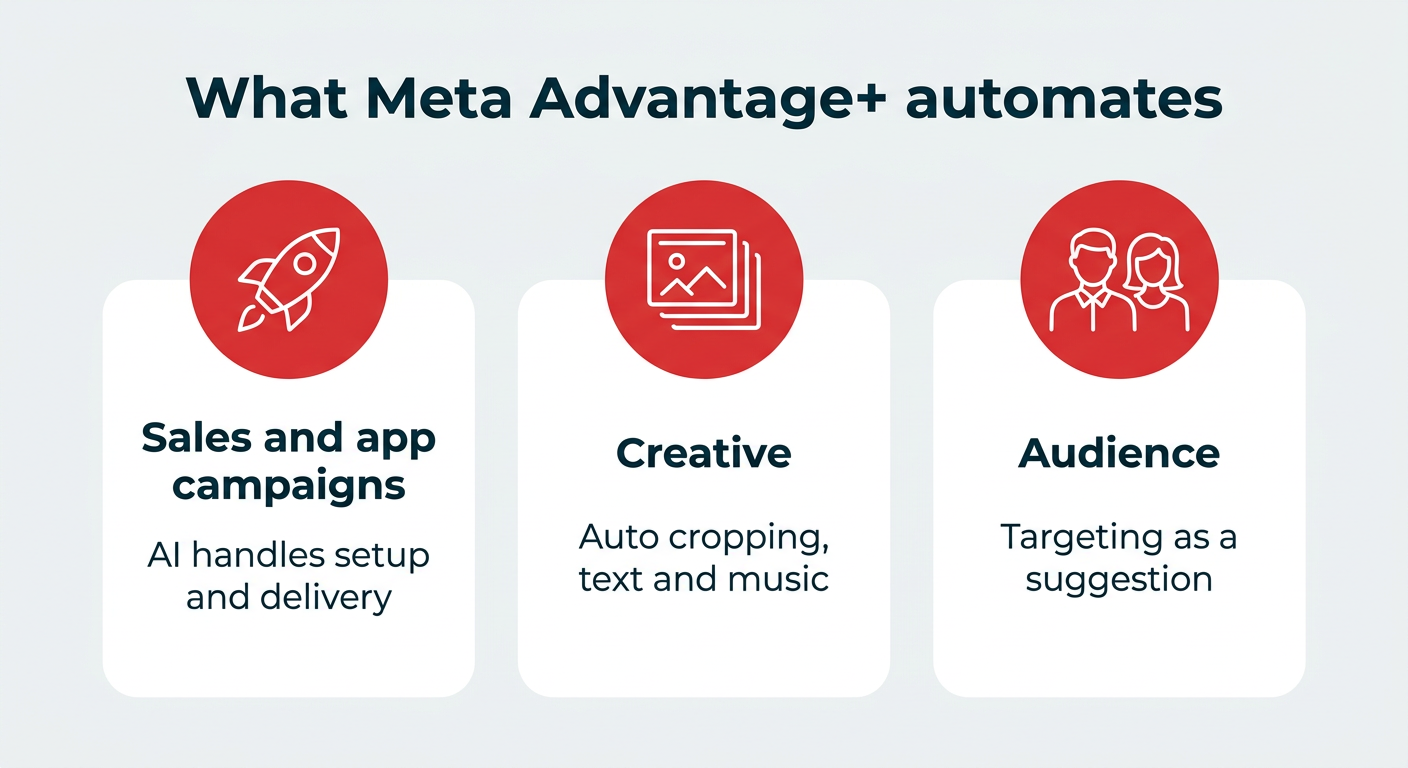
At the center of this movement is Meta Ads Manager and its proprietary Advantage+ suite. Advantage+ sales and app campaigns empower Meta’s sophisticated machine learning algorithms to shoulder the bulk of setup and delivery decisions. Furthermore, Advantage+ creative features apply automated enhancements—including dynamic cropping, localized text variations, and optimized background audio—while Advantage+ audience models utilize targeting inputs merely as suggestions, allowing delivery algorithms to autonomously expand reach toward high-converting user segments. Internal data released by Meta indicates that campaigns leveraging generative AI features achieve an average click-through rate increase of roughly 11 percent.
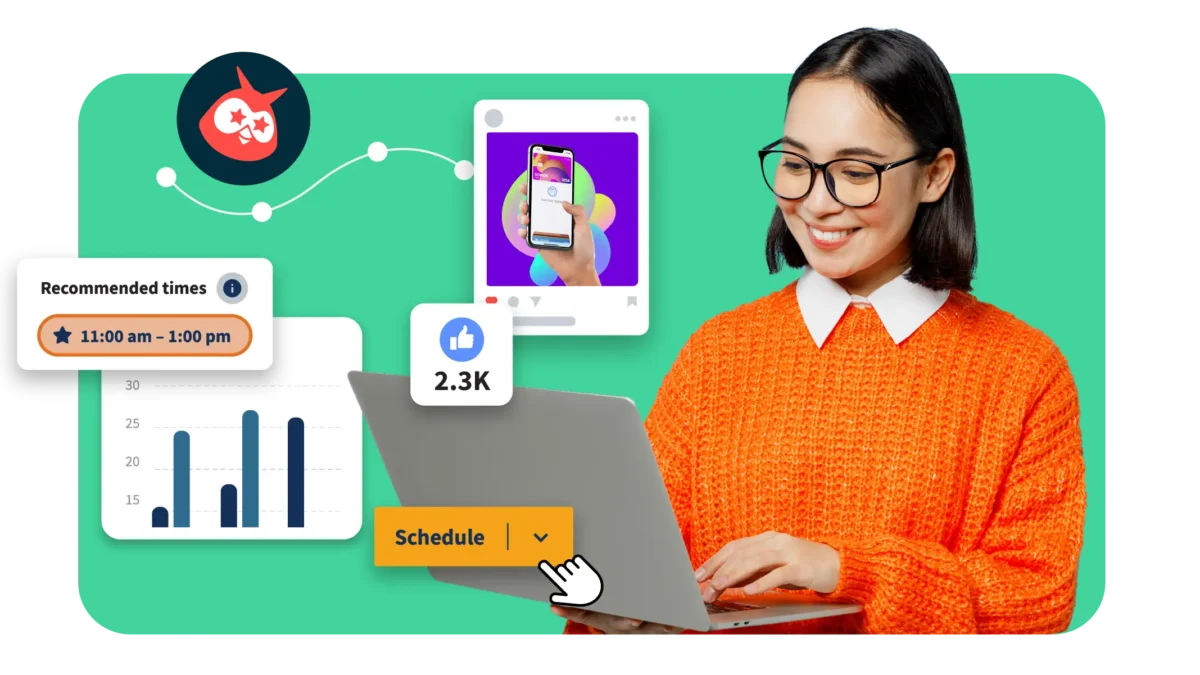
Complementing native solutions, enterprise platforms like Hootsuite Social OS provide comprehensive environments where paid advertising and organic social media management converge. Through unified dashboards, marketing teams can monitor performance, schedule campaigns across multiple social networks, and analyze accurate ROI without jumping between disparate portals. Similarly, specialized tools like Madgicx provide deep, account-level AI audits, generating instant tactical recommendations to elevate return on ad spend (ROAS).

Advanced Reporting and Data Modeling Solutions
Accurate attribution and comprehensive performance reporting remain vital for modern media buyers. While native analytics provide deep insights into platform-specific metrics, cross-channel marketers frequently require consolidated reporting systems to visualize how Facebook campaigns interact with broader digital marketing initiatives.

Enterprise solutions such as TapClicks and Funnel aggregate data from dozens of distinct advertising networks, web analytics platforms, and customer relationship management (CRM) systems. Funnel, for instance, excels at data modeling by automatically normalizing mismatched field names and currency conversions across platforms, enabling data analysts to build clean, centralized reporting dashboards. This cross-channel visibility allows organizations to quickly identify macroeconomic trends, reallocate budgets dynamically, and defend marketing expenditures to executive leadership with empirical precision.
Creative Automation, Copywriting, and Design Software

Creative fatigue remains one of the primary obstacles to sustained advertising success. To combat this, digital marketers increasingly rely on AI-driven creative generation and copywriting assistants to maintain a steady stream of fresh, high-performing visual assets.
Platforms like AdCreative.ai and Canva’s Magic Studio leverage generative AI to produce thousands of brand-compliant ad variations in minutes. AdCreative.ai uniquely evaluates and scores creative assets based on predicted performance metrics before any media budget is allocated, mitigating financial risk. Meanwhile, Wisdom by Hootsuite allows social media managers to instantly repurpose top-performing organic social posts into high-converting paid advertisements, bridging the traditional gap between content creation and media buying. For competitive analysis, the public Facebook Ad Library continues to serve as an invaluable, free repository where marketers can inspect active competitor campaigns across global markets.

Automation and Scheduling Mechanics
Scaling advertising operations efficiently demands robust automation rules that execute campaign adjustments instantaneously. Tools such as RevealBot and Adzooma allow media buyers to establish complex, conditional automation workflows. Whether pausing underperforming ad sets when cost-per-acquisition thresholds are exceeded, scaling budgets based on real-time weather patterns, or managing multi-network campaigns across both Meta and Google Ads, these scheduling platforms eliminate manual monitoring overhead and protect profit margins around the clock.

Implications and Future Outlook for Advertisers
The proliferation of sophisticated Facebook ad tools underscores a broader industry evolution: manual, labor-intensive campaign management is rapidly becoming obsolete. As machine learning algorithms assume control over audience targeting and ad delivery mechanics, the core competency of modern marketers has shifted toward strategic oversight, creative ideation, and data governance.

Organizations that successfully consolidate their technology stacks—minimizing operational friction through unified platforms while leveraging AI for rapid creative iteration—will capture significant competitive advantages. Conversely, teams bogged down by fragmented software architectures and manual reporting processes risk falling behind in an increasingly automated digital economy. Ultimately, the strategic deployment of these advanced advertising tools ensures that marketing budgets are spent with maximum efficiency, clear accountability, and measurable business growth.