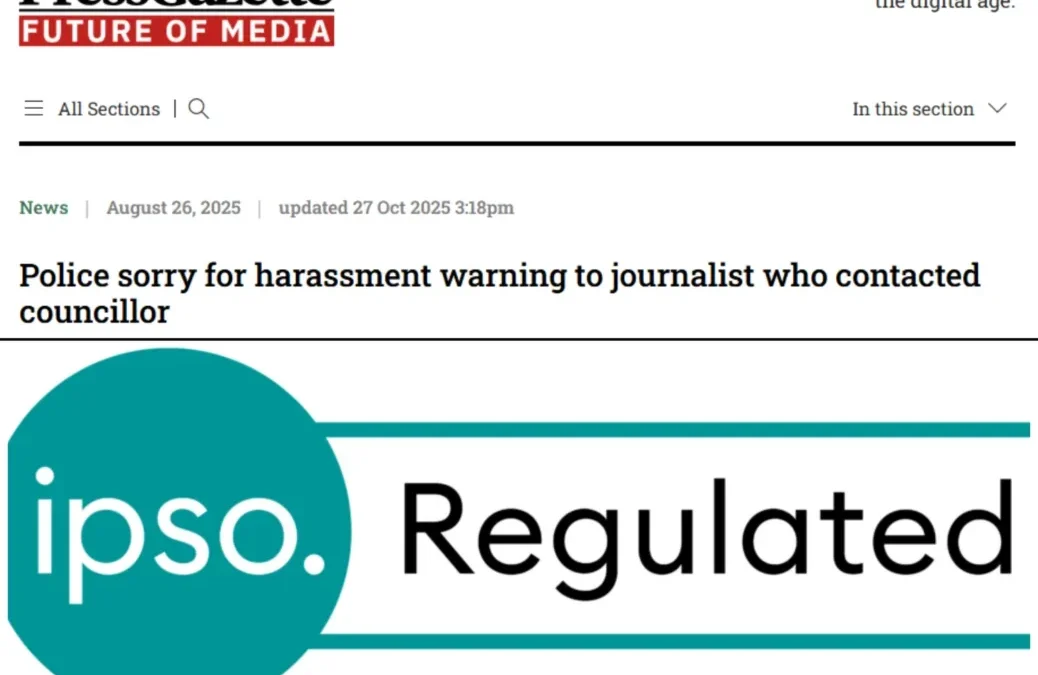
The Independent Press Standards Organisation (IPSO) has delivered a formal ruling finding that the Press Gazette breached accuracy guidelines in an article concerning Matthew Binley, a former North Northamptonshire councillor. The regulatory body determined that the publication failed to take adequate care when reporting an unproven claim that Binley had made admissions regarding a severe sexual offense during a public council meeting. Specifically, the watchdog noted that the article omitted Binley’s explicit denials, creating a misleading impression for readers regarding his accountability and statements.
The regulatory decision underscores the strict journalistic boundaries required when reporting on serious criminal allegations, even when those allegations are tied to matters of public interest, such as police warnings issued to reporters. While IPSO stopped short of ruling that the reporting of the underlying allegations was entirely prohibited, it underscored that news outlets carry a distinct obligation to ensure that claims of admissions are rigorously contextualized, balanced, and verified prior to publication.
Background Context of the Local Political and Media Dispute
The core of the dispute traces back to a complex intersection of local investigative journalism, historic police matters, and political accountability in Northamptonshire. Sarah Ward, editor of the Substack-based local news platform NN Journal, had previously published a series of four articles focusing on historic allegations dating back to 2009 involving Matthew Binley. Binley, who served as a local councillor and was previously a police officer, has consistently and strongly denied all wrongdoing regarding these historic matters.
The tension escalated when Binley lodged a formal complaint with Northamptonshire Police regarding Ward’s reporting methods. He argued that the continuous dispatch of "right of reply" emails constituted harassment. In response to his complaint, a local police officer issued a formal harassment warning to Ward, cautioning her that she could face potential arrest if she attempted to contact Binley again.
This police action against a working journalist triggered widespread professional concern and coverage within the media industry, prompting the Press Gazette to step in with its own reporting. In August of the previous year, the Press Gazette published an article examining the controversy surrounding the police warning given to Ward. However, it was within this broader investigative narrative that the publication included the contentious sub-headline and references regarding Binley’s alleged admissions at a council meeting.
Chronology of Events and Investigative Missteps
The sequence of events leading up to the IPSO adjudication highlights critical breakdowns in standard pre-publication verification protocols:
- February 2025: Northamptonshire Police publicize a historic appeal for information regarding historical allegations, bringing public attention back to the case involving Binley.
- Months Preceding August: Sarah Ward publishes multiple reports on NN Journal concerning Binley, prompting his police complaint about her email approaches.
- August (Five Days Prior to Publication): Press Gazette dispatches an email to Binley’s council address notifying him of an impending story focused on the journalist’s harassment warning. However, this correspondence fails to outline the specific, grave allegations concerning his supposed admissions at a council meeting.
- August (Publication Date): Press Gazette publishes the article, featuring a sub-headline stating that Binley “admitted to having sex with a 14-year-old when in his twenties.” The text relies on accounts from local councillors who stated they were willing to testify that Binley made the admission during a council meeting.
- Post-Publication: Binley files a formal complaint with IPSO. Only following this complaint does the Press Gazette actively seek secondary verification, speaking directly with two local councillors and reviewing an extract from local Conservative Association meeting minutes which referenced the alleged admission.
- Regulatory Ruling: IPSO investigates the matter, ultimately finding the publication in breach of the Editors’ Code of Practice for inaccuracies and failure to publish a rebuttal.
Analysis of the IPSO Ruling and Key Findings
IPSO’s Complaints Committee structured its findings around several distinct clauses of the Editors’ Code of Practice, primarily focusing on Clause 1 (Accuracy). The regulatory body acknowledged a fundamental principle of media law: the press maintains the freedom to report on allegations that are in the public domain. IPSO explicitly stated that merely reporting the existence of an allegation that Binley had made an admission did not, by itself, breach the regulatory code.
However, the committee emphasized that the manner of reporting crossed regulatory lines. While the body of the article contained a generic statement from Binley dismissing the historic allegations as closed matters investigated with no further action taken, it completely omitted his explicit denial regarding the specific, grave claim that he had admitted to the offense at a council meeting.
Furthermore, IPSO noted that the Press Gazette failed to put this specific allegation directly to Binley prior to publication. Although the publication had sent an initial notification email five days prior, that message addressed only the broad theme of the journalist’s harassment complaint and contained no hint of the sexual offense admission claim. Compounding the issue, the email was sent to an inactive council inbox, and the publication made no subsequent follow-up efforts when no auto-reply or response was received.
Consequently, IPSO ruled that the article presented the allegation not as an unproven claim, but with a misleading slant that suggested Binley tacitly accepted making the admission. Because the offense alleged was of a profoundly serious nature—involving a serving police officer and a minor—the omission of his rebuttal constituted a significant distortion, mandating an official correction.
Official Responses and Remedial Actions Taken
In response to the regulatory process, the Press Gazette removed the contested allegation from the digital version of the story once the IPSO complaint was formally lodged. Following the final adjudication, the publication fulfilled IPSO’s mandate by publishing a prominent correction directly beneath the headline area.
The published correction reads: “A previous version of this article reported that Matthew Binley ‘admitted to having sex with a 14-year-old when in his twenties’ during a council meeting. It did not make clear that Mr Binley disputes this claim: he says he made no such admission during the council meeting. This correction has been published following an upheld ruling by the Independent Press Standards Organisation.”
Regarding other dimensions of Binley’s complaint, IPSO ruled in favor of the publication on several counts. The committee declined to uphold complaints regarding Clause 2 (Privacy), noting that the core details of the historic police investigations and his complaints against the journalist were already matters of public record. Similarly, complaints under Clause 3 (Harassment) were dismissed, with the committee establishing that the publication of a single investigative article does not constitute a sustained pattern of behavior capable of being classified as harassment or intimidation.
Broader Media Implications and Industry Impact
The outcome of this regulatory proceeding serves as a critical case study for trade publications and mainstream newsrooms navigating complex local investigative reporting. As local journalism increasingly shifts toward digital-first models, niche reporting, and distributed networks (such as Substack outlets), the interplay between regional digital publishers and national trade watchdogs is evolving.
The ruling highlights the absolute necessity of rigorous verification protocols when dealing with sensitive, uncorroborated claims originating from third-party accounts, such as political group meetings or hearsay among local officials. Media analysts point out that while national trade press outlets operate under immense pressure to cover threats to press freedom—such as police harassment warnings issued to journalists—that urgency cannot supersede foundational journalistic standards of fairness, pre-publication outreach, and balanced attribution.
Ultimately, the IPSO decision reinforces the balancing act required by regulatory frameworks: protecting the freedom of the press to scrutinize interactions between authorities and the media, while simultaneously safeguarding individuals from distorted, unverified, and highly damaging characterizations in published reports.