The landscape of digital discovery has undergone a profound structural shift. For decades, businesses relied on traditional search engine optimization (SEO) to secure prominent spots on a page of blue links. Today, millions of users turn directly to conversational artificial intelligence models like OpenAI’s ChatGPT, Perplexity, Google Gemini, and Google AI Overviews to find information. Rather than presenting a list of disparate URLs, these systems synthesize data from across the web and deliver a single, comprehensive answer. For brands, this zero-click environment means that traditional visibility metrics can vanish into an AI-generated summary that consumers read and act upon without ever visiting an external website.
To navigate this paradigm, digital marketers have rapidly adopted Answer Engine Optimization (AEO), and more specifically, AEO checkers. These specialized auditing and monitoring instruments track whether an artificial intelligence model actively cites, references, or recommends a brand within its synthesized responses. As consumer behavior continues to pivot away from conventional search loops toward generative AI, understanding the architecture, metrics, and software solutions behind AEO has become a critical operational requirement for modern enterprises.
The Evolution of Search: From Keyword Rankings to Conversational Synthesis
![AEO checker tools that measure answer engine visibility [2026]](https://53.fs1.hubspotusercontent-na1.net/hubfs/53/aeo-checker-1-20260903-3858273.webp)
The transition toward answer engines accelerated significantly in May 2024, when Google officially rolled out AI Overviews to its primary search engine interface. This launch normalized the display of synthesized summaries at the top of search result pages. Concurrently, standalone conversational interfaces like ChatGPT and Perplexity experienced exponential user growth, fundamentally altering how consumers research products, compare software, and vet service providers.
In this new era, traditional SEO and AEO serve complementary functions. SEO focuses heavily on securing crawlability, technical health, and keyword rankings within traditional index lists. AEO, conversely, is engineered to capture citations and brand mentions inside the narrative body of an AI response. Answer engines rely heavily on the foundational authority signals supplied by traditional SEO—such as high-quality backlinks and clean site architecture—but they parse data differently. They favor structured content, direct answers to natural-language queries, and assertions backed by verifiable primary sources. When an AI model determines a brand is a trustworthy authority for a specific query, it integrates that brand into its output, either as an inline citation or a direct textual mention.
Decoding the Core Functions of an AEO Checker
Because manual spot-checking of AI interfaces is time-consuming and prone to subjective bias, the market has seen the emergence of automated AEO checking software. An effective AEO checker systematically executes a defined set of priority queries across multiple artificial intelligence engines to measure a brand’s share of voice.
![AEO checker tools that measure answer engine visibility [2026]](https://no-cache.hubspot.com/cta/default/53/9dd5e54b-fbef-4dd0-bc44-1689feb1ea18.png)
These software solutions typically evaluate several core parameters:
- Citation Frequency: Measuring how often a brand’s web domain is directly linked inside an AI-generated response.
- Brand Sentiment and Context: Assessing whether the brand is framed positively, neutrally, or negatively within the conversational output.
- Competitor Benchmarking: Identifying which rival brands are capturing citations for critical consumer queries where the target company is absent.
- Content and Schema Gaps: Pinpointing structural, informational, or technical deficiencies on a website that prevent AI crawlers from accurately parsing and citing its pages.
By continuously logging these data points, AEO checkers translate raw visibility metrics into prioritized, actionable remediation tasks. Digital marketing teams can then update existing content, restructure information for easier machine readability, or deploy necessary schema markup to capture lost traffic.
Manual Verification Protocols for AI Overviews, ChatGPT, and Perplexity
While enterprise-level automated software provides continuous monitoring, organizations often begin by establishing manual auditing protocols to benchmark their baseline visibility.
![AEO checker tools that measure answer engine visibility [2026]](https://53.fs1.hubspotusercontent-na1.net/hubfs/53/aeo-checker-2-20260903-852936.webp)
When conducting manual checks for Google AI Overviews, specialists must define a precise list of queries that reflect their brand names, product categories, and informational buyer questions. Because AI Overviews only appear when Google’s algorithms determine a summary adds value to traditional search, these features do not trigger uniformly for every keyword. Marketers must run queries in incognito or signed-out browser sessions, record whether an overview appears, note if their domain is cited among the inline source links, and catalog the exact claims made by the model. Furthermore, because AI-generated summaries fluctuate between sessions, analysts must compile longitudinal records supported by screenshots, dates, and geographic locations to build a defensible baseline of performance.
A similar methodology applies to platforms like ChatGPT and Perplexity. Perplexity automatically attaches inline citations to every response alongside a dedicated sidebar panel listing all referenced sources. ChatGPT incorporates citations when utilizing web-search capabilities or when explicitly prompted with current, real-world questions. To audit these platforms effectively, analysts must phrase queries using natural, transactional language—such as "best software solutions for specific enterprise use cases"—to force the AI engine to retrieve live web sources. Running these prompts repeatedly across fresh sessions helps filter out run-to-run volatility and highlights consistent citation patterns versus isolated anomalies.
AEO Checker Software Landscape and Buyer Criteria
As the martech ecosystem matures, selecting the right AEO checking tool requires careful evaluation of specific buyer criteria. Key features to look for include multi-engine tracking capabilities spanning ChatGPT, Perplexity, and Gemini; historical data reporting to track visibility trends over time; automated prompt generation; and integration capabilities with existing customer relationship management (CRM) and content management systems (CMS).
![AEO checker tools that measure answer engine visibility [2026]](https://53.fs1.hubspotusercontent-na1.net/hubfs/53/aeo-checker-3-20260903-8904553.webp)
The software market has quickly segmented to accommodate these diverse operational demands:
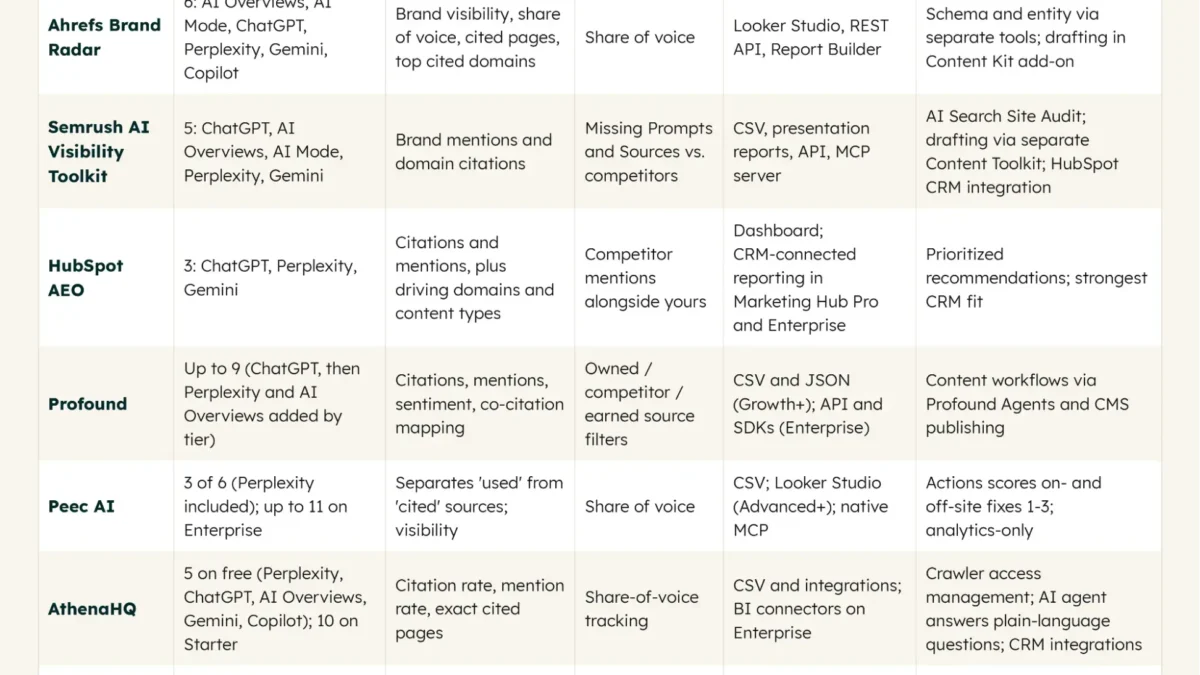
- AI Overviews Tracking: Tools such as Ahrefs Brand Radar and the Semrush AI Visibility Toolkit leverage vast organic search indexes to flag which ranking keywords already trigger AI summaries, helping brands prioritize pages for near-inclusion.
- Citation Detection and Context: Platforms like HubSpot AEO and Profound go beyond basic link tracking by measuring citation context, sentiment scoring, and the specific source types (owned, earned, or competitor) driving visibility.
- Dedicated Perplexity Monitoring: Tools like Peec AI and AthenaHQ offer specialized, streamlined analytics focused primarily on tracking performance within Perplexity’s conversational search environment.
- Schema and Entity Readiness: Platforms such as Scrunch AI and Conductor focus heavily on technical monitoring, ensuring that AI crawlers can successfully crawl, render, and interpret a website’s underlying semantic data.
Metrics That Matter in Answer Engine Optimization
Evaluating success in answer engine optimization requires a shift away from traditional vanity metrics toward specialized performance indicators. Industry analysts emphasize tracking a specific subset of metrics over time:
- Visibility and Share of Voice: The percentage of target queries in which a brand is either cited or mentioned relative to its top competitors.
- Citation Coverage vs. Brand Mentions: Differentiating between instances where an AI engine links directly to a domain versus instances where it names the brand in text without a hyperlink. Zero-click mentions still build brand equity, but direct citations drive measurable referral traffic.
- AI-Referred Traffic and Pipeline Attribution: Utilizing advanced CRM integrations to isolate traffic originating from conversational search engines and tying those sessions downstream to qualified leads and closed deals.
Because answer engines frequently resolve a user’s inquiry entirely within the chat interface without triggering a click-through, direct referral traffic represents only a fraction of AEO’s true commercial impact. Consequently, forward-thinking organizations evaluate visibility scores and pipeline attribution as two distinct yet highly interconnected pillars of modern marketing measurement.
![AEO checker tools that measure answer engine visibility [2026]](https://53.fs1.hubspotusercontent-na1.net/hubfs/53/aeo-checker-4-20260903-6212698.webp)
Strategic Implications and Future Outlook
The rise of answer engines marks a permanent structural evolution in how human beings interact with digital information. Brands that fail to optimize their content for machine comprehension risk invisibility in an increasingly automated marketplace.
Industry experts stress that AEO does not replace traditional SEO; rather, it builds upon it. The foundational requirements of a healthy web presence—technical crawlability, high authority, clear information architecture, and rigorous fact-based content—remain the primary prerequisites for AI citation. However, the operational workflow required to manage this visibility has evolved from passive keyword tracking to active, continuous generative AI auditing.
As software solutions mature, the integration of AEO diagnostics directly into CRM and content management platforms—exemplified by HubSpot’s combined marketing and AEO toolsets—signals a broader industry trend toward unified automation. By bridging the gap between visibility diagnosis and instant content remediation, organizations can rapidly adapt their digital footprints to meet the demands of conversational search engines. Moving forward, maintaining a competitive advantage will depend entirely on a brand’s ability to measure, adapt to, and master the mechanics of AI-driven synthesis.