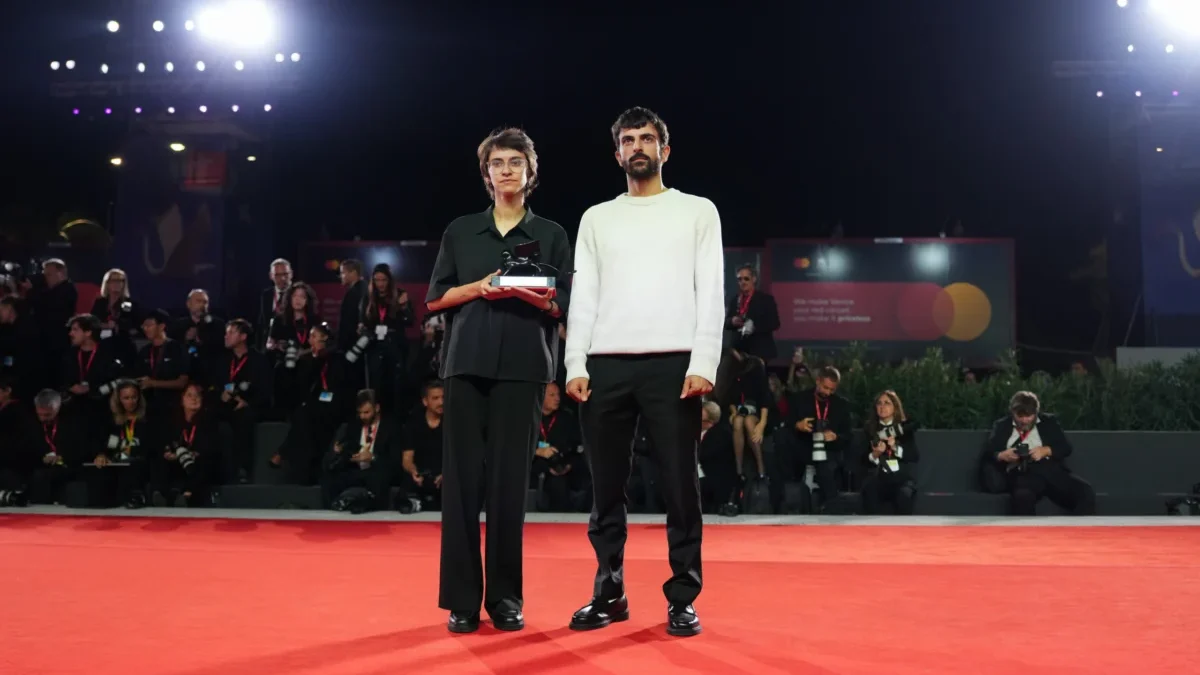
The global premiere of a new documentary at the Venice Film Festival has ignited a fierce political storm inside Israel, drawing sharp lines between freedom of the press, military accountability, and national security in a time of war. Titled NAZA—an acronym for the Hebrew military term nezek agavi, meaning "collateral damage"—the 77-minute film examines the mechanisms behind the Israel Defense Forces’ operations in the Gaza Strip following the events of October 7, 2023. Featuring anonymous interviews with elite intelligence personnel, the documentary alleges that numerical quotas are systematically assigned to potential strikes to quantify acceptable civilian casualties.
While the film received a sustained standing ovation upon its September 10 debut in Italy, its mere existence has triggered severe backlash from Israeli state officials, right-wing activists, and the military establishment. The controversy highlights deep internal divisions over transparency, the role of investigative journalism, and the ethical implications of modern warfare driven by automated targeting systems.
Chronology of the Controversy
The unfolding crisis surrounding the documentary follows a rapid timeline of events that began on the international stage and quickly reverberated through domestic Israeli politics:
- September 10: NAZA premieres at the Venice Film Festival, drawing critical acclaim and a 25-minute standing ovation, while sparking immediate concern among Israeli officials.
- Mid-September: Shin Bet, Israel’s internal security agency, queries the Israel Defense Forces regarding whether a formal investigation has been launched into the filmmakers. The IDF confirms no such probe exists, noting that officials have not yet viewed the picture.
- Mid-September: Israeli Minister of Culture Miki Zohar publicly accuses directors Rachel Szor and Yuval Abraham of treason. IDF Chief of Staff Eyal Zamir condemns the project as a direct assault on the state, pledging to explore legal countermeasures.
- Late September: Prime Minister Benjamin Netanyahu signals an intent to pursue legislation that would severely penalize the defamation of soldiers and strip citizenship from individuals deemed to have defamed military personnel.
- September 30: The documentary opens in New York City theaters, ahead of a planned nationwide rollout on October 9.
Inside the Film: Methodology and Subject Matter
Directed by Rachel Szor and Yuval Abraham, NAZA relies heavily on the testimony of anonymous Israeli intelligence officers and soldiers. Shot predominantly on Tel Aviv rooftops under the cover of night, the subjects’ faces are obscured and their voices digitally altered to protect their identities. According to the production, these elite personnel describe the operational processes used to select targets in Gaza, where the death toll has exceeded 70,000 since the outbreak of hostilities.
The central thesis of the documentary focuses on the calculus of civilian casualties. Interviewees explain how the military assigns a specific NAZA designation to potential strikes, establishing a threshold of permissible civilian fatalities deemed acceptable to neutralize a designated combatant. The film asserts that these calculations make no distinction between demographic categories such as infants, children, or adults, aggregating all non-combatant casualties into standardized units of collateral impact.
The investigative roots of the film trace back to previous reporting by Yuval Abraham and his colleagues at the independent outlets Local Call and +972 Magazine. Abraham previously collaborated on the critically acclaimed documentary No Other Land, which focused on the West Bank occupation and won an Academy Award for Best Documentary Feature in 2024. His prior investigative work covered the IDF’s deployment of advanced technological systems, including an artificial intelligence platform known as Lavender, which has been utilized to compile automated target lists for military strikes in densely populated urban environments.
Official Responses and Institutional Reactions
The reaction from Israeli leadership has been uncompromising. Prime Minister Benjamin Netanyahu announced plans to introduce sweeping legislative measures. These proposals aim to increase monetary damages for defamation convictions by a factor of twenty and empower the state to revoke the citizenship of anyone found to have defamed IDF soldiers.
IDF Chief of Staff Eyal Zamir issued a strongly worded condemnation, characterizing the film as "an attack on the State of Israel" and promising to employ "every tool at our disposal" to examine and advance legal proceedings against those involved in its creation. Cultural Minister Miki Zohar went further, explicitly labeling the filmmakers as traitors.
In a formal statement, the IDF elaborated on its stance: "The film adopts narratives of Israel’s haters, defames our soldiers and commanders, and seeks to portray the IDF as deliberately acting unlawfully. This is a dangerous attempt to strip us of the legitimacy to defend ourselves against the worst of our enemies, and in doing so to pose a real danger to IDF soldiers and commanders."
Conversely, international media organizations and press freedom advocates have rallied behind the production team. The Guardian, which produced the project, defended the journalistic integrity of the work and its creators. "The interviews were given by confidential journalistic sources," the publication stated. "We will robustly defend NAZA—and the team behind it—from any attacks or attempts at censorship."
Additionally, the Committee to Protect Journalists (CPJ), joined by ten other civil liberties and press advocacy groups, released an open letter urging Israeli authorities to safeguard the fundamental rights and physical safety of Abraham and Szor amid escalating public threats.
Domestic Unrest and Public Backlash
The friction surrounding the documentary has manifested physically on the streets of Israel. Right-wing figures and prominent social media activists have targeted the filmmakers and their families directly. Images resembling mug shots of Abraham and Szor have circulated widely on digital platforms, and unruly crowds have gathered outside the Szor family home, chanting slogans advocating for severe punitive measures and property demolition.
Intimidation tactics have also extended to journalistic workspaces. Figures with large online followings have filmed themselves entering the Tel Aviv offices shared by Local Call and +972 Magazine, confronting staff members and disrupting operations.
During an appearance on Israeli news station Channel 13, interviewed by prominent investigative journalist Raviv Drucker, Yuval Abraham articulated the personal toll of the backlash. Speaking remotely, Abraham acknowledged his precarious situation: "Israel is my home. It’s the place where I want to live, the place that’s so important to me. So of course I’m scared that I won’t be able to return. What will I do?"
Broader Implications and Analytical Perspectives
Observers and media analysts suggest that the profound discomfort caused by NAZA within Israeli society stems from its unique focus. Unlike previous documentation of the conflict, which often centered on ground troops or distant political leadership, this film trains its lens on the architecture of modern military intelligence.
Ben Reiff, deputy editor of +972 Magazine, noted in a recent essay that the documentary addresses a distinct demographic within the military apparatus. The intelligence officers operating automated systems and reviewing targeting data are frequently drawn from secular, upper-middle-class backgrounds who traditionally identify with the political left or center-left. By focusing on personnel who view themselves as liberal professionals overseeing mass operations from computer screens, the film challenges conventional self-perceptions among Israel’s educated urban elite.
The controversy also underscores a widening chasm within the Israeli media ecosystem regarding wartime self-censorship and investigative reporting. While international audiences engage with the film through festival screenings in Venice and New York, mainstream domestic outlets have faced intense scrutiny over the extent of their coverage concerning military targeting protocols and the human cost in Gaza.
As NAZA prepares for broader international theatrical distribution, beginning with its New York release, the film serves as a flashpoint in an ongoing global debate over the boundaries of wartime documentation, state security, and the essential protections required for investigative journalists operating in high-conflict zones.