In a move that has sent shockwaves through the journalistic community and ignited fierce debate over press freedom, federal agents on Friday evening delivered subpoenas to the homes of several New York Times reporters, compelling them to testify before a federal grand jury. The targeted journalists—Julian E. Barnes, Adam Goldman, Eric Lipton, Tyler Pager, and Eric Schmitt—are part of a team that recently published a series of investigative reports raising significant security concerns regarding President Donald Trump’s newly acquired and custom-decorated Air Force One. The Times immediately went public with the development, with its executive editor, Joe Kahn, issuing a memo to staff over the weekend condemning the action and promising a robust legal challenge. David McCraw, the Times newsroom lawyer, articulated the gravity of the situation in a stark statement: "The appearance of federal law enforcement agents on the doorstep of news reporters should shock the conscience of any American who believes in the Constitution and the press freedom it protects. This brazen act should be seen as nothing more than an attempt to prevent the public from knowing what is happening in their country by intimidating journalists from doing their jobs."
The Genesis of Controversy: Trump’s Custom Air Force One
The unfolding drama is rooted in President Trump’s long-standing public dissatisfaction with the aesthetic and perceived prestige of the presidential fleet. Since returning to office, he has frequently expressed a desire for a more "modern" and "imposing" presidential aircraft, lamenting that other nations’ leaders often arrive in planes that appear "bigger and sleeker and sharper" than the traditional Air Force One. This sentiment, often voiced on platforms like Fox News, laid the groundwork for a significant acquisition.
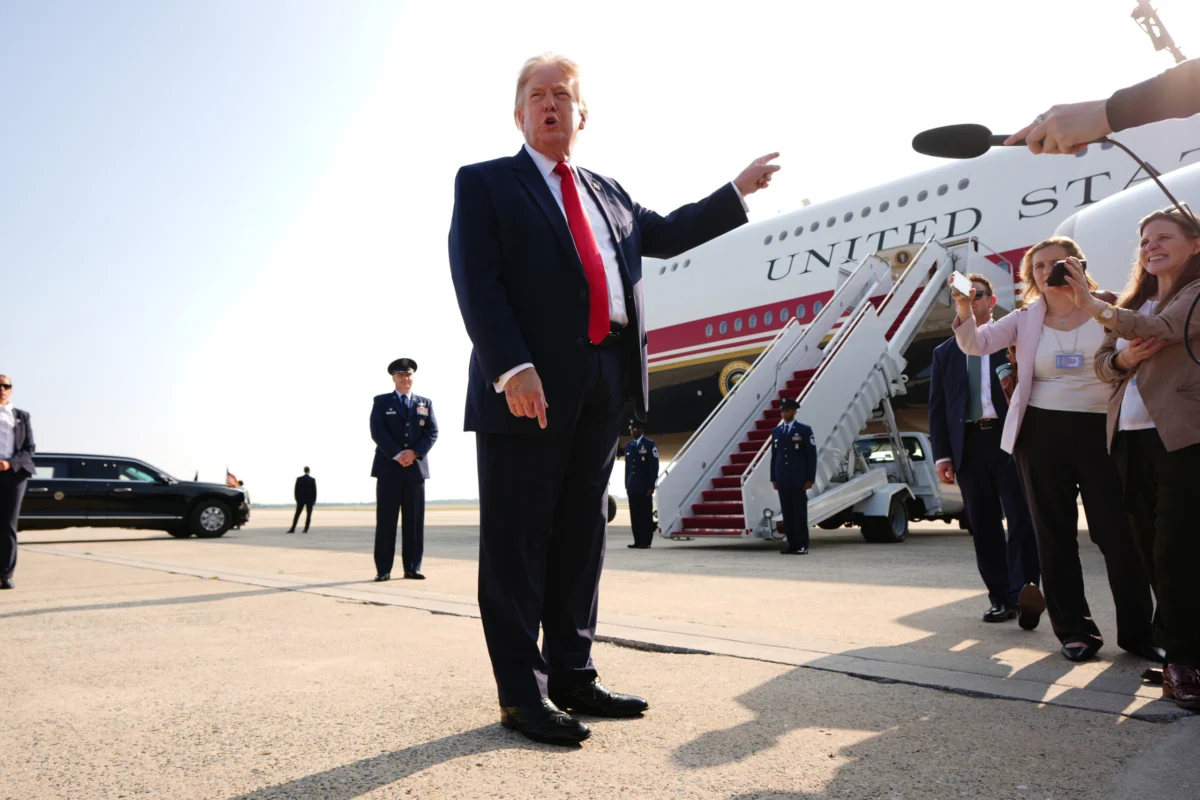
In May 2025, the United States accepted a remarkable gift from Qatar: a Boeing 747-8 jetliner. This state-of-the-art aircraft, reportedly valued at approximately $200 million, was intended to serve as the primary presidential transport until two new Boeing aircraft, commissioned in 2018 but repeatedly plagued by delays, were finally ready for service. The Qatari plane underwent rapid refurbishment and extensive customization to align with President Trump’s opulent tastes. Its interior was lavishly redecorated in the distinctive cream-and-gold motif that has become synonymous with Trump’s personal brand, reflecting a style previously seen in his properties and even the Oval Office during his prior term.
President Trump personally unveiled the newly configured aircraft, which he dubbed "a flying White House at a level of luxury that nobody’s ever seen before," during a grand ceremony in a Maryland hangar last month. During the unveiling, he proudly declared, "Now when we land at airports in London and Germany and different places, nobody tops this one." The aircraft was presented as a symbol of American power and prestige, designed to impress on the global stage.
The Security Breach and the Times Investigation
However, the narrative of unparalleled luxury and national pride was quickly overshadowed by critical security concerns. On Wednesday, July 8, 2026, New York Times reporters Barnes, Lipton, Pager, and Schmitt received information from multiple sources indicating that President Trump had been forced to abruptly switch from the new Qatari-gifted 747-8 to the older, existing Air Force One when departing a NATO summit in Türkiye. This unexpected change was reportedly due to pressing security concerns surrounding the new plane’s readiness.
The Times investigation revealed serious doubts about whether the Qatari plane had been adequately outfitted with essential security improvements, specifically a state-of-the-art missile defense system. These defensive countermeasures, crucial for protecting the Commander-in-Chief and his extensive entourage of officials, staff, and journalists, were deemed particularly vital in light of renewed and escalating threats from Iran. The core question posed by the reporting was a matter of profound public interest: had millions in taxpayer dollars been spent on a presidential plane that, despite its opulent interior, lacked the fundamental defensive capabilities necessary for the safety of its high-value occupants?
A Chronology of Confrontation
The sequence of events leading to the subpoenas underscores the escalating tension between the Trump administration and the press:
- Wednesday, July 8, 2026: The New York Times team, having corroborated information from "people briefed on the new plane’s capabilities" who spoke anonymously to discuss sensitive security issues, prepared to publish their exposé. Prior to publication, a senior official at the FBI reportedly contacted the Times, requesting that the article be held, citing national security implications, and demanding the identity of the reporters’ sources. The Times firmly rejected both requests, upholding its journalistic principles and publishing the story.
- Thursday, July 9, 2026: Following up on their initial report, the Times published a second article that delved more deeply into the specific defensive countermeasures that may have been omitted or insufficiently integrated during the Qatari plane’s refitting process.
- Friday, July 10, and Saturday, July 11, 2026: Both Times articles garnered significant attention, prominently featuring on the newspaper’s front page, fueling public debate and international scrutiny.
- White House Reaction: According to reports from outlets like CNN, President Trump was "fuming," "embarrassed and angry" by the revelations, viewing them as a personal slight and a national embarrassment on the international stage.
- Leak Investigation Initiated: In response, President Trump personally instructed Kash Patel, the Director of the FBI, to oversee a leak investigation. Patel, who was reportedly en route to Chicago, canceled his travel plans and instead spent eight hours at the White House on Friday, July 10.
- Friday Evening, July 10, 2026: Later that day, federal agents appeared at the homes of the New York Times reporters, delivering grand jury subpoenas issued from the Southern District of New York. The subpoenas compel the journalists to testify in Manhattan on Wednesday, July 15, 2026.
Broader Implications: A Pattern of Press Intimidation
The issuance of these subpoenas is strikingly uncommon in leak investigations, particularly as a first step in such a probe. Typically, authorities would exhaust internal avenues to identify the source of a leak before targeting journalists. While a spokeswoman for the Justice Department insisted on Saturday that "reporters are not the targets; those leaking classified information are," the immediate and direct targeting of journalists raises serious questions about the administration’s true intent.
This latest development is widely seen by press freedom advocates as part of a broader, more aggressive push by the Trump administration to criminalize routine newsgathering practices, especially concerning national security topics. This pattern of confrontation with the media is well-documented:
- June 2026 Subpoenas: Just weeks prior, the Justice Department issued grand jury subpoenas to journalists at the Washington Post and the Wall Street Journal. The Post subpoenas were reportedly related to a story concerning Venezuela, while the Journal‘s were for a report on military action against Iran. Both sets of subpoenas were later withdrawn after significant pushback from the news organizations, though the filings in those cases remain sealed.
- January 2026 FBI Raid: In a move described as "virtually without comparison" by Maddy Crowell for CJR, the FBI raided the home of Hannah Natanson, a Washington Post reporter, seizing her devices and controversially referring to her reporting materials as "contraband."
- Presidential Lawsuits: Beyond federal actions, President Trump has personally initiated multiple lawsuits against news organizations for coverage he deemed unfavorable.
Jodie Ginsberg, the chief executive of the Committee to Protect Journalists, characterized the Times subpoenas as an "extraordinary escalation" in efforts to "threaten and intimidate independent news organizations." This sentiment is echoed across the media landscape, where many fear a chilling effect on investigative journalism.
The Threat to Anonymous Sources and the First Amendment
The Times subpoenas are particularly revealing because they suggest the administration’s primary impulse is to pursue reporters, even before a thorough internal leak investigation has been conducted. This approach treats journalists as potential criminals for legally receiving information, and critics argue it serves as a cynical pretext to gain access to their notes, communications, and confidential sources.
If the five Times journalists are compelled to appear before a grand jury, they could face immense pressure to reveal their sources. As Perry Stein noted in the Washington Post, refusal to comply could lead to severe consequences, including charges of contempt of court or obstruction of justice. This directly threatens the cornerstone of national security reporting: the ability to protect anonymous sources who often expose governmental wrongdoing or critical information in the public interest, relying on journalistic confidentiality for their safety and careers.
Jon Schleuss, the president of the NewsGuild-CWA, of which the subpoenaed reporters are members, expressed deep concern, stating, "This is not something that should be normal. But when the president attacks journalists every single day, that becomes an unfortunate normalization—and if we ignore it, then we’re doomed." Schleuss further warned of a dangerous trend, noting that Trump’s tactics against the press "are filtering down at the state and the county and the city level. You have county sheriffs who will see this and say, ‘This is how we actually prevent reporting about the no-good contracts that we’ve got.’" This highlights the broader democratic implications, where a federal precedent of intimidating the press can embolden local officials to suppress unfavorable reporting.
A Legal Battle Ahead
The New York Times has made its intentions clear: it will aggressively fight the subpoenas. Executive Editor Joe Kahn, in his email to staff, reaffirmed the paper’s resolve: "This is a naked attempt to intimidate individual reporters and to prevent the Times and other independent news media from doing important reporting protected by the First Amendment." Kahn expressed confidence in the Times‘ legal position, pointing out that the "impulsive" subpoenas "used vague pretenses of a threat to national security" and stating, "we expect to prevail."
Indeed, the Trump administration’s track record in courtrooms regarding its efforts to crack down on critical journalism has been mixed, with many attempts failing to withstand judicial scrutiny. Courts have often upheld the constitutional protections afforded to the press, particularly under the First Amendment. However, even a successful legal defense comes at a cost. Kahn also acknowledged the "impending strain" these subpoenas will place on the lives and families of the five targeted journalists, who will inevitably be entangled in what could be a protracted and emotionally taxing legal battle within "Trump’s sprawling web of litigation."
The confrontation over the Air Force One security story and the subsequent subpoenas represents a critical juncture for press freedom in the United States. It underscores the enduring tension between government secrecy and the public’s right to know, particularly when matters of national security and significant public expenditure are at stake. The outcome of this legal challenge will not only shape the future of investigative journalism but also send a powerful message about the robustness of constitutional protections for a free and independent press in an increasingly polarized political landscape.