The Disconnect: Why Users Aren’t Embracing the AI Revolution as Advertised

The prevailing narrative in the technology sector often suggests a universal eagerness for advanced artificial intelligence features. However, a growing body of evidence and user sentiment indicates that many individuals and organizations are not clamoring for more AI, particularly not in the additive, often disruptive manner currently envisioned by many AI leaders. This disconnect highlights a fundamental misunderstanding of user needs and the true value proposition of AI integration, leading to low adoption rates, wasted resources, and potential reputational damage for companies pushing these technologies.
The assumption that everyone is actively seeking new AI features, products, and workflows that will seamlessly replace existing, perhaps imperfect, practices is proving to be a flawed premise. While the potential of AI is undeniable, its current implementation frequently clashes with real-world user experiences. A significant contributing factor to this disconnect is the perception that AI is not inherently a value proposition. As research from organizations like Nielsen Norman Group suggests, simply branding a feature as "powered by AI" does not automatically translate into user satisfaction or excitement. Instead, AI features are often perceived as bolted-on additions or separate tools that interrupt established workflows, forcing users to deviate from their established routines.
The inherent nature of AI, particularly in its current developmental stages, is to amplify existing organizational strengths and weaknesses. This means that issues like poor data quality, inconsistent decision-making processes, technical debt accumulated over years, or entrenched internal politics are not magically resolved by AI. Instead, AI can make these inconsistencies more apparent, presenting users with a more visible, and often more frustrating, landscape of problems to navigate. The expectation that AI will fix deeply ingrained organizational issues is often unmet, leaving users to grapple with the amplified fallout.
Furthermore, the architecture of modern work often involves navigating multiple disconnected systems. Introducing a new AI tool, without deep integration, adds yet another system to the user’s repertoire, demanding further context-switching and increasing the overall workload. This often results in tasks that are not only more numerous but also less rewarding, as the perceived benefits of the AI tool fail to materialize in terms of genuine efficiency or improved outcomes.
The financial and cognitive costs associated with AI are also significant deterrents. The effort required to identify and rectify "AI hallucinations" – instances where AI generates inaccurate or nonsensical information – is substantial. While the initial act of prompting an AI might feel simpler than composing content from scratch, the subsequent burden of verification and correction can outweigh the perceived shortcut. This cost is borne by the user, often without clear acknowledgment or compensation, further eroding enthusiasm for AI adoption.

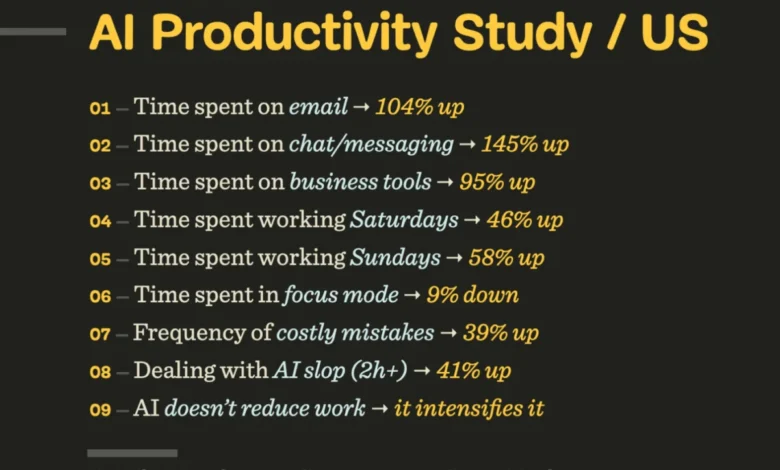
The rollout of AI technologies often occurs without user agency, being imposed at the pace and discretion of the implementing organization. This top-down approach, coupled with pervasive narratives about AI potentially displacing jobs, fosters an environment of fear and anxiety rather than excitement. The perception is often one of resistance to change and a deep-seated worry about individual relevance in a rapidly evolving technological landscape. Studies on AI productivity, such as those cited by publications like NBC News, the Wall Street Journal, and Harvard Business Review, have indicated that rather than reducing work, AI can sometimes intensify it. Reports have shown increases in time spent on email, chat, and business tools, along with a rise in working hours, suggesting that AI adoption may be contributing to increased workloads rather than alleviating them. This counterintuitive outcome fuels user skepticism and apprehension.
The unreliability and unpredictability of AI also contribute to its perception as a liability rather than an asset. Unlike conventional software features that are expected to perform consistently, AI’s current limitations in accuracy and predictability necessitate a healthy dose of skepticism from users. This caution often manifests as resistance to change, particularly when AI features are perceived as a threat to job security or established professional identities.
The desire for AI extends primarily to its capacity to enhance efficiency and alleviate tedium, not to replace human connection or creativity. There is little public demand for AI-generated art museums, AI-powered refrigerators, or AI narrators for children’s books. The prospect of AI romantic partners or the active management of a multitude of AI agents operating autonomously in sensitive areas like personal finance often evokes concern rather than anticipation. The prevailing sentiment is not a desire for constant interaction with a digital assistant, but rather a preference for human-centric experiences and interactions.

The prevailing discourse around AI often draws comparisons to human fallibility, suggesting AI’s potential to be more reliable. However, users do not typically compare software features to human interactions. Instead, they benchmark them against similar features within other products. If one product’s AI feature is unreliable while a competitor’s analogous feature functions flawlessly, users will invariably opt for the more dependable solution. The critical factor is not the presence of AI, but the consistent and reliable performance of the functionality itself.
While the speed of delivery is frequently touted as a key benefit of AI, this metric holds limited value for many users. What is prioritized is the quality of work, sufficient time for thoughtful decision-making, and the enjoyment derived from the process. The incremental erosion of reward and achievement, often attributed to rapid, unconsidered technological shifts, is a significant concern. The enduring human desire remains for features that are consistently fast, accessible, reliable, and useful. Crucially, the ideal AI is not one that overhauls existing workflows but one that augments them, taking over the most mundane, tedious, and unengaging tasks.
A recent analysis of jobs most exposed to AI automation, as reported by The Washington Post, highlights that while many professions are susceptible, a significant portion of these roles contain inherently rewarding, creative elements that demand human judgment, taste, and intuition. When AI can effectively automate the more tedious aspects of these jobs, it presents a clear advantage, boosting productivity and enhancing overall job satisfaction. This automation of monotonous tasks, where AI’s value is most readily apparent, requires deep integration into existing workflows rather than being a superficial addition.

Effective AI integration must align with users’ established mental models – the frameworks they have developed over years or even decades of experience. AI should adapt to human cognitive processes, not the other way around. The branding of these features as "AI," "smart," or "automated" is less critical than their seamless functionality and tangible benefit to the user. Awareness of specific use cases where AI demonstrably assists users is paramount, fostering a sense of empowerment and encouraging users to discover further applications independently.
The most successful AI-driven tools often emerge not as "AI-first" solutions but as "AI-second" innovations. These are characterized by their subtlety, humility, and ambient presence, operating supportively in the background to alleviate dull and unnecessary work. This approach allows AI to enhance human capabilities without overshadowing or dictating the user experience.
As Bo Young Lee articulated in a widely shared sentiment, the desire is not for AI to replicate human creativity or decision-making in areas like literature, art, education, or healthcare. Instead, the aspiration is for AI to shoulder the burdensome physical and mental labor, freeing individuals to engage with human-created content and experiences. The ultimate goal is for AI to simplify life, rather than demanding significant personal adaptation.

In conclusion, the widespread assumption that users are universally clamoring for more AI is a mischaracterization of current sentiment. The reality points to a significant demand for AI that automates the mundane and tedious aspects of daily work, thereby freeing up human time and cognitive resources for more engaging, creative, and personally fulfilling activities. This is not about increasing interaction with AI, but about enhancing the quality of human interaction and experience by delegating repetitive and unenjoyable tasks. The focus must shift from simply integrating AI to strategically deploying it as a supportive tool that augments human capabilities and enriches lives, allowing for more meaningful engagement with both work and personal relationships.
The development of effective AI interfaces is crucial for bridging this gap. Initiatives like "Design Patterns For AI Interfaces," a video course by Vitaly Friedman, aim to provide practical guidance and real-world examples for creating AI experiences that are user-centric and genuinely beneficial. Such educational efforts underscore the growing recognition that successful AI integration hinges on understanding and respecting human needs, rather than simply pushing technological advancements. The future of AI lies not in its ubiquity, but in its judicious and thoughtful application to solve real problems and enhance human potential.