The digital marketing landscape has irrevocably shifted, positioning social media not merely as a platform for engagement but as a critical driver of business outcomes. In an era where every marketing dollar is scrutinized, understanding and quantifying the Return on Investment (ROI) from social media efforts has become an indispensable strategic imperative for organizations across all sectors. Social media ROI represents the tangible and intangible value a business derives from its social media marketing and advertising investments, directly comparing the resources expended—spanning costs, time, and effort—against the resultant benefits. This foundational metric moves beyond superficial engagement figures, delving into direct revenue generation, enhanced brand equity, and measurable improvements in customer relationships.
The Strategic Imperative of Social Media ROI
For years, social media’s value proposition was often perceived as nebulous, confined to "vanity metrics" like likes and shares. However, the contemporary business environment demands concrete evidence of impact. The classic ROI formula, ((value generated – costs) / costs) x 100, while simple in its mathematical representation, has evolved significantly within the social sphere. It now encompasses both direct monetary gains—such as sales and lead conversions—and the often-underestimated non-monetary benefits, including brand awareness, customer sentiment, and community engagement. Assigning estimated values to these intangible outcomes is crucial for a holistic ROI assessment, allowing marketers to present a comprehensive picture of social media’s contribution to the bottom line.
The urgency to master social media ROI is underscored by recent industry findings. A report by Hootsuite revealed that a substantial 68% of marketers express concern about effectively proving ROI from their social media endeavors to stakeholders. This apprehension highlights a persistent gap between perceived value and demonstrable financial impact. Yet, the undeniable growth of social commerce offers a compelling counter-narrative. Statista’s social commerce market data projects global transactions to reach an astonishing $908.5 billion by 2026, marking a 10.7% year-over-year increase. By 2028, purchases facilitated through social media channels are anticipated to surpass the $1 trillion mark, as reported by Oberlo. These figures unequivocally demonstrate social media’s potent capacity for direct revenue generation, transforming it from a mere communication tool into a powerful e-commerce engine. With nearly 5.75 billion social media users projected worldwide by 2026, according to Statista, the sheer scale of audience reach further solidifies social media’s position as a vital conduit for business growth and customer acquisition.

For enterprise-level organizations, robust ROI proof is not just a performance indicator but a safeguard for continued social media investment, especially when budgets face rigorous scrutiny. Tracking social ROI empowers teams to make data-driven decisions, secure future funding, optimize campaign performance, identify high-performing platforms, deepen audience understanding, and ultimately, demonstrate the profound value social media brings to overarching business objectives. Data consistently shows that 46% of marketers believe social media usage directly improves sales, complementing its role in driving traffic, boosting exposure, and generating leads that indirectly contribute to profitability.
Understanding the Complexities: Why Social ROI Remains Elusive
Despite its strategic importance, measuring social media ROI is fraught with inherent challenges, primarily due to the multi-faceted nature of digital customer journeys. Social media rarely operates in isolation; a customer’s path to conversion often involves multiple touchpoints across various channels. This complexity introduces significant hurdles to accurate attribution, necessitating sophisticated measurement strategies to avoid undervaluing social media’s true influence.
One primary roadblock is multi-touch attribution across channels. Traditional single-touch attribution models, which credit only the last interaction before conversion, frequently overlook social media’s role as an initial touchpoint or an influencer earlier in the customer journey. A user might discover a product via an Instagram post, then interact with an email campaign, and finally convert through a paid search advertisement. In such scenarios, without multi-touch attribution, social media’s critical contribution to discovery and consideration can be entirely missed, leading to an incomplete and often misleading assessment of its ROI.
Another significant challenge stems from delayed conversions and long sales cycles. The impact of social media influence often manifests weeks or even months after the initial interaction, particularly prevalent in B2B and enterprise sales environments. A compelling LinkedIn post might plant a seed of interest that culminates in a major deal several quarters later. If ROI measurement is confined to immediate, same-day results, the long-term, cumulative value generated by social media engagement will be severely underestimated, obscuring its strategic importance in nurturing leads over extended periods.

Furthermore, quantifying non-monetary value presents a persistent dilemma. Metrics such as brand awareness, sentiment, and share of voice are undeniably valuable assets, contributing significantly to a brand’s long-term health and market position. However, assigning a precise dollar figure to these intangibles remains a complex task. To bridge this gap, many organizations resort to proxy metrics, leveraging insights like customer lifetime value (CLV) for new followers or assigning estimated monetary values per engagement, lead, or click based on historical conversion data. While not perfectly precise, these estimations provide leadership with tangible numbers to incorporate into ROI calculations.
Finally, data silos across platforms create substantial fragmentation in reporting. Each social media platform typically offers its own proprietary analytics dashboard, making the aggregation of a comprehensive, cross-channel performance picture a manual and error-prone endeavor. This fragmentation was identified as a top barrier to calculating ROI in Nielsen’s 2025 Marketing Report. Without a unified analytics solution, marketing teams often spend disproportionate amounts of time on data collection and reconciliation rather than on insightful analysis and strategic action.
The Foundational Framework: Calculating Social Media ROI
To accurately assess social media’s value, a systematic approach is essential. The core formula, Social media ROI = ((Value generated from social media – Costs of social media investment) / Costs) * 100, serves as the starting point. Executing this formula effectively requires meticulous attention to two critical components: the total value generated and the comprehensive costs incurred.
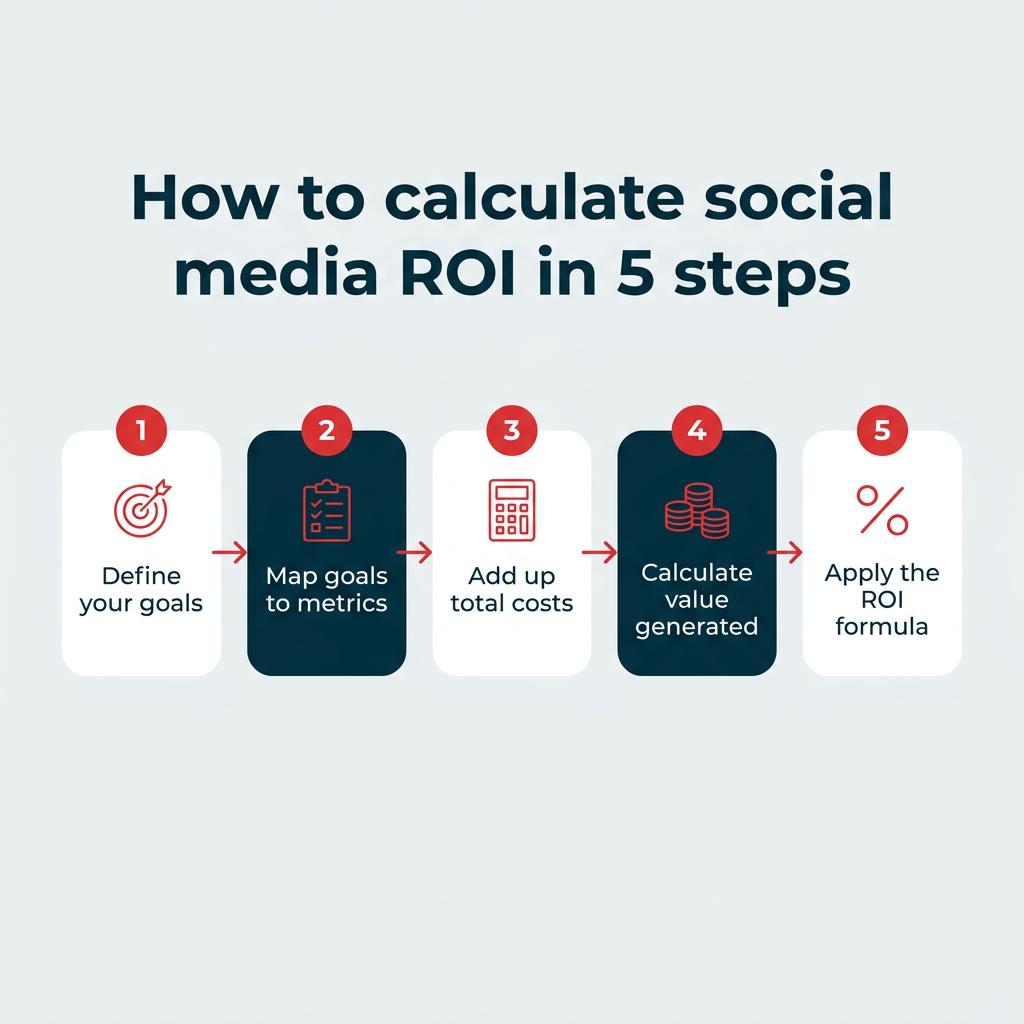
The process of calculating social media ROI can be broken down into five key steps:

-
Defining Crystal-Clear Objectives: Before any measurement begins, organizations must establish what social media is intended to achieve. ROI metrics vary dramatically depending on whether the primary focus is sales, lead generation, brand awareness, or customer experience. While overarching business goals are important, setting specific, measurable campaign-level objectives provides clearer benchmarks. For instance, goals might include increasing website traffic by 15% through Instagram, generating 50 qualified leads from LinkedIn, or boosting brand mentions by 20% on X (formerly Twitter). As Eileen Kwok, former Social & Influencer Marketing Strategist at Hootsuite, emphasizes, "The goals you have set at the start of the year could have already changed. Depending on the shifts your organization is making, or the changing social landscape, make sure you are revisiting your goals every quarter to see if any updates need to be made." Regular re-evaluation ensures alignment with evolving business priorities.
-
Aligning Goals with Measurable Metrics: Once goals are defined, the next step involves selecting the most pertinent social media metrics that directly demonstrate progress toward those objectives. Not all metrics are equally relevant for every goal. For a brand awareness campaign, metrics such as impressions, reach, and follower growth rate are paramount. For engagement and consideration, focus shifts to engagement rate, click-through rate (CTR), shares, and comments. When the objective is direct conversion and revenue, critical metrics include actual conversions, revenue directly attributed to social media, cost per lead (CPL), cost per acquisition (CPA), and return on ad spend (ROAS).
-
Comprehensive Cost Aggregation: This step demands a meticulous accounting of all resources—time, money, and personnel—invested in social media activities over a specified period. This includes, but is not limited to:
- Social media tools and software: Subscription fees for management platforms, analytics tools, design software.
- Paid social media advertising spend: Budget allocated for promoted posts, targeted ads, influencer campaigns.
- Personnel costs: Salaries or hourly wages for social media managers, content creators, community managers, and strategists.
- Content creation expenses: Costs associated with graphic design, video production, copywriting, and photography.
- Agency fees: If external agencies manage social media efforts.
- Training and development: Costs for upskilling teams in new platforms or strategies.
- Contest and promotion costs: Prizes, platform fees for running campaigns.
A granular approach here ensures that the "costs" component of the ROI formula is as accurate and inclusive as possible.
-
Valuing Monetary and Non-Monetary Returns: This is where the generated value is quantified.
- Monetary Value: This includes direct sales generated through social commerce links, lead conversions resulting in new customers, email list sign-ups, app downloads, and subscriptions directly attributable to social media campaigns.
- Non-Monetary Value: This encompasses brand awareness (measured by reach, impressions, mentions), brand sentiment (positive mentions, reviews), customer loyalty (repeat purchases influenced by social interactions), and improved customer service (reduced support costs due to social care). To integrate non-monetary outcomes into the ROI formula, a dollar value must be assigned. A common strategy is to use customer lifetime value (CLV) for new followers or to estimate a value per lead, click, or engagement based on historical conversion data and average transaction values. While imperfect, these estimations provide a tangible number for executive review.
-
Applying the Formula and Interpreting Results: With total value and total costs established, the final step is to apply the ROI formula. The result, typically expressed as a percentage, indicates the return on investment. A positive ROI signifies that social media efforts are generating more value than they cost, validating the investment. Conversely, a negative ROI signals that expenditure exceeds value generated, necessitating a strategic reassessment and adjustment of tactics to improve efficiency and impact.
Key Performance Indicators Across the Customer Journey
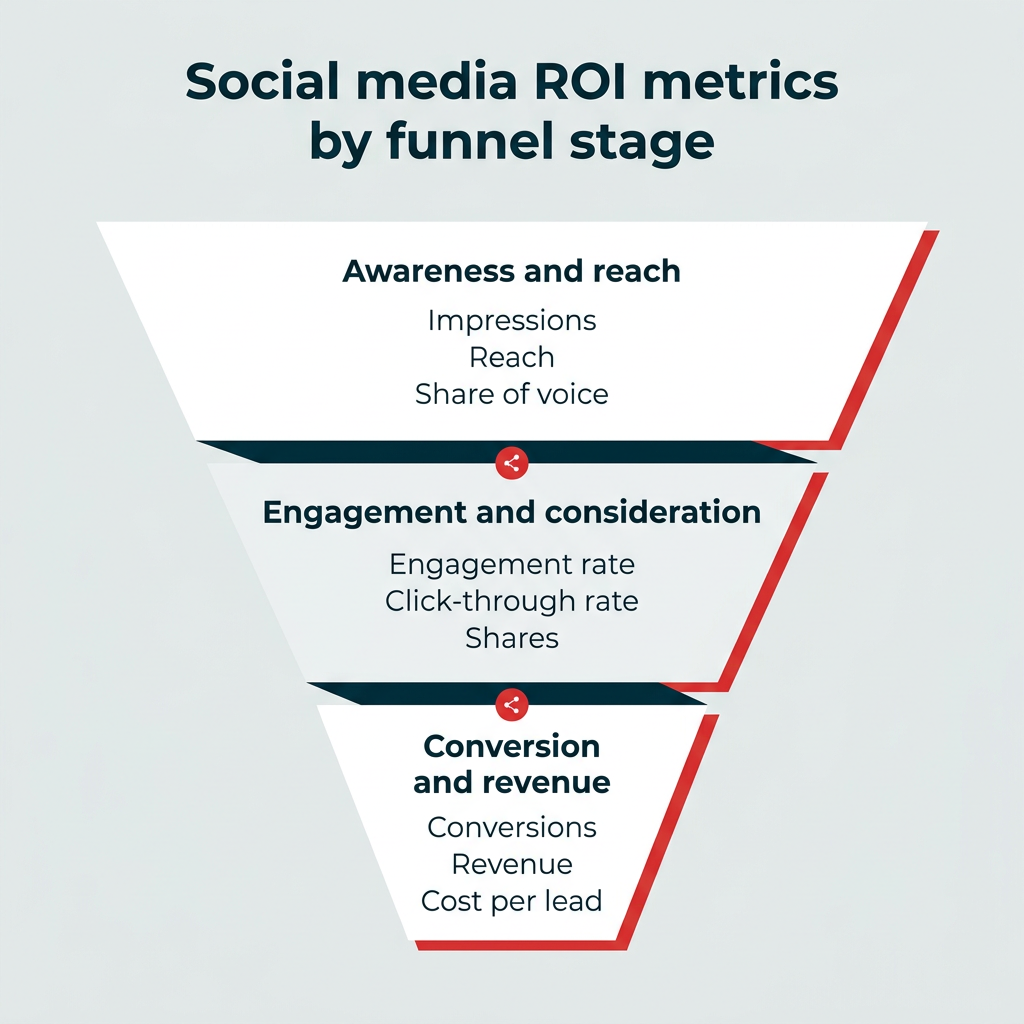
Effective ROI measurement hinges on tracking the right metrics at each stage of the customer funnel. Rather than tracking an exhaustive list, focus should be placed on KPIs that directly align with specific goals and contribute to demonstrable business outcomes.
-
Awareness and Reach: Expanding Brand Footprint: At the top of the funnel, awareness metrics gauge how effectively a brand is extending its visibility. Key indicators include:
- Impressions: The total number of times content was displayed.
- Reach: The unique number of users who saw the content.
- Brand Mentions: The frequency with which the brand is discussed.
- Share of Voice: The brand’s proportion of conversations within its industry.
- Follower Growth Rate: The speed at which the audience base is expanding. These metrics are crucial for establishing market presence and generating initial interest that can translate into conversions down the line.
-
Engagement and Consideration: Fostering Audience Connection: Mid-funnel metrics reveal how deeply content resonates with the audience, indicating their level of interest and potential for future action. Relevant KPIs include:
- Engagement Rate: The percentage of the audience that interacts with content.
- Click-Through Rate (CTR): The percentage of users who click on a link.
- Saves and Shares: Indicators of content utility and virality.
- Comments: Reflecting audience interaction and sentiment.
- Video Views: Measuring consumption of video content. Strong engagement signals that content is perceived as valuable, acting as a leading indicator for eventual conversions and deeper customer relationships.
-
Conversion and Revenue: Driving the Bottom Line: At the bottom of the funnel, conversion metrics provide concrete evidence of social media’s direct impact on financial objectives. These are the numbers that resonate most strongly with executives:
- Conversions: The number of desired actions completed (e.g., purchases, sign-ups).
- Revenue Attributed to Social: Direct income generated via social channels.
- Cost Per Lead (CPL): The cost incurred to acquire a single lead.
- Cost Per Acquisition (CPA): The cost to acquire a paying customer.
- Return on Ad Spend (ROAS): Revenue generated per dollar spent on social ads. These metrics directly link social media activities to tangible financial returns.
Real-World Applications: Illustrative Case Studies
To contextualize the ROI calculation, consider how different business models apply the framework:
-
E-commerce Sector: An online fashion retailer launches a social media campaign to promote a new collection. Their investment includes $5,000 in ad spend, $2,000 for content creation, and $1,000 in staff time. The campaign generates $20,000 in direct sales attributed via UTM links and results in 500 new newsletter subscribers, valued at $10 each (based on CLV).
- Total Value: $20,000 (sales) + (500 subscribers * $10) = $25,000
- Total Costs: $5,000 + $2,000 + $1,000 = $8,000
- ROI: (($25,000 – $8,000) / $8,000) * 100 = 212.5%. This indicates a robust return, generating over double the invested resources.
-
B2B Lead Generation: A B2B software company focuses on generating qualified leads through LinkedIn. Their investment includes $3,000 in sponsored content, $1,500 for a social media specialist’s time, and $500 for a lead magnet. The campaign yields 100 marketing qualified leads (MQLs), each estimated to be worth $200 (based on historical conversion rates and average deal size).
- Total Value: 100 MQLs * $200 = $20,000
- Total Costs: $3,000 + $1,500 + $500 = $5,000
- ROI: (($20,000 – $5,000) / $5,000) * 100 = 300%. This demonstrates a highly effective lead generation strategy via social media.
-
Brand Awareness Initiatives: A non-profit organization runs a quarter-long campaign to increase public awareness for a cause. Their investment is $4,000 in outreach and content. While direct sales aren’t the goal, they gain 1,000 new social media followers and increase website traffic by 10,000 visitors. Based on previous donor data, a new follower is estimated to contribute $5 in long-term engagement/donations (proxy for CLV), and each website visitor from social is valued at $0.50.
- Total Value: (1,000 followers $5) + (10,000 visitors $0.50) = $5,000 + $5,000 = $10,000
- Total Costs: $4,000
- ROI: (($10,000 – $4,000) / $4,000) * 100 = 150%. This example illustrates how to quantify ROI even when immediate revenue is not the primary objective, by assigning proxy values to brand-building activities.
Benchmarking Success: What Constitutes "Good" ROI?
The definition of a "good" social media ROI is not universal; it is highly contextual, dependent on industry, specific campaign goals, and whether the focus is on paid or organic efforts. Any positive ROI technically means the investment generated more value than it cost, but true success is measured against more nuanced benchmarks.
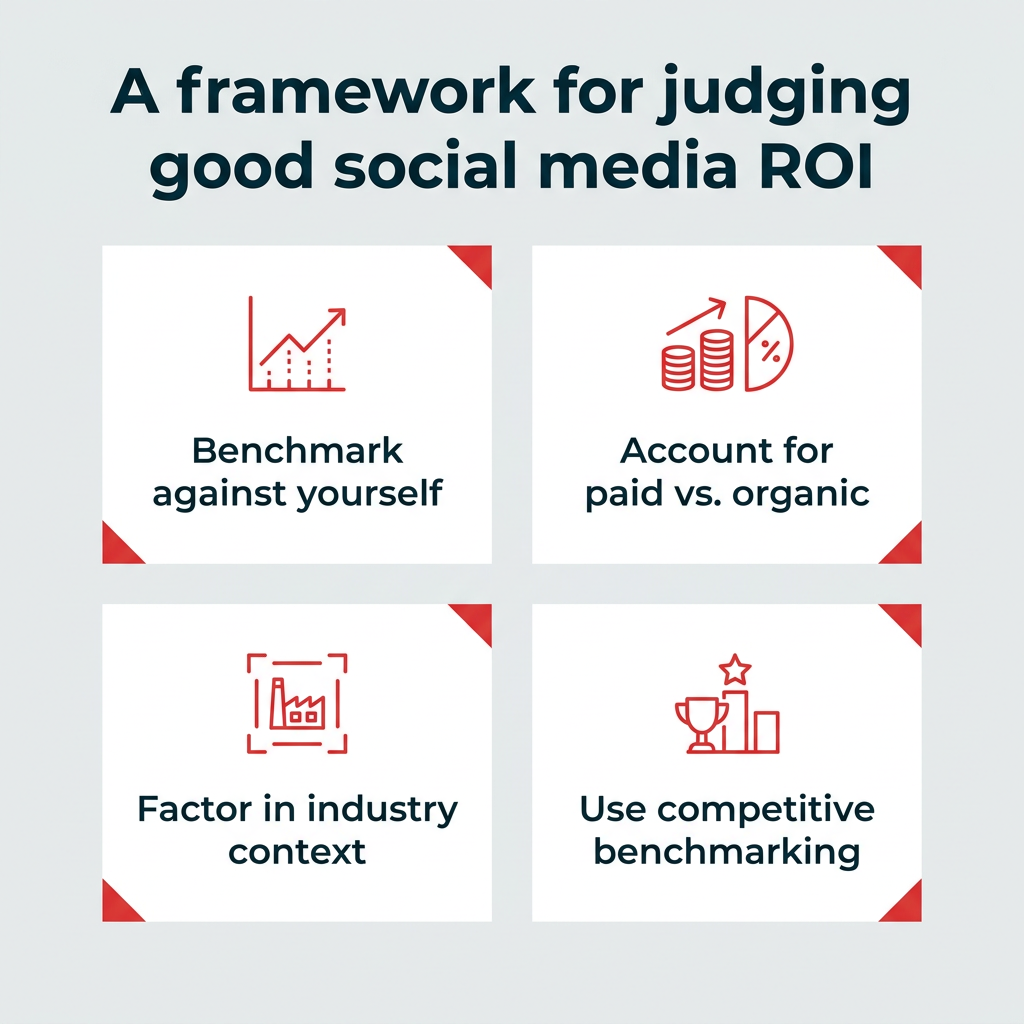
A useful framework for evaluating social media ROI involves several considerations:
- Internal Benchmarking: Comparing current performance against past campaigns provides a critical baseline. Is ROI improving over time? Are new strategies yielding better returns than previous ones?
- Competitive Analysis: How does your ROI stack up against direct competitors within your niche? Outperforming peers often indicates a competitive advantage in social media strategy.
- Industry Averages: While broad, industry-specific benchmarks (e.g., e-commerce vs. B2B software) can offer a general sense of where your performance lies.
- Goal Alignment: A "good" ROI is ultimately one that successfully achieves or surpasses predefined business objectives, whether that’s sales growth, lead generation targets, or brand awareness metrics.
- Paid vs. Organic ROI: It’s crucial to differentiate. Paid social media often has a more direct and measurable ROI due to explicit conversion tracking, while organic ROI frequently relies on more sophisticated attribution models and proxy metrics for intangible benefits. Generally, paid efforts are expected to yield higher, more immediate returns, while organic builds long-term brand equity.
The ultimate measure of success is a positive, consistently improving ROI that not only meets but ideally exceeds both internal goals and industry benchmarks, signaling effective resource allocation and strategic prowess.
Optimizing for Impact: Strategies to Enhance Social Media Returns

Improving social media ROI is an ongoing process of experimentation, rigorous tracking, and continuous refinement. Several key strategies can significantly enhance the effectiveness of social media investments.
-
The Critical Role of A/B Testing and Experimentation: Social media platforms are dynamic, with algorithms and user behaviors constantly evolving. Continuous testing is paramount. Running A/B tests on content variables—such as different topics, visual formats (e.g., static images vs. video vs. carousels), call-to-action phrasing, and optimal posting times—allows marketers to identify what resonates most effectively with their target audience. For example, Hootsuite’s own experiments revealed that Instagram carousels sometimes outperformed Reels in engagement and reach, challenging assumptions about "trendy" formats. This data-driven approach allows for scaling successful content and ad strategies, directly boosting ROI.
-
Competitive Intelligence and Industry Insights: Monitoring competitor strategies provides invaluable insights. While public social profiles offer a basic view, advanced analytics tools, such as Hootsuite Analytics, enable deeper competitive benchmarking. These tools allow businesses to track competitor performance across channels, identify their top-performing content, trending hashtags, and preferred content styles. By understanding what drives success for competitors, organizations can adapt and refine their own strategies, pinpointing areas for improvement and capitalizing on market opportunities.
-
Leveraging UTM Parameters for Granular Tracking: Urchin Tracking Module (UTM) parameters are essential for precise ROI measurement. These tags appended to URLs allow marketers to track the exact source, medium, and campaign that drove traffic to a specific landing page or conversion point. For instance, a unique UTM link on a LinkedIn post directing users to an online store enables granular tracking of how many users clicked through, engaged, and ultimately made a purchase. This direct link between social media activity and conversions is fundamental for accurate ROI calculation.
-
Capitalizing on the Social Commerce Revolution: Social commerce represents one of the most direct avenues for driving revenue from social media. With projections nearing a trillion dollars, shoppable posts, product tags, and in-app checkout functionalities transform engagement directly into sales, often without users ever leaving the platform. Measuring social commerce ROI involves tracking in-app purchases, product tag clicks, and checkout completions through the respective platform’s commerce tools. The integrated nature of social commerce offers a closed-loop measurement system, providing cleaner attribution than many other social media activities.
-
Prioritizing High-Performing Content Formats: Not all content formats yield equal returns. Analyzing performance data is crucial to identify which formats—be it short-form video, carousels, or static images—drive the best results on each platform. Doubling down on proven winners ensures that content creation efforts are optimized for maximum impact and higher ROI. This data-guided approach prevents wasted resources on underperforming content.
-
Precision in Audience Targeting: For paid social media campaigns, refined audience targeting is paramount for maximizing ROI. Leveraging retargeting campaigns to re-engage users who have previously interacted with the brand, building lookalike audiences based on existing high-value customers, and utilizing social data to narrow targeting parameters significantly improves return on ad spend (ROAS). The more precisely an audience is targeted, the less budget is wasted on irrelevant impressions, leading to higher conversion rates and a more favorable ROI.
Technological Integration: Unifying Data for Actionable Insights
The fragmented nature of social media data across multiple platforms presents a significant hurdle to accurate ROI measurement. The most effective approach involves integrating various data sources through a centralized social media analytics platform. This typically combines native platform analytics, web analytics tools like Google Analytics, and CRM data to paint a comprehensive picture.
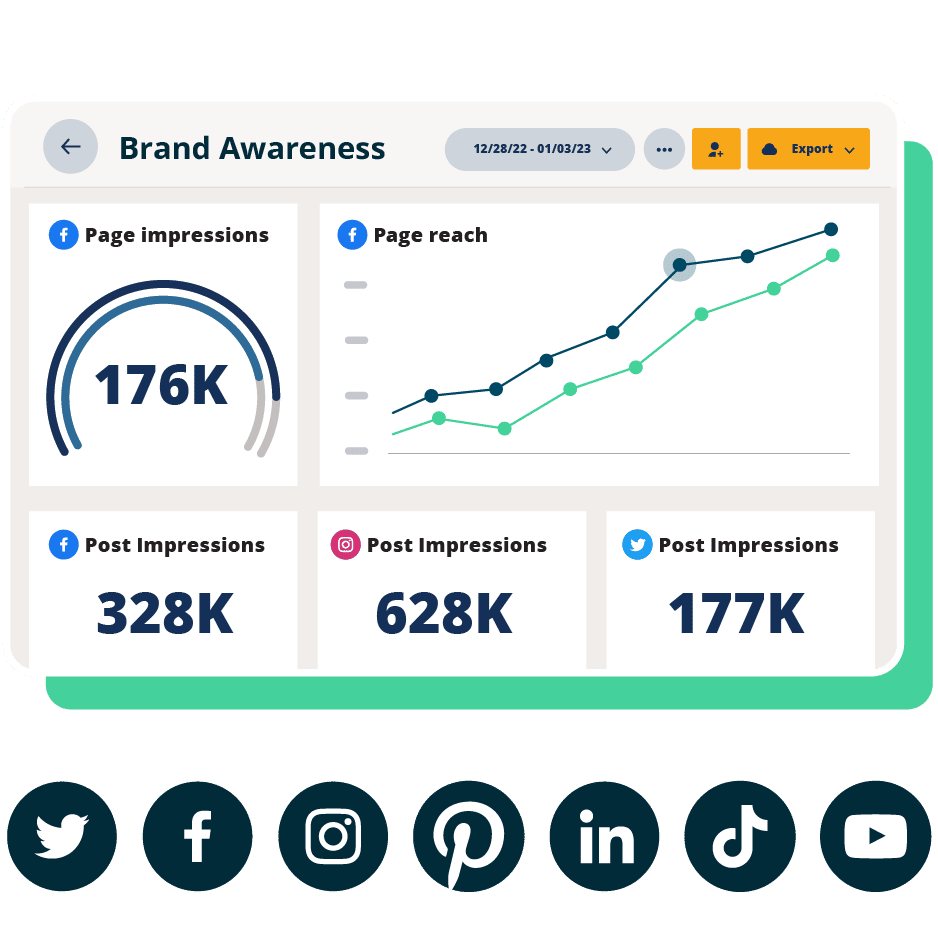
Platforms like Hootsuite Analytics are designed to address these data silos, consolidating social media performance metrics into a single, unified dashboard. This centralization allows marketers to connect social activity directly to business outcomes without the laborious process of juggling multiple dashboards. Hootsuite’s Advanced Analytics capabilities, for instance, enable users to track sales, sign-ups, and conversions directly from specific posts, facilitating a direct correlation between content strategy and financial results. This unified view not only highlights top-performing activities but also identifies areas requiring strategic adjustment.

Beyond internal performance, Hootsuite offers robust competitive analysis, allowing enterprise and advanced plan users to monitor up to 20 competitors per social network. This feature provides insights into competitors’ most engaging posts, trending hashtags, and content styles, offering strategic intelligence to refine one’s own approach. Furthermore, industry benchmarking capabilities enable brands to compare their profile impressions, reach, followers, and engagement rates against industry averages, revealing competitive standing and identifying growth opportunities.
Crucially, modern social media analytics platforms integrate with broader business intelligence tools. Hootsuite’s compatibility with Google Analytics and Adobe Analytics allows organizations to transcend purely social metrics, connecting social media efforts to overall website conversions, lead generation, and ultimately, the bottom line. These integrations, combined with link tracking and real-time analytics, empower marketers to attribute web conversions directly back to specific social activities and respond to emerging trends dynamically, rather than waiting for end-of-month reports.
Executive Communication: Translating Social Performance into Business Language
Effectively reporting social media ROI to executive stakeholders is not merely about presenting numbers; it’s about communicating value in a language that resonates with business objectives. A polished, concise, and outcome-oriented report is essential for demonstrating social media’s impact and securing continued budget allocation.
Key best practices for executive reporting include:

- Tailoring the Message: Customize reports to align with the specific priorities of the audience. Executives are typically concerned with revenue, growth, market share, and cost efficiency.
- Focusing on Business Outcomes: Connect every metric back to how it contributes to the organization’s overarching strategic goals. Instead of just "engagement rate," discuss how higher engagement led to increased website traffic and subsequent conversions.
- Clarity and Conciseness: Present data clearly, using visuals like charts and graphs. Avoid jargon and extraneous detail, focusing on key takeaways and actionable insights.
- Highlighting Trends Over Time: Show performance trends over quarters or years to illustrate sustained impact and growth, demonstrating the long-term value of social investments.
- Providing Context and Analysis: Explain why certain metrics are significant and what implications they have for future strategy.
- Recommending Next Steps: Conclude with clear, data-backed recommendations for optimizing future campaigns or reallocating resources. This demonstrates strategic thinking and accountability.
- Quantifying Non-Monetary Value: Even for brand awareness campaigns, present estimated monetary values for brand equity gains to provide a complete picture of ROI.
As Eileen Kwok rightly points out, "You don’t know what your ROI is until you’ve laid out the goals you are tracking towards." This underscores the foundational importance of clear objective setting before any reporting can be truly meaningful.
Conclusion: The Future of Social Media Accountability
The journey from initial social media adoption to sophisticated ROI measurement reflects the broader evolution of digital marketing. Social media is no longer an optional add-on but a fundamental component of a comprehensive business strategy. Enterprise organizations, in particular, must move beyond rudimentary metrics, embracing advanced analytics and attribution models to link social activity directly to revenue, lead generation, and demonstrable cost savings across multi-brand and multi-region campaigns.
The metrics that truly signify business impact are those tied to tangible outcomes: revenue influenced by social, qualified leads generated, conversion rates, and improvements in customer retention. Leading brands achieve this by integrating tracking tools, implementing clear attribution models, and fostering data sharing across diverse teams. This integrated approach, layering multi-touch attribution with CRM data, provides a granular view of social media’s critical role throughout the entire customer journey, from initial awareness to final conversion.
The landscape of social media ROI is dynamic, with the highest-performing platforms varying by industry and audience. While short-form video platforms like TikTok and Instagram Reels have consistently shown high engagement and conversion rates in recent years, the ultimate determinant of ROI for any business is its own analytics, revealing where its specific audience actively