The modern Honda Passport stands as a testament to the brand’s ability to pivot its identity in the competitive crossover utility vehicle (CUV) segment. While Honda’s reputation has been built largely on the efficiency of the Civic and the versatility of the CR-V, the Passport has carved out a unique space for itself as a rugged, adventure-oriented vehicle. Today’s iteration, particularly in the TrailSport trim, offers a sophisticated balance of off-road capability and on-road refinement. However, the history of this nameplate is far more complex than a simple product launch, tracing back to a transformative era in the 1990s when Honda navigated the burgeoning American SUV market through a strategic, albeit temporary, partnership with Isuzu.
A Historical Retrospective: The 1990s SUV Boom
To understand the trajectory of the Honda Passport, one must examine the automotive landscape of the early 1990s. As consumer preferences shifted away from traditional sedans and station wagons toward the perceived security and utility of sport utility vehicles, manufacturers scrambled to expand their portfolios. Ford had found massive success with the Explorer, and Toyota was cementing its reputation with the 4Runner. Honda, meanwhile, found itself in a precarious position; its lineup was highly efficient and globally respected, yet it lacked a credible entry in the rapidly expanding SUV segment.
The development cycle for a clean-sheet SUV platform in the early 1990s was a multi-year, capital-intensive endeavor. Recognizing that it could not wait for internal development to catch up to market demand, Honda entered into a reciprocal agreement with Isuzu, a manufacturer that had already established a strong reputation for rugged, body-on-frame vehicle construction.
The Isuzu Connection: The Birth of the Original Passport
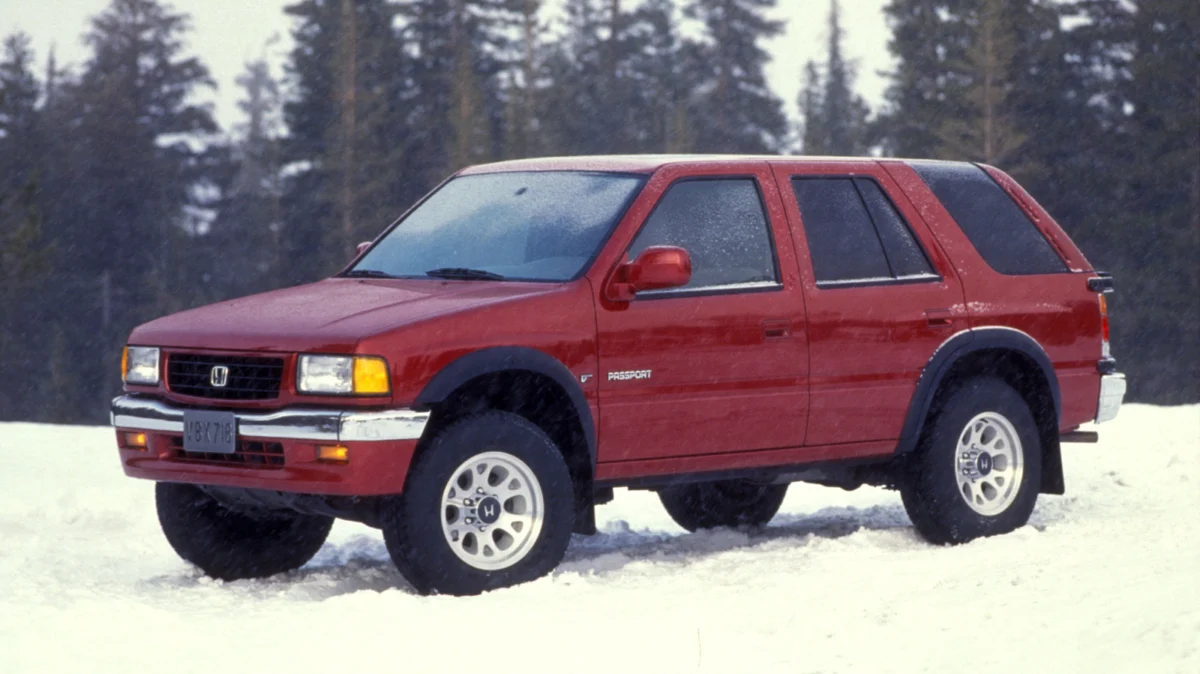
The original Honda Passport, which debuted for the 1994 model year, was effectively a rebadged Isuzu Rodeo. This move allowed Honda to enter the market with minimal overhead. The Rodeo was a proven platform, featuring a robust ladder-frame chassis, a two-speed transfer case in 4WD configurations, and a suspension geometry designed for light-to-moderate trail use.
From 1994 to 2002, the Passport served as the stopgap that allowed Honda to keep its dealership network competitive while it developed its own dedicated SUV architecture. The arrangement was multifaceted: Isuzu provided the Rodeo (Passport) and the Trooper (sold as the Acura SLX), while Honda supplied the Odyssey minivan to Isuzu, which was sold in the United States as the Isuzu Oasis. This "badge-engineering" period was common in the 1990s, allowing manufacturers to fill gaps in their lineups without the risk of developing proprietary technology for segments where they had little experience.
However, by the early 2000s, the limitations of this strategy became apparent. As Honda’s internal engineering capabilities matured, the company shifted toward unibody platforms that prioritized passenger comfort and handling—hallmarks of the Honda driving experience. The partnership with Isuzu concluded in 2002, marking the end of the first generation of the Passport and signaling the start of a new, independent chapter for Honda’s SUV division.
The Transition to Independence: The Pilot and the Hiatus
Following the discontinuation of the Isuzu-based Passport, Honda introduced the Pilot. Based on the same unibody platform as the Odyssey minivan, the Pilot offered three rows of seating and a level of on-road comfort that the old-school, truck-based Passport could not match. The market responded overwhelmingly in favor of this new direction. The Pilot became a staple of the American family, and the Passport nameplate was retired to the archives for over 15 years.
During this period, the automotive industry underwent a paradigm shift. The "truck-based SUV" model began to decline in favor of "crossover" architectures. Consumers realized that for 95% of their driving, the independent rear suspension and lighter, more rigid unibody chassis of a crossover were superior to the heavy, cumbersome frames of traditional 4x4s. Honda leveraged this shift, refining its i-VTM4 all-wheel-drive system to provide advanced torque vectoring, which allowed its vehicles to handle loose terrain without needing the low-range gearing of a dedicated off-roader.
The 2019 Revival: A Modern Approach to Utility
In 2019, Honda reintroduced the Passport as a two-row, five-passenger SUV positioned between the CR-V and the Pilot. This was not a return to the truck-based roots of the 1990s, but rather a reimagining of the Passport as a lifestyle-focused vehicle. By utilizing the Pilot’s platform but shortening the wheelbase and removing the third row, Honda created a vehicle that was more agile, more spacious for cargo, and more capable than its smaller siblings.
The revival was not merely an aesthetic choice; it was a response to the "overlanding" and "weekend warrior" trends that began to dominate the North American automotive market. Data from the Automotive Research Council suggests that consumer interest in "adventure-ready" vehicles with factory-installed off-road equipment has increased by over 40% since 2015. Honda’s decision to launch the TrailSport trim was a direct answer to this demand.
Analyzing the TrailSport Philosophy
The TrailSport trim level represents a significant milestone in Honda’s product strategy. Unlike competitors that focus on extreme rock-crawling capabilities—often at the expense of highway fuel efficiency and noise, vibration, and harshness (NVH) levels—the TrailSport focuses on "attainable capability."
Key specifications of the current Passport TrailSport include:
- Powertrain: A naturally aspirated 3.5-liter V6 engine, providing 280 horsepower and 262 lb-ft of torque.
- Drivetrain: The i-VTM4 intelligent torque-vectoring all-wheel-drive system, capable of sending up to 70% of torque to the rear wheels and 100% of that torque to either the left or right wheel.
- Chassis Tuning: Retuned suspension with increased spring rates and dampers tuned for unpaved surfaces.
- Utility: Standard all-terrain tires and enhanced underbody protection.
From an engineering perspective, this configuration allows the Passport to outperform many traditional SUVs on gravel, mud, and snow, while maintaining the refined ride quality that Honda owners expect. Market analysts have noted that by eschewing body-on-frame construction, Honda has successfully targeted a demographic that wants the aesthetic and functional capability of an off-roader without the compromises associated with a true 4×4.
Broader Implications and Future Outlook
The trajectory of the Honda Passport offers a compelling case study on brand positioning. By moving away from the dependency on Isuzu and reclaiming the Passport nameplate for a proprietary, unibody design, Honda has effectively demonstrated that "capability" is not synonymous with "truck frame."
Industry experts observe that Honda’s current strategy is to lean heavily into the versatility of its existing platforms. By applying the TrailSport treatment across the lineup—including the Pilot and the Ridgeline pickup—Honda is insulating itself against the need to build a dedicated, heavy-duty 4×4 platform. This is a fiscally disciplined approach that maximizes returns on research and development while meeting the actual needs of the vast majority of SUV buyers.
Furthermore, the longevity of the Passport nameplate itself has become a brand asset. Despite the 15-year hiatus, the name still resonates with buyers who remember the original as a reliable, utilitarian vehicle. By tethering this nostalgia to a modern, technologically advanced platform, Honda has bridged the gap between its historical identity and its future ambitions.
Conclusion
The evolution of the Honda Passport from a rebadged Isuzu Rodeo to a sophisticated, trail-ready crossover encapsulates the history of the modern automotive industry. It reflects a transition from an era of necessity-driven partnerships to an era of specialized, platform-based engineering. As Honda continues to refine the Passport and expand the TrailSport sub-brand, it remains clear that the company is committed to its core philosophy: providing durable, capable, and refined vehicles that adapt to the changing requirements of the consumer. Whether on a paved commute or a weekend trail, the modern Passport serves as a definitive example of how Honda continues to punch above its weight in a crowded and highly competitive market.