The rapid evolution of search behavior has triggered a structural shift in digital marketing, moving traditional Search Engine Optimization (SEO) toward Answer Engine Optimization (AEO). As consumers increasingly rely on conversational artificial intelligence platforms such as ChatGPT, Perplexity, Google Gemini, Anthropic’s Claude, and Microsoft Copilot to find information, brands face a new imperative: optimizing their visibility within AI-generated responses. In this emerging category, two platforms have risen to the forefront of industry comparisons: Profound and Peec AI. Meanwhile, established ecosystem players like HubSpot have introduced integrated alternatives, complicating software selection for marketing and growth teams.
This analysis provides a comprehensive, head-to-head evaluation of Profound, Peec AI, and HubSpot AEO across critical operational criteria, including data methodology, engine coverage, analytics depth, enterprise security, pricing models, and post-analysis execution workflows.
Understanding the AEO Category Landscape
The emergence of Answer Engine Optimization stems from a fundamental change in how users consume information online. Rather than receiving a list of blue links, modern searchers are presented with synthesized, direct answers generated by large language models (LLMs). These models pull data from a select group of sources, often rendering traditional ranking metrics insufficient.
Consequently, specialized AEO software vendors have emerged to track brand sentiment, share of voice, citation frequencies, and average positioning within AI outputs. However, the technical approaches to capturing this data vary wildly between platforms. Some vendors query public model APIs, while others deploy browser automation or server-side crawler analytics to log real-time consumer interactions. Choosing the right tool requires aligning a organization’s technical maturity, data security requirements, and existing technology stack with the specific strengths of each platform.
Platform Profiles: Built for Distinct Operational Needs
While all three leading solutions monitor answer-engine visibility, each platform is architected to serve a fundamentally different user base and organizational workflow.

Profound: Enterprise-Grade Infrastructure and Execution
Positioned at the highest tier of the market, Profound functions as a comprehensive read-and-write system rather than a passive reporting dashboard. The platform’s enterprise focus is underscored by significant financial backing, highlighted by a $180 million Series D funding round in September 2026 that valued the company at $1.8 billion, following a $96 million Series C earlier that year.
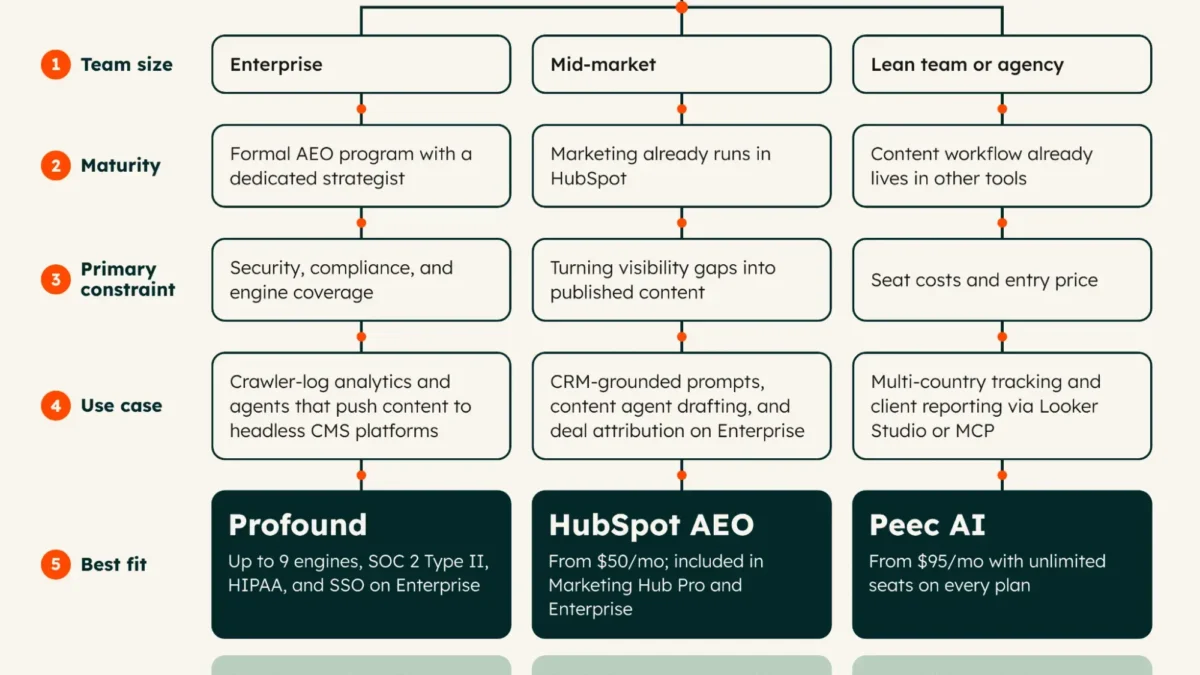
Profound targets enterprise growth teams, dedicated AEO strategists, public relations leads, and large marketing agencies. Its workflow depth is extensive, featuring server-side bot-crawl tracking, consumer prompt-demand research, and support for up to nine distinct search engines on its top-tier plans. Furthermore, Profound incorporates drag-and-drop autonomous agents capable of connecting directly to enterprise Content Management Systems (CMS) such as headless infrastructures. Given its log-level crawler data and stringent compliance protocols—including SOC 2 Type II, HIPAA, and SAML/OIDC Single Sign-On—Profound is built for mature organizations managing complex, regulated digital portfolios.
Peec AI: Lean Analytics for Mid-Market Teams
In contrast to Profound’s enterprise-heavy architecture, Peec AI offers a streamlined, analytics-focused solution tailored for lean marketing teams, content managers, and growth agencies. Backed by a $21 million Series A funding round secured in November 2025, Peec AI emphasizes multi-country visibility tracking without imposing per-seat pricing penalties.
The platform centers on measurement and diagnostics. Users select target engines, tag prompts by customer funnel stage or audience persona, and analyze visibility trends through clean reporting dashboards. When the platform flags content gaps, users can utilize a built-in editor to draft passage-level revisions. However, Peec AI functions primarily as a reporting and optimization layer rather than a publishing engine; finalized drafts must be exported manually to an external CMS.
HubSpot AEO: CRM-Connected Execution
HubSpot approaches the category by bridging the gap between visibility measurement and customer relationship management (CRM). Available either as a standalone tool or integrated directly into Marketing Hub Professional and Enterprise tiers, HubSpot AEO tracks a core set of three answer engines: ChatGPT, Perplexity, and Gemini.

What distinguishes HubSpot AEO from standalone measurement tools is its contextual integration. By linking AI visibility data with the HubSpot Smart CRM, the platform grounds prompt suggestions in actual contact lists, deal pipelines, and target market segments. Furthermore, marketers can act on identified gaps immediately using built-in content generation agents to draft, review, and publish optimized content within the same system.
Data Coverage and Collection Methodology
A critical consideration for digital strategists is how different AEO platforms acquire their underlying data, as methodologies dictate the accuracy and freshness of visibility scores.
Profound adopts an active measurement strategy by querying live, consumer-facing answer engines directly rather than relying solely on static model APIs. This captures real-time browsing behaviors that standard APIs often miss. Additionally, Profound utilizes "Agent Analytics," which are server-side trackers installed at the CDN or hosting level (such as Cloudflare, Vercel, AWS, and Fastly). These trackers log AI crawler user-agents and cross-check visitor Internet Protocol (IP) addresses against published crawler ranges to filter out spoofed traffic. A licensed consumer-panel dataset then models estimated AI search volumes and user intent.
Peec AI employs a distinct methodology by deliberately avoiding APIs. Instead, the platform runs browser automation against each engine’s live web interface as a logged-out user, operating on the premise that API responses are frequently sanitized and diverge from standard consumer experiences. Crawler activity is similarly captured via CDN integrations or raw log uploads. While Peec AI permits modular engine selection and queries models from localized IPs every 24 hours, multi-country tracking is restricted based on subscription tiers, whereas language support remains unlimited across all plans.
HubSpot AEO mirrors traditional direct-query frameworks by executing a fixed set of prompts daily from country-specific IPs tailored to a brand’s specific geographic target markets. It logs exact daily answers and specific citation URLs, providing verifiable transparency without modeled estimates.
Security, Compliance, and Enterprise Integration
As data privacy regulations tighten globally, technical integrations and security protocols dictate how safely an AEO tool can be deployed across corporate environments.

Enterprise-tier solutions must provide robust programmatic access via REST APIs, reliable BI connectors (such as Looker Studio or Snowflake integrations), and strict compliance certifications. Profound satisfies these demands through comprehensive API access, enterprise security frameworks, and log-level tracking capabilities designed for large-scale operations. Peec AI offers flexible data streaming options, including Looker Studio connectors and Model Context Protocol (MCP) servers, though advanced API capabilities and SSO are reserved for its highest pricing tiers.
Conversely, HubSpot leverages its established infrastructure to offer enterprise-grade security features, including SAML-based SSO, SOC 2 Type II compliance reports, and GDPR-compliant data management tools designed to handle user consent and record erasure seamlessly.
Pricing Structures and Market Positioning
The financial commitment required for AEO tools varies significantly depending on scale, seat allocation, and geographic requirements.
- Profound operates primarily on custom enterprise pricing models determined after an initial evaluation period, with agency billing structured around individual client workspaces. Advanced features, ongoing tracking, and API access require formal enterprise agreements.
- Peec AI scales its pricing based on prompt volume and geographic deployment, charging modular add-on fees for supplemental engines beyond the base offering. Notably, Peec AI permits unlimited user seats across all plans, making it attractive for multi-stakeholder agency environments.
- HubSpot AEO provides accessible entry points starting at modular price points for standalone measurement, while comprehensive CRM-integrated capabilities and automated publishing workflows are included within Marketing Hub Professional and Enterprise subscriptions.
Strategic Implications and Industry Outlook
The rapid valuation growth of leading AEO startups signals that brand visibility in generative AI is no longer an experimental marketing tactic, but a core component of digital acquisition strategies. As search engines continue to evolve into conversational answer engines, organizations must evaluate whether their chosen tooling merely reports on visibility losses or actively facilitates remediation.
For security-conscious enterprises requiring deep log-level crawler analytics and multi-engine tracking, platforms like Profound provide the necessary technical depth. For agencies and mid-market teams prioritizing collaborative access and multi-country reporting without per-seat overhead, Peec AI offers a flexible alternative. Meanwhile, organizations embedded within established ecosystems seeking to connect AI visibility metrics directly to closed-loop revenue attribution and content publishing workflows will find integrated solutions like HubSpot AEO uniquely suited to operational efficiency.
Ultimately, selecting an AEO platform requires a rigorous assessment of internal resource constraints, technical infrastructure, and the overarching imperative to translate generative AI visibility into measurable business pipeline.