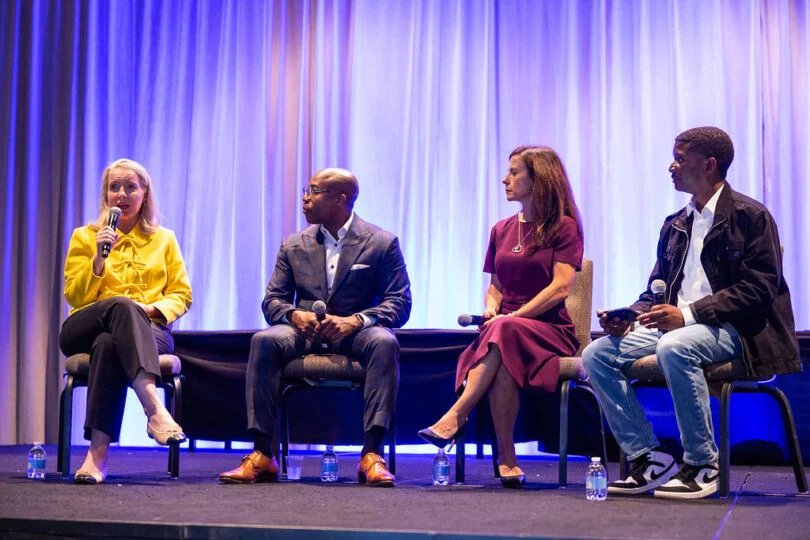
The communications landscape is undergoing a profound transformation, driven by the convergence of rapid technological advancement, shifting cultural expectations, and an increasingly complex global business environment. As organizations grapple with these volatile forces, the role of the communications leader has expanded from a traditional narrative-shaping function to a core strategic pillar of business operations. At PRSA ICON 2026 in Orlando, Florida, industry veterans gathered to dissect this transition, moving beyond buzzwords to establish a roadmap for the next chapter of the profession.
The session, titled 2026 Communications Trends: What’s Now, What’s Next, What’s Over?, featured a panel of elite practitioners: Erica Ettori, SVP of corporate communications at Universal; Damon Jones, chief communications officer at Procter & Gamble; and Hannah Vazzana, chief brand & communications officer at Hilton Grand Vacations. Moderated by Thomas Bennett III, SVP at FleishmanHillard and Co-chair of the PRSA Black Voices Affinity Group, the discussion served as a critical pulse check for an industry at an inflection point.
The Evolution of the Communications Function: A Chronology of Change
To understand where the profession is headed, one must first look at the trajectory of the last decade. Ten years ago, the communications department was often siloed, focused primarily on media relations and corporate messaging. By 2020, the mandate began to shift toward internal culture and social responsibility, accelerated by the global pandemic and heightened political polarization.
Today, in 2026, the mandate has crystallized into something more integrated. Communications is no longer a peripheral department; it is a primary stakeholder in business strategy. The panelists emphasized that the modern communicator must possess a sophisticated grasp of profit-and-loss statements, supply chain pressures, and the geopolitical factors that influence consumer sentiment. This evolution reflects a broader trend: as reputation and brand value become increasingly intangible yet vital assets on corporate balance sheets, the C-suite has turned to communication experts to interpret external signals and mitigate risks that could derail long-term growth.
The Now: Navigating the Business Mandate and Information Fragmentation
The "Now" phase of the profession is characterized by an information environment that is more fragmented than ever before. With the rise of niche social ecosystems and the decline of traditional news gatekeepers, organizations are finding it harder to control their narratives.
Data from recent industry surveys suggests that over 70% of senior communicators now report directly to the CEO or a board-level committee, a sharp increase from the 50% reported in the early 2020s. This shift confirms the panelists’ observations: the scope of the function has broadened to include reputation management, employee engagement, and navigating the complexities of "always-on" crisis management.
The panel argued that the primary challenge today is not just the volume of information, but the speed of response. However, they cautioned against a reflex-driven approach. Speed without context is a liability. The most effective communications leaders are those who know when to weigh in and when to remain silent. According to Damon Jones, the ability to discern the difference between a fleeting social media trend and a substantive business issue is the defining competency of the modern era.
The Next: AI, Automation, and the Human Premium
As the industry looks toward the latter half of the decade, the integration of Artificial Intelligence stands as the most disruptive force. The panel’s analysis of "What’s Next" focused on a fundamental shift in the value proposition of human talent.
While AI is currently automating content drafting, sentiment analysis, and basic media monitoring, the panel suggested that these capabilities will inevitably raise the bar for entry-level professionals. If an algorithm can generate a basic press release in seconds, the premium on human skill shifts toward higher-order capabilities: strategic judgment, cultural intelligence, and the ability to build and sustain complex human relationships.
The implications for leadership development are significant. Organizations are now facing a "junior-level dilemma": how do new hires gain the foundational experience necessary to develop executive-level judgment if the tasks that traditionally taught those lessons are now performed by machines? The consensus among the panelists was that mentorship and active participation in strategy meetings—rather than just execution-focused tasks—must become the new standard for training the next generation of leaders.
The Over: Discarding Legacy Practices
A recurring theme throughout the PRSA ICON 2026 conference was the necessity of "de-adopting" outdated practices. The panel explicitly called out "communications for communications’ sake" as a relic of a bygone era.
Practitioners were encouraged to audit their current activities and ask whether specific tasks—such as long-form, unread newsletters or broad-reach press releases that lack targeted distribution—are still serving the business. In an era where data-driven results are expected, the profession must move away from vanity metrics, such as "impressions" or "mentions," toward outcomes that align with business objectives, such as employee retention rates, customer sentiment shifts, and direct impact on market capitalization.
This transition requires a culture of courage. Letting go of legacy habits that provided a sense of security is difficult, but the panel noted that those who fail to prune their operational portfolios will eventually find themselves overwhelmed by the demands of a modern, data-intensive communications strategy.
Broader Implications and Strategic Synthesis
The analysis provided by the panel underscores a broader, industry-wide shift toward professionalization and strategic integration. For organizations, the implications are clear: the communications department is a critical engine for navigating an environment defined by volatility, uncertainty, complexity, and ambiguity (VUCA).
Data collected during the lead-up to the conference indicates that organizations that integrate communications strategy into their core decision-making processes outperform their peers in market recovery during crises by an average of 15%. This statistic validates the panel’s assertion that communications is not a "soft" skill but a hard business requirement.
The path forward for practitioners involves a dual commitment: deep technical curiosity and broad business acumen. Professionals who can bridge the gap between human empathy and data-driven strategy will define the success of their organizations in the coming years.
Conclusion: Staying Ready for the Unpredictable
As the 2026 PRSA ICON event concluded, the overarching takeaway was one of resilience through adaptation. No executive on the panel claimed to have a crystal ball for the shifts that will occur in 2027 or 2028. Instead, they advocated for a posture of perpetual readiness.
The successful communications leader of the future will be defined by three traits:
- Business Literacy: A deep understanding of the economic and operational levers that drive their specific organization.
- Cultural Sensitivity: An ability to navigate the nuances of diverse stakeholder groups in a globalized, yet hyper-localized, world.
- Strategic Decisiveness: The courage to abandon ineffective legacy practices and invest in high-value, human-centric strategies that technology cannot replicate.
The communications profession is no longer merely about the delivery of messages; it is about the stewardship of institutional credibility. As the industry continues to evolve, those who remain anchored in the business while keeping their gaze firmly on the horizon will be the ones who successfully navigate the challenges of the next decade. For those currently entering the field, the mandate is clear: build your foundation, stay curious, and be prepared to reinvent your practice as the world changes around you.
As the industry looks forward, the consensus remains: technology will continue to reshape the tools, but the essence of the profession—the human connection, the strategic narrative, and the integrity of the message—will remain the ultimate source of organizational value. The conference provided a definitive roadmap for those ready to lead that charge.