
The digital marketing landscape experienced a rare and seismic shockwave when PayPal Honey, one of the most prominent consumer affiliate publishers and browser extensions in the world, was systematically removed and suspended from the United States’ two largest affiliate marketing environments: Rakuten Advertising and impact.com. Acquired by fintech giant PayPal for $4 billion six years ago, Honey’s abrupt disciplinary actions followed rigorous public investigations by digital forensics experts and investigative reports, most notably a viral exposé by digital watchdog MegaLag and a meticulous technical audit conducted by Ben Edelman. The enforcement actions underscore a growing intolerance within the partnership economy for unethical traffic acquisition, attribution hijacking, and the deliberate evasion of standardized network protocols.
The timeline of enforcement began unfolding at the start of a major industry gathering. On Monday, January 12, coinciding with the opening day of the Affiliate Summit West conference in the United States, Rakuten Advertising issued a definitive statement announcing that Honey had been terminated from its network. Rakuten explicitly framed the expulsion as a necessary measure to maintain high standards of quality and integrity across its ecosystem. Days later, on Friday, January 16, impact.com followed suit, notifying stakeholders that Honey was out of compliance with core platform policies. Consequently, impact.com implemented a temporary suspension, removing the browser extension from its Discovery Marketplace pending a comprehensive review of its tracking and attribution mechanics.
Industry executives and platform leaders were quick to identify the root cause of the punitive actions: attribution manipulation and deliberate noncompliance with established industry norms. Specifically, the controversy centers on the exploitation of "last-touch-wins" attribution models, which dictate that the final affiliate partner interacting with a consumer before a purchase receives 100% of the commission for that transaction. Investigations revealed that certain downloadable software publishers (DSPs) and browser extensions have systematically ignored or covertly circumvented "stand-down" rules. These protocols mandate that extensions must yield attribution if a consumer entered the merchant’s checkout funnel via another affiliate’s link earlier in the clickstream. By overriding existing referral cookies without adding genuine value, infringing tools effectively hijack commissions from content creators, loyalty platforms, and publishers who initiated the consumer’s journey.
The timing of Rakuten’s announcement—dropping on the exact morning thousands of affiliate marketers, network executives, and brand managers converged for the Affiliate Summit West—created an immediate PR tempest. The intersection of high-profile investigative journalism, rapid network enforcement, and public deliberation transformed the conference hallways and digital platforms into a massive forum on attribution ethics. For years, critics within the performance marketing community argued that major networks turned a blind eye to the aggressive tactics of dominant browser extensions due to the sheer volume of gross merchandise value (GMV) those entities generated. The swift actions by Rakuten and impact.com signal a potential turning point, suggesting that network operators are increasingly willing to prioritize long-term ecosystem trust over short-term transaction volume.
Examining the Fallout Through the Lens of Program Management
The expulsion of PayPal Honey serves as a compelling case study for brand-side affiliate managers and digital marketing directors. Industry veterans emphasize that merchant programs cannot afford to be passive observers when network-level violations occur. Managing an affiliate program in the wake of such a high-profile disqualification requires a strategic recalibration across several operational pillars. First, the incident highlights the adage that one bad apple can spoil an entire program. Savvy, rule-abiding affiliates—such as premium content publishers, trusted reviewers, and high-integrity loyalty sites—frequently audit the other partners housed within a merchant’s program before committing resources or promotional inventory. When a brand harbors aggressive, cookie-hijacking entities that engage in aggressive attribution overwrites, reputable partners frequently choose to sit out or deprioritize promotions, fearing their efforts will be systematically unrewarded.

Second, brand managers are being urged to take active control of program policing rather than relying entirely on network compliance departments. While affiliate networks maintain broad terms of service, their policing mechanisms primarily monitor infractions against network-wide policies rather than specific brand guardrails. Furthermore, network compliance teams have historically faced criticism for sluggish response times. Experts advise brand managers to establish crystal-clear terms and conditions within their individual program agreements, granting them the legal and contractual basis to audit traffic, pause suspicious publishers, and enforce compliance independently.
The Complexities of Downloadable Software Publishers and Attribution Audits
Understanding the intricate mechanics of software-based affiliates is vital for maintaining a healthy program. Not all browser extensions operate maliciously; many deliver genuine value by surfacing legitimate coupon codes, cashback offers, or specialized rewards. However, distinguishing between compliant tools and those engaging in soft-click injection or unauthorized cookie-stuffing requires deep technical literacy.
Recent research underscores the urgency of this educational requirement. An independent audit conducted by the Affiliate & Partner Marketing Association (APMA) in the United Kingdom evaluated thirty brands across ten affiliate networks, analyzing the behavior of distinct publisher categories. The resulting audit highlighted the profound complexity of early-funnel attribution rules and provided actionable recommendations to safeguard merchant revenues. Similarly, resources such as the Performance Marketing Association’s Affiliate Network DSP Policies Comparison offer essential benchmarks for brand managers seeking to evaluate software publishers objectively.
Crucially, industry analysts warn against the dangers of overgeneralization. A common mistake made by inexperienced program managers is to ban entire classes of publishers—such as all browser extensions, all loyalty sites, or all coupon aggregators—simply because a dominant player violated terms. Effective affiliate management demands granular evaluation, assessing each partner based on its unique traffic sources, user engagement metrics, and compliance history rather than broad categorical stereotypes.
Diversification as a Defensive Strategy
Perhaps the most critical takeaway from the PayPal Honey suspension is the absolute necessity of revenue diversification. For years, digital auditors have flagged a systemic vulnerability in many corporate affiliate programs: the heavy concentration of risk in a single basket. In numerous program audits, researchers find that 80% or more of all affiliate-driven revenue is concentrated among a mere handful of publishers, with over half of those top producers belonging to a single affiliate category.
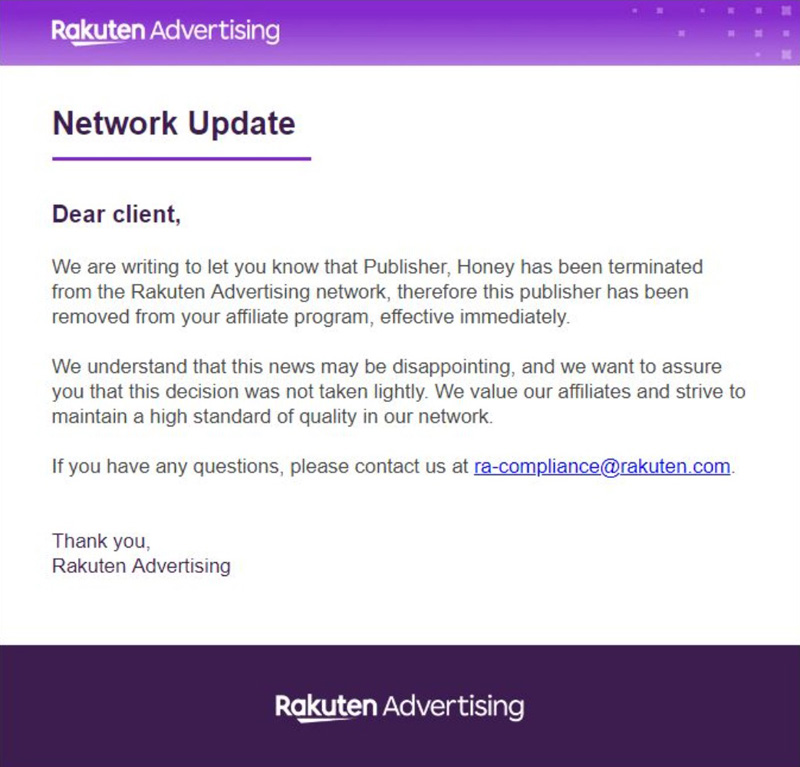
When a dominant publisher like Honey is suddenly removed or suspended, programs suffering from extreme concentration face catastrophic drops in monthly attributed sales. Conversely, mature and resilient programs maintain a healthy distribution of risk across a wide spectrum of publisher business models. Industry educators actively recommend expanding recruitment efforts across a diverse array of partnership types, extending far beyond traditional coupon and loyalty sites.
To build a robust and shock-resistant affiliate ecosystem, brand managers should systematically evaluate and recruit across an expansive taxonomy of partnership models. A comprehensive diversification strategy should incorporate twenty-eight distinct publisher types:
• Affinity groups
• Card-linked offers
• Charities and fundraisers
• Content producers
• Complementary brands
• Co-registration affiliates
• Coupons and deals
• Connected TV (CTV) publishers
• Consultants and service providers
• Datafeed-driven websites
• Domainers
• Educators
• Email marketers
• Existing customers and brand advocates
• Loyalty affiliates (including both D2C websites and closed user group solutions)
• Mass media opportunities
• Mobile-oriented affiliates
• Online communities and forums
• Paid search affiliates
• Pay-per-call publishers
• Podcasters
• Post-checkout solutions
• Ranking and review sites
• Retargeting and cart abandonment solutions
• Social media influencers
• Sub-affiliate networks
• Software and browser extensions
• Video marketers
By actively cultivating partnerships across these diverse categories, brands insulate themselves against the operational shocks of individual publisher suspensions while fostering a fairer, more competitive marketplace.
Broader Implications for the Partnership Economy
The expulsion of PayPal Honey from Rakuten Advertising and impact.com marks a watershed moment for the digital marketing industry. It demonstrates that the era of unchecked traffic interception and opaque attribution manipulation is facing heightened institutional resistance. As networks sharpen their compliance enforcement and brands adopt more rigorous internal policing, the partnership economy is slowly migrating toward higher standards of transparency and accountability.
For digital marketing professionals, the episode serves as an urgent call to action. Moving forward, maintaining a successful and sustainable affiliate program requires a proactive posture: rigorous contractual safeguards, deep technical comprehension of attribution models, individualized partner vetting, and an unwavering commitment to revenue diversification. By learning the hard lessons of the Honey suspension, brands can fortify their marketing channels against disruption and ensure that growth is driven by genuine consumer intent rather than algorithmic manipulation.