The rapid transformation of digital search behavior has fundamentally altered how brands capture consumer attention, moving the primary battleground from traditional search engine results pages to synthesized artificial intelligence responses. When modern consumers turn to platforms like ChatGPT, Perplexity, and Google Gemini for information, they increasingly receive direct, comprehensive answers without ever clicking through to an external website. This zero-click reality means that brand visibility, which historically relied on standard keyword rankings, can quietly vanish into an opaque AI-generated summary. To counter this loss of measurable traffic, digital marketers and enterprise organizations are adopting specialized Answer Engine Optimization (AEO) checkers to monitor, analyze, and improve their brand presence across generative search platforms.
Understanding the Shift: What is Answer Engine Optimization?
Answer Engine Optimization represents the systematic practice of improving how frequently and how accurately a brand or its content is cited within the synthesized replies generated by AI search tools. Unlike traditional Search Engine Optimization, which focuses on earning a high-ranking position within a list of blue hyperlinks, AEO targets the internal citations, brand mentions, and reference blocks embedded directly within an AI engine’s narrative response. This evolution was accelerated significantly when major technology providers integrated conversational synthesis into their core products—most notably exemplified by Google’s rollout of AI Overviews in May 2024.
![AEO checker tools that measure answer engine visibility [2026]](https://53.fs1.hubspotusercontent-na1.net/hubfs/53/aeo-checker-1-20260903-3858273.webp)
While SEO and AEO serve different functions within a broader digital marketing strategy, they remain deeply interdependent. Answer engines rely heavily on the foundational signals established by traditional SEO, including robust crawlability, structured data schemas, domain authority, and verifiable primary source material. Content that is clearly organized, directly answers specific user queries, and is supported by authoritative data is far more likely to be parsed and cited by large language models. Consequently, organizations must approach AEO not as a replacement for legacy search optimization, but as a crucial, complementary layer designed for the generative era.
The Mechanics and Value of an AEO Checker
As manual spot-checking becomes unsustainable due to the volatility of generative search outputs, organizations are turning to automated AEO checkers to maintain oversight. These software solutions monitor brand visibility across multiple AI engines, identifying precisely which informational queries surface a company’s content, which prompts reward competitors, and where artificial intelligence tools misrepresent a brand’s offerings or provide factually incorrect information.
An effective AEO checker performs several distinct functions simultaneously. It logs instances of brand citations where a link connects directly back to the domain, tracks unlinked brand mentions within conversational text, and analyzes competitor positioning across identical queries. By continuously evaluating these metrics, advanced checking tools generate prioritized action plans—highlighting specific content gaps, technical schema corrections, and entity-building tasks designed to improve citation rates over time.
![AEO checker tools that measure answer engine visibility [2026]](https://no-cache.hubspot.com/cta/default/53/9dd5e54b-fbef-4dd0-bc44-1689feb1ea18.png)
Manual Methodologies for Google, ChatGPT, and Perplexity
Before investing in enterprise-grade software, many marketing teams begin by executing manual audits to understand their baseline visibility. Conducting these checks requires a structured approach across different platforms to account for the unique ways each engine retrieves and displays information.
For Google AI Overviews, visibility checks require running high-priority industry queries within signed-out or incognito browser sessions. Because Google dynamically determines when a summary adds value to a classic search, these overviews do not trigger for every query and can fluctuate dramatically between sessions. Analysts must record whether an overview appears, whether their domain is included among the inline citation links, and the exact claims made by the system. Establishing a defensible before-and-after record requires capturing screenshots complete with timestamps, query parameters, and geographical locations, particularly because standard analytics dashboards historically aggregate this data under broader web search metrics.
Similarly, monitoring ChatGPT and Perplexity involves evaluating both inline citations and dedicated source panels. Perplexity typically attaches visible citations to every generated response, accompanied by a comprehensive sidebar listing all referenced domains. ChatGPT incorporates web search indicators and source links when processing current information or utilizing browsing capabilities. To effectively audit these platforms, operators must frame practical, up-to-date queries—such as best-in-category comparisons or specific use-case evaluations—and execute them repeatedly across fresh sessions to identify consistent citation patterns rather than anomalous single-run results.
![AEO checker tools that measure answer engine visibility [2026]](https://53.fs1.hubspotusercontent-na1.net/hubfs/53/aeo-checker-2-20260903-852936.webp)
Evaluating the Market: AEO Checker Tooling and Capabilities
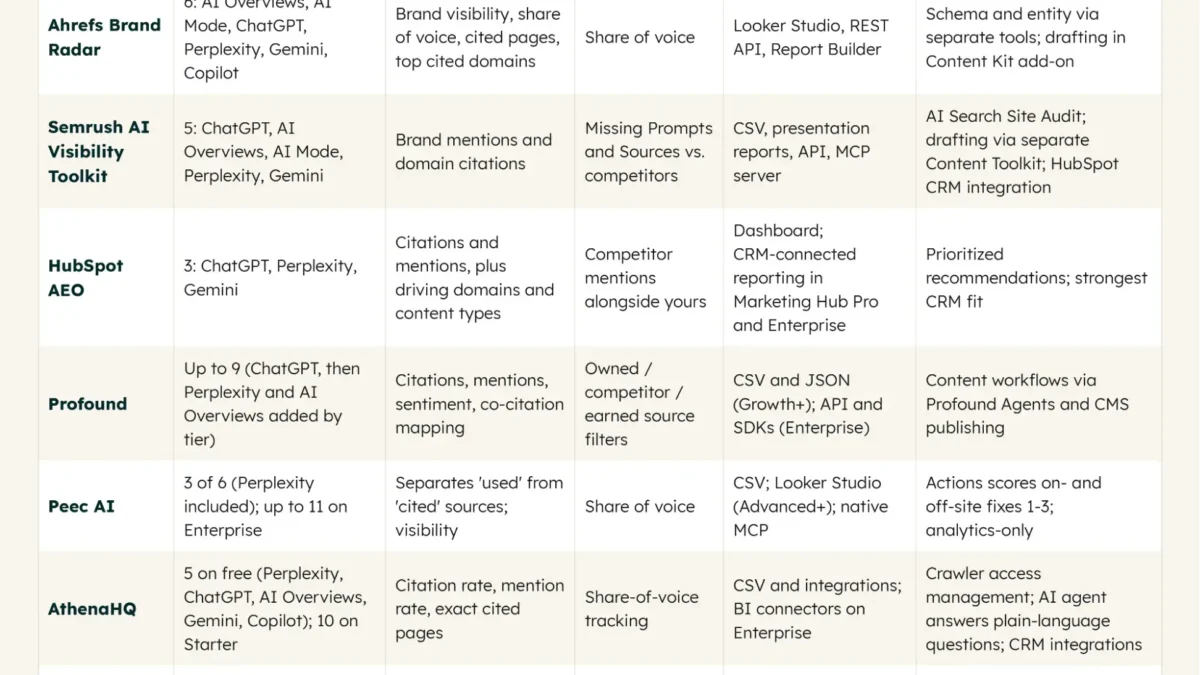
The software market has responded rapidly to the demand for AI visibility tracking, resulting in a diverse ecosystem of tools tailored to specific monitoring needs. Selecting the appropriate AEO checker requires evaluating several critical buyer criteria, including the breadth of engines tracked, the ability to distinguish between branded and unbranded queries, citation sentiment analysis, and the integration of actionable remediation workflows.
Tools with AI Overviews Tracking
Platforms such as Ahrefs Brand Radar and the Semrush AI Visibility Toolkit leverage vast organic search indexes to monitor how traditional ranking keywords intersect with generative features. Ahrefs Brand Radar utilizes real search query data rather than synthetic prompts to map AI Overview visibility, while Semrush’s AI Visibility Toolkit flags existing ranking keywords that currently trigger AI summaries, allowing marketing teams to optimize near-inclusion web pages for potential citation.
![AEO checker tools that measure answer engine visibility [2026]](https://53.fs1.hubspotusercontent-na1.net/hubfs/53/aeo-checker-3-20260903-8904553.webp)
Tools with Citation Detection and Context Analysis
HubSpot AEO and Profound specialize in tracking granular engagement metrics within conversational engines like ChatGPT. HubSpot AEO explicitly differentiates between direct citations—where an AI answer links directly to a domain—and unlinked brand mentions, while mapping the specific content types driving visibility. Profound extends this capability by incorporating sentiment scoring, identifying un-cited prompts where a brand should naturally appear, and categorizing citations by source type, including owned, earned, and competitor properties.
Tools for Perplexity Monitoring and Technical Readiness
Dedicated analytics solutions like Peec AI and AthenaHQ offer specialized tracking focused primarily on Perplexity’s citation ecosystem, providing clean data feeds and conversational assistants to interpret visibility trends. Meanwhile, technical platforms like Scrunch AI and Conductor focus heavily on the underlying infrastructure required for generative search success. Scrunch AI evaluates whether AI web crawlers can successfully reach, render, and interpret a website’s code, whereas Conductor pairs continuous technical monitoring with content scoring algorithms to ensure maximum entity readiness.
![AEO checker tools that measure answer engine visibility [2026]](https://53.fs1.hubspotusercontent-na1.net/hubfs/53/aeo-checker-4-20260903-6212698.webp)
Key Metrics for Measuring Generative Search Success
Tracking progress within generative search requires a shift away from traditional click-through rate models toward metrics designed for zero-click environments. Organizations utilizing AEO software must focus on a specific set of core performance indicators:
- Visibility Score: The percentage of target queries where a brand is either cited or mentioned by name within an AI-generated response.
- Citation Share: The proportion of total citations captured by a brand compared to its primary competitors for a defined set of industry prompts.
- Unlinked Mention Rate: The frequency with which a brand’s name appears in conversational answers without a corresponding hyperlink, indicating brand authority that requires structural optimization to convert into traffic.
- Sentiment and Accuracy: The qualitative measure of how artificial intelligence engines describe a brand’s products, pricing, and capabilities, ensuring that synthesized summaries remain factually correct.
Because answer engines frequently resolve user intent without generating an outbound click, these visibility metrics must be evaluated as trend lines over extended periods rather than isolated snapshots. Forward-thinking enterprises combine these visibility scores with downstream proxies—such as AI-referred session data and branded search volume lifts—to fully capture the indirect influence of zero-click brand exposure.
Strategic Implications and Future Outlook
![AEO checker tools that measure answer engine visibility [2026]](https://53.fs1.hubspotusercontent-na1.net/hubfs/53/aeo-checker-5-20260903-8938354.webp)
The integration of answer engine optimization into mainstream digital marketing marks a permanent shift in how organizations conceptualize online authority and audience reach. As artificial intelligence models become the primary gatekeepers of digital information, the ability to audit, manage, and optimize brand representation within these systems is no longer optional. Whether through rigorous manual spot-checks or continuous enterprise automation using platforms like HubSpot AEO, Ahrefs, Semrush, or Profound, businesses must actively adapt to a landscape where being cited by an algorithm is just as critical as ranking on a search engine results page. Ultimately, organizations that master the art and science of answer engine optimization will secure their competitive advantage, ensuring their voice remains prominent in an increasingly automated digital future.