The rapid evolution of digital discovery has fundamentally altered how consumers interact with search engines and conversational platforms. As artificial intelligence transforms traditional search engine optimization (SEO) into answer engine optimization (AEO), enterprise marketing teams face an entirely new set of measurement challenges. Brands no longer compete exclusively for blue links on a results page; instead, they vie for citations, recommendations, and visibility within complex, AI-generated synthesized responses. To navigate this paradigm shift, organizations are turning to specialized analytics platforms designed to decode how major AI models perceive and present their brand equities. Among the emerging tools leading this market, Profound and Bluefish AI have established themselves as prominent contenders, each offering distinct architectures for tracking brand presence across conversational models.
Understanding the underlying mechanics of AEO requires examining more than just surface-level visibility metrics. Because generative engines produce dynamic outputs influenced by market variables, geographic locations, timing, and prompt phrasing, marketing organizations must deploy sophisticated measurement infrastructure. This comparative analysis investigates the capabilities, methodologies, data capture strategies, and reporting frameworks of both Profound and Bluefish AI, evaluating how each platform supports modern marketing governance, citation tracking, and strategic decision-making.
The Evolution of AI Discovery and the Shift Toward Answer Engine Optimization
To fully grasp the utility of platforms like Profound and Bluefish AI, it is necessary to contextualize the broader transformation occurring within digital search behavior. For decades, traditional SEO relied on keyword rankings, technical site audits, and backlink profiles to capture organic traffic. However, the integration of generative pre-trained transformers and large language models into search experiences—exemplified by platforms such as OpenAI’s ChatGPT, Google’s Gemini, and Perplexity—has replaced static result pages with conversational summaries.
In this new landscape, a user searching for a software solution or consumer product receives a direct, synthesized recommendation complete with embedded citations. If a brand is absent from that synthesized text, or if the underlying model misinterprets its value proposition, the organization loses potential discovery opportunities long before a traditional click ever occurs. Consequently, AEO has emerged as a distinct operational discipline. While AI SEO applies machine learning to optimize traditional search workflows, AEO specifically measures how, where, and why a brand is referenced within AI-generated outputs.

This operational shift introduces significant complexity. Two identical queries executed minutes apart across different geographic nodes can yield divergent citations and brand sentiments. Therefore, enterprise marketers require robust measurement frameworks that track the complete chain of interaction: from initial user prompt to AI-generated answer, brand presence, cited source URLs, strategic diagnosis, and subsequent remedial action.
Engine Coverage, Model Cadence, and Geographic Controls
A foundational criterion when evaluating any AEO platform is its ability to accurately monitor the specific models and regional markets relevant to a brand’s target audience. While both Profound and Bluefish AI provide daily tracking cadence, their public documentation reveals distinct approaches to platform breadth and configuration.
Profound provides granular control over engine configurations, regional settings, and language variations, allowing digital teams to tailor their tracking environments to specific geographic markets. However, enterprise buyers must carefully audit Profound’s specific datasets, as regional and platform availability can vary significantly between distinct modules, such as Answer Engine Insights versus Prompt Volumes datasets. Confirming coverage parameters at the exact engine, region, and language level is essential to ensure that collected data mirrors actual consumer behavior.
Conversely, Bluefish AI advertises monitoring capabilities spanning more than ten distinct models, incorporating commerce-focused AI systems and specialized shopping assistants alongside general-purpose conversational engines. This expanded model coverage proves particularly valuable for retail, direct-to-consumer, and e-commerce brands whose customers increasingly rely on AI-driven shopping assistants to evaluate products. Bluefish also emphasizes static prompt sets and model-drift controls, addressing a critical measurement concern: maintaining baseline consistency to ensure that period-over-period performance variations reflect genuine shifts in brand visibility rather than underlying algorithmic fluctuations in the AI models themselves.
For organizations seeking alternative or supplementary frameworks, native integrations such as HubSpot AEO track core prompts across ChatGPT, Gemini, and Perplexity on a daily basis. Meanwhile, free beta monitoring tools, including the AI Search Sensor, offer directional, industry-level insights regarding how these major engines cite commercial entities and drive downstream referral traffic. Ultimately, platform coverage is only as valuable as its alignment with actual audience touchpoints and the stability of its historical baseline data.

Citation Tracking, Fact-Checking, and Strategic Feedback Loops
Tracking brand mentions in conversational text provides limited strategic value without precise attribution of the underlying sources. Both Profound and Bluefish AI trace generative responses back to individual source URLs, enabling marketing and communications teams to investigate instances of inaccurate representation, weak brand positioning, or competitor dominance.
Profound addresses this through its Answer Engine Insights module, which incorporates dedicated Citations and FactCheck analyses. This functionality cross-references claims made about a brand against a customer-defined Knowledge Base. When discrepancies or factual errors appear in an AI response, the platform connects those claims directly to their citation URLs, providing a clear pathway for teams to update owned content, develop targeted publishing strategies, or execute digital PR outreach.
Bluefish AI deploys a similarly structured approach within its AI Monitoring Suite, identifying citation URLs and comparing generative claims against verified brand truth. However, Bluefish expands upon this by introducing quantitative metrics known as Impact Score and Influence Rank. These proprietary indicators attempt to estimate how strongly a specific source URL influenced the final AI response.
While such metrics offer a structured way to prioritize optimization efforts, industry analysts advise interpreting modeled citation influence with caution. Because influence is calculated through algorithmic estimation rather than direct observation, procurement teams should thoroughly examine the underlying mathematical models during vendor demonstrations. When effectively leveraged, however, citation data facilitates a complete diagnose-act-retest workflow—identifying low citation rates, correlating them with technical crawl issues or content gaps, and verifying recovery after site architecture or metadata modifications.
Data Capture Methodologies: Consumer Interfaces Versus Provider APIs

A critical yet frequently overlooked differentiator among AEO platforms is their data capture methodology. The manner in which an analytics tool collects AI responses directly dictates what its visibility metrics represent. Platforms generally capture data through one of three primary mechanisms: scraping consumer-facing web interfaces, querying provider-supplied developer APIs, or combining multiple inputs into a unified baseline.
Profound transparently documents its capture architecture, noting that Answer Engine Insights gathers responses directly from consumer-facing answer-engine experiences. This methodology ensures that the captured data closely mirrors the actual interface and outputs encountered by everyday users searching on those platforms.
Bluefish AI maintains a precisely controlled environment supported by daily monitoring across multiple models, static prompt sets, and model-drift controls. Its public materials incorporate references to search signals, brand-specific inputs, and panel data. However, documentation clarity varies regarding whether individual AI responses are captured via direct consumer interface simulation or through provider application programming interfaces.
It is vital for enterprise buyers to recognize that API availability does not inherently explain how foundational data was collected. A platform can provide an enterprise API for data retrieval regardless of whether the raw responses originated from consumer interfaces or API endpoints. Testing capture methodologies during technical demonstrations remains the most effective method for understanding why two distinct AEO platforms might evaluate identical prompts and report differing visibility scores.
Reporting Capabilities, BI Integrations, and Attribution Ladders
To secure ongoing executive buy-in and budget allocation, marketing analytics must ultimately connect visibility metrics to tangible business outcomes and revenue attribution. Profound provides robust integration pathways, including CSV data exports, an enterprise-grade API, and native connections with major business intelligence and analytics tools. Notably, Profound’s Google Analytics integration bridges the gap between agent visibility and downstream performance, enabling teams to evaluate AI-originating traffic alongside conversions, sign-ups, and purchases.

Bluefish AI approaches ROI and reporting through its AI Data Suite, utilizing organized Collections to group URLs, products, and topics. This structure allows marketers to establish historical baselines, track tactics against specific product lines, and measure performance across varied audience segments and AI channels. While Bluefish references conversion contribution and closed-loop attribution in its marketing materials, detailed documentation regarding named CRM and BI integrations is less prominent, making these capabilities a key validation point during vendor evaluations.
To evaluate attribution claims objectively, organizations frequently rely on a progressive attribution ladder: AI visibility leading to an identifiable referral, progressing to a web conversion, advancing to a known lead or contact, and finally culminating in a sales opportunity or closed-won pipeline. Establishing causation along this continuum requires rigorous evidence linking measured AEO activity directly to the customer journey, preventing teams from mistakenly attributing organic business growth solely to correlative increases in AI visibility.
Security, Compliance, and Enterprise Governance
For enterprise organizations, procurement reviews hinge heavily on robust security architecture, data governance protocols, and compliance certifications. Both Profound and Bluefish AI have matured their security postures, documenting SOC 2 Type II compliance and single sign-on (SSO) capabilities.
Profound publishes detailed documentation concerning administrative controls, role-based access permissions, granular audit logging, encryption standards, and secure backup procedures. Bluefish AI has similarly updated its compliance standing to reflect SOC 2 Type 2 certification and references compliance postures such as being "HIPAA Ready"—a designation that healthcare and highly regulated enterprises must verify against specific organizational compliance requirements.
Procurement teams evaluating these platforms must address core operational questions: Who possesses administrative access to AEO dashboards? What sensitive organizational data traverses API integrations? How are user permissions managed across decentralized marketing departments, and what are the platform’s established data retention schedules? Ensuring compliance alignment protects organizational assets while maintaining data integrity across all connected marketing tech stacks.

Onboarding, Strategic Resources, and Agency Operations
The long-term success of an AEO program depends heavily on initial setup quality, prompt selection discipline, and internal ownership. Profound’s documentation recommends establishing an initial foundation of five to ten strategic topics, allowing teams to generate or upload customized prompt libraries organized via tags. Profound also provides educational resources through Profound University. Crucially, Profound cautions that modifying tracked prompts disrupts period-over-period comparability, underscoring the reality that prompt libraries function as foundational measurement infrastructure.
Bluefish AI adopts a highly service-oriented onboarding model. In addition to platform training, Bluefish offers custom data integrations, ongoing AEO program support, strategic consulting, executive briefings, and change management services designed to achieve operational readiness within the first week of deployment.
For agency environments, Profound offers a dedicated "Agency Mode" featuring isolated workspaces that cleanly segregate data across different client accounts, brands, and pitch environments. While Bluefish supports robust monitoring across complex URL structures and product lines, its public documentation lacks equivalent references to multi-client agency partitioning. Agencies evaluating Bluefish must explicitly confirm data isolation and client permission structures during pre-sales demonstrations.
Conclusion: Selecting the Right AEO Platform for Strategic Growth
The decision to invest in Profound, Bluefish AI, or an integrated ecosystem like HubSpot AEO depends entirely on an organization’s specific operational model, internal resources, and strategic goals. Profound delivers extensive, configurable control over prompt management, regional variations, language parameters, and citation tracking, making it well-suited for organizations requiring granular operational oversight and agency-grade client partitioning. Conversely, Bluefish AI offers comprehensive multi-model monitoring paired with enterprise-grade consulting services, brand accuracy analysis, and audience intelligence workflows.

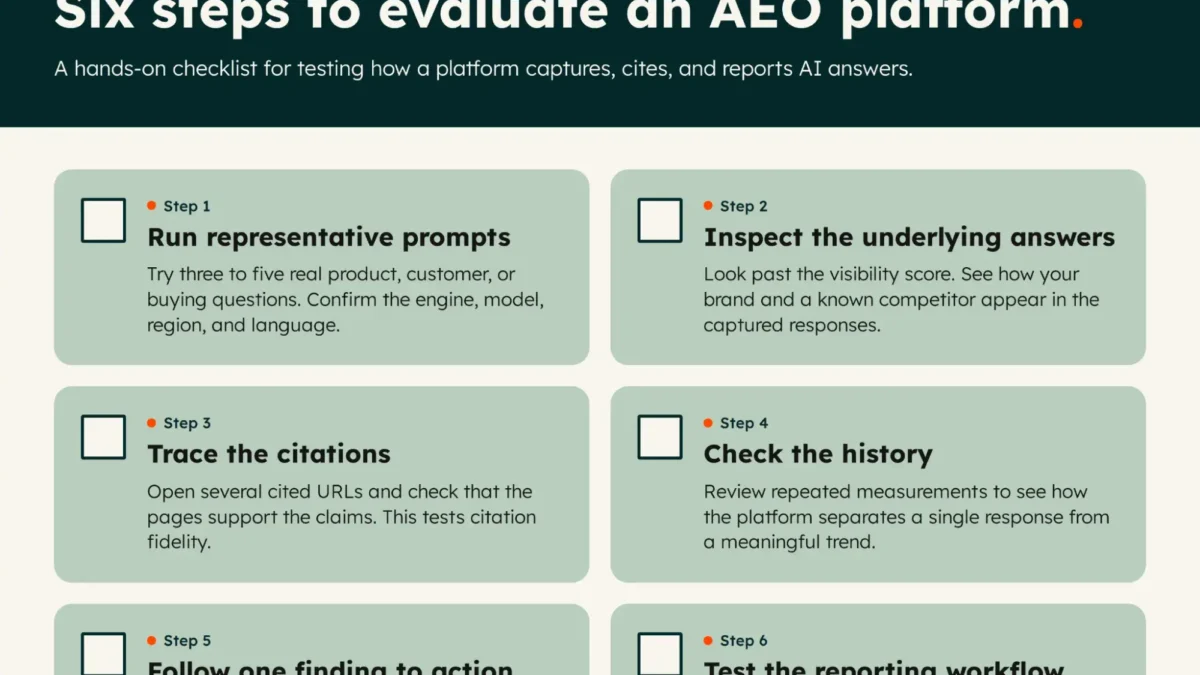
Marketing leaders are advised to conduct rigorous, standardized platform demonstrations using real-world enterprise prompts, known competitor visibility challenges, and actual brand accuracy discrepancies. By systematically evaluating capture methodologies, engine coverage, reporting depth, and security governance, organizations can select an AEO platform that provides the empirical evidence necessary to navigate the future of conversational search with absolute confidence.