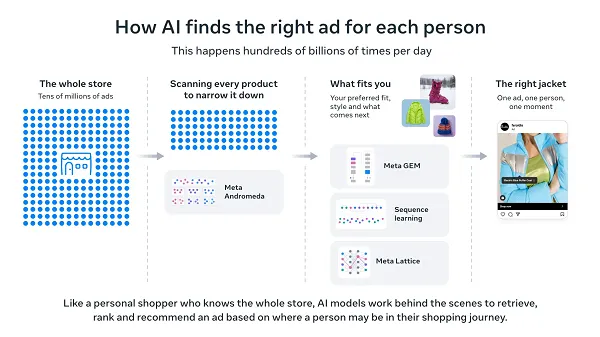
The modern digital advertising ecosystem is undergoing a profound structural transformation, driven largely by rapid advancements in artificial intelligence and machine learning. As platforms compete to provide maximum return on investment for brands navigating complex economic landscapes, Meta Platforms has released comprehensive new insights detailing how its evolving, AI-powered ad delivery and ranking systems are significantly boosting user engagement, click-through rates, and overall campaign conversions. According to recent data shared by the company, these deep technological upgrades are not merely incremental adjustments; they represent a fundamental overhaul of how digital ads are matched with prospective buyers, yielding measurable performance leaps across Facebook, Instagram, and connected Meta platforms.
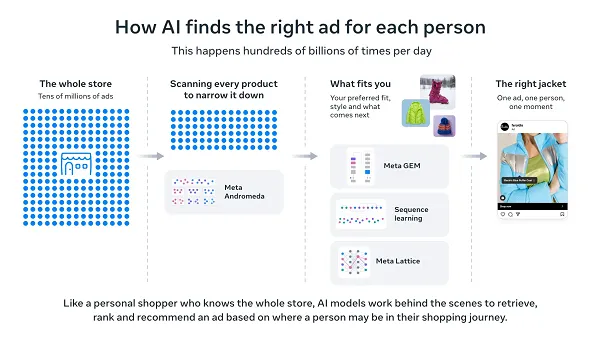
The intersection of massive data processing infrastructure and sophisticated algorithmic modeling has unlocked unprecedented capabilities for global brands and small-to-medium-sized businesses alike. By leveraging upgraded machine learning architectures, Meta’s ad delivery networks are now capable of analyzing vast oceans of user behavioral signals in real time. This allows the system to identify subtle patterns and correlation vectors that traditional targeting methods routinely miss. Consequently, advertisers are witnessing substantial performance improvements, with the latest corporate disclosures indicating that technological optimizations are directly translating into higher conversion volumes without requiring proportional increases in advertising budgets.
Performance Breakthroughs and Quantitative Metrics
The quantitative impact of Meta’s AI integration is clearly visible in the performance metrics recorded during the second and third quarters of the fiscal year. In an official announcement released on October 28, Meta highlighted that ongoing, systematic refinements to its ad ranking architecture generated an 8.3 percent year-over-year increase in ad clicks alongside a remarkable 15.7 percent uplift in total ad conversions specifically on the Facebook platform. These figures underline a broader trend: as the underlying models become more adept at understanding user intent, the friction between consumer discovery and final conversion is systematically reduced.
Beyond standard ad placements, specialized campaign formats are also experiencing exponential expansion. Partnership ads—which allow commercial brands to collaborate directly with content creators, influencers, and publishing partners—surged by more than 97 percent year-over-year during the third quarter. This explosive category has officially crossed a major financial milestone, boasting an annual revenue run-rate exceeding $15 billion. This surge demonstrates that modern consumers respond more favorably to peer-verified, creator-led marketing campaigns, a dynamic that Meta’s algorithmic distribution networks are uniquely equipped to amplify.
Furthermore, Meta’s newly deployed AI business assistant, which is currently rolling out to advertisers globally, has demonstrated immediate utility. Early corporate data indicates that brands utilizing this generative conversational assistant are securing a 5 percent increase in conversions while maintaining identical cost parameters. This efficiency gain highlights the practical value of embedding artificial intelligence directly into the campaign management workflow, helping marketers optimize copywriting, audience segmentation, and budgetary allocation with minimal manual friction.
Technological Foundations and Infrastructure Investment
To understand the mechanics driving these performance gains, one must examine the immense infrastructural commitments underpinning Meta’s artificial intelligence initiatives. The capacity of Meta’s ad ranking systems to assess a broader range of user actions, engagement histories, and product preferences at record speeds is not accidental. It is the direct result of a multi-year, multi-billion-dollar capital expenditure program aimed at expanding the company’s global data center footprint and high-performance computing clusters.
Industry analysts note that Meta’s commitment of hundreds of billions of dollars toward U.S. AI infrastructure spending has created a formidable technological moat. These state-of-the-art data centers process billions of micro-interactions daily, training advanced neural networks to recognize how minor shifts in creative design, timing, and audience parameters impact consumer response data. By feeding these massive datasets into real-time inference engines, Meta ensures that its ad auction and ranking systems operate with a degree of predictive accuracy that was unimaginable just a half-decade ago.
Chronology of Meta’s AI Ad Evolution
The path to these advanced ranking systems has been marked by a deliberate, phased rollout of artificial intelligence tools spanning several years:
Early Phase (2020–2022): Meta initiates foundational shifts toward automation, introducing Advantage+ campaign automation tools to help advertisers automate audience targeting, placement selection, and budget distribution.
Mid-Phase (2023): In the wake of privacy regulations and shifting data-sharing landscapes, Meta doubles down on predictive AI, developing machine learning models capable of optimizing ad delivery even with sparse data signals.
Late 2024 to Early 2025: The company rolls out generative AI tools for creative optimization, enabling marketers to instantly generate background variations, text overlays, and dynamic visual assets tailored to specific demographic segments.
Mid-2026: Meta introduces advanced AI business assistants and deepens the integration of conversational agents equipped with in-stream checkout features.
Current Period (Late 2026): Performance metrics validate the strategy, with Meta reporting an 8.3 percent click increase, a 15.7 percent conversion uplift on Facebook, and partnership ad revenues surpassing $15 billion.
Future Horizons: In-Stream Commerce and AI Agents

Looking ahead, Meta is aggressively positioning its AI systems to bridge the gap between discovery and transaction entirely within its social applications. Among the most anticipated developments is the integration of native checkout options directly inside conversational AI agents and specialized assistants, such as Muse. Rather than forcing users to navigate away from an app to an external e-commerce portal—a point in the customer journey where drop-off rates are traditionally high—these AI agents will facilitate frictionless, in-stream purchases.
This capability represents the natural evolution of social commerce. By combining personalized ad delivery with conversational artificial intelligence and secure, embedded payment rails, Meta aims to transform its platforms from discovery engines into comprehensive digital storefronts. Advertisers will no longer just buy visibility and clicks; they will be purchasing guaranteed transactional pathways powered by intent-driven AI matching.
Industry Implications and Market Analysis
From a broader economic and competitive standpoint, Meta’s heavy reliance on artificial intelligence for ad delivery carries significant implications for the digital marketing landscape. As privacy updates and regulatory frameworks continue to restrict traditional third-party data tracking, platforms that possess proprietary first-party engagement data and superior machine learning infrastructure hold a distinct advantage.
Independent marketing analysts observe that Meta’s ability to drive double-digit conversion uplifts compensates for broader macroeconomic uncertainties, reassuring enterprise and small-business advertisers alike that social media advertising remains a highly lucrative growth channel. However, this dynamic also raises important considerations regarding market consolidation. Smaller advertising platforms that lack the capital resources to invest heavily in proprietary AI infrastructure and expansive data center networks may find it increasingly difficult to compete with the predictive accuracy and cost-efficiency offered by tech conglomerates like Meta.
As artificial intelligence continues to redefine the boundaries of digital marketing, Meta’s latest performance data underscores a new reality: the future of advertising belongs to systems that can process intent, automate creativity, and execute transactions at the speed of thought. With its infrastructure investments bearing fruit and adoption rates for AI business tools climbing rapidly, Meta has firmly established algorithmic optimization as the cornerstone of modern digital commerce.