The landscape of digital marketing has shifted dramatically, moving far beyond the ad-hoc posting strategies that characterized early platform ecosystems. Today, organizations face unprecedented pressure to maintain a consistent, multi-platform digital footprint without exhausting their internal resources. Social media content planning has evolved into a sophisticated discipline, bridging the gap between creative execution and high-level enterprise goals. As marketing teams navigate tighter budgets and heightened consumer expectations for brand authenticity, the implementation of a structured, repeatable content planning workflow has become a baseline operational requirement for successful modern enterprises.

Understanding Social Media Content Planning and Its Strategic Value
At its core, content planning on social media is the methodical process of deciding what to publish, when to distribute it, and how each asset supports overarching corporate and marketing objectives. Moving well beyond basic scheduling tools, a comprehensive content plan dictates topics, formats, and integrated campaigns well in advance. This strategic foresight ensures brand consistency and message relevance while liberating marketing teams from the cyclical inefficiency of rebuilding monthly workflows from scratch.

Industry experts emphasize that a well-designed content plan fundamentally alters organizational output by driving efficiency and protecting teams from burnout. Content batching—the practice of creating assets in groups rather than building individual posts reactively—allows marketing departments to maximize their return on investment. For instance, a single foundational research report or whitepaper can be strategically repurposed into a multi-part LinkedIn article, a short-form video script for TikTok or Instagram Reels, a series of infographic carousels, and an email newsletter segment. This cascading approach extends the lifespan and impact of a single creative idea without requiring proportional increases in staff or budget.
Furthermore, proactive planning acts as an organizational safeguard against the unpredictability of digital fatigue. By mapping out product launches, seasonal campaigns, and industry-specific milestones weeks or months in advance, marketing departments can maintain high publishing standards while leaving adequate bandwidth to respond to breaking industry news or cultural moments. Most importantly, a robust content plan serves as the vital connective tissue between day-to-day engagement metrics and executive-level Key Performance Indicators (KPIs). While individual posts hold limited standalone value, their cumulative contribution toward a unified objective determines the success or failure of a brand’s digital strategy.

The Ten-Step Blueprint for Executing an Effective Content Plan
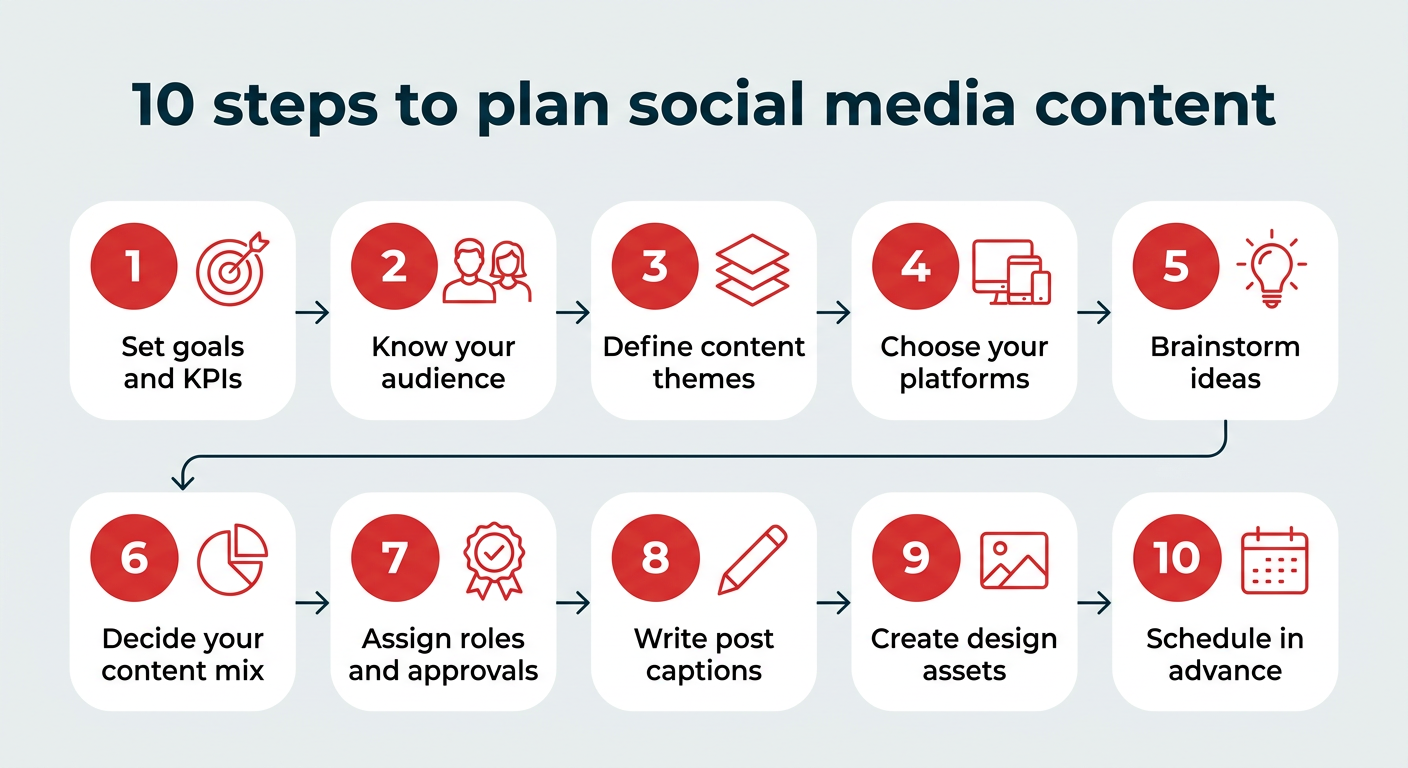
Building an efficient, scalable social media content plan requires a disciplined, multi-stage methodology. Organizations looking to streamline their operations typically follow a structured ten-step framework designed to align team capabilities with business objectives.

Step 1: Establishing Goals and Measurable KPIs
Every successful content strategy begins with a clear definition of desired outcomes. Social media objectives generally fall into distinct categories, such as building brand awareness, generating inbound leads, fostering community engagement, or driving direct website conversions. To ensure accountability, teams must pair these objectives with quantifiable metrics. Vague ambitions like "growing brand awareness" are replaced by concrete targets, such as "increasing monthly impressions by 20% within the second quarter." Industry best practice suggests limiting a team to two or three primary goals per quarter to prevent strategic dilution.
Step 2: Conducting Deep Audience Research
Content planning must be grounded in empirical data regarding target consumer behaviors, preferences, and pain points rather than internal assumptions. Leveraging native analytics platforms alongside social listening tools allows brands to identify the exact language, sentiment, and unprompted topics that resonate with their target demographic. Documenting these insights in a centralized, accessible repository ensures that audience understanding scales across growing marketing departments.

Step 3: Defining Core Content Themes and Pillars
Content themes act as strategic guardrails for a brand’s digital presence. These pillars—which commonly encompass educational thought leadership, behind-the-scenes culture, product spotlights, customer success stories, and industry commentary—must directly support broader corporate marketing goals. If a proposed post fails to align with an established content pillar, it is either discarded or signals the need for a deliberate expansion of the brand’s overarching strategy.
Step 4: Prioritizing and Selecting Platforms
Attempting to maintain an active, high-frequency presence across every available social network frequently results in resource depletion and diminished returns. Organizations must use their audience research and business goals to prioritize two or three core channels where their target demographic is most active. Publishing cadences must be established for each chosen platform, dictating the volume of creative assets required and guiding subsequent design and copywriting workflows.
Step 5: Brainstorming Campaigns and Post Pipelines
With core themes and channel priorities established, content teams must build a continuous pipeline of post ideas and seasonal campaigns. Establishing dedicated ideation channels, routine brainstorming sessions, and cross-departmental submission workflows ensures the organization never faces a creative vacuum. High-performing teams consistently anchor their brainstorming sessions in historical performance analytics, ensuring that newly conceptualized campaigns build upon proven engagement patterns.
Step 6: Optimizing the Content Mix
A sustainable digital marketing strategy relies on a strategic balance between original thought leadership and curated third-party content. While original assets establish brand authority, curated content keeps channels active and relevant without exhausting creative teams. Industry standards often suggest a baseline ratio of roughly 40% original content to 60% curated material, provided all external resources meet the brand’s rigorous quality and compliance standards. Additionally, teams must intentionally vary their content formats—incorporating short-form video, text posts, link shares, and interactive carousels—to protect their overall strategy against sudden algorithmic shifts on individual platforms.
Step 7: Assigning Responsibilities and Approval Workflows
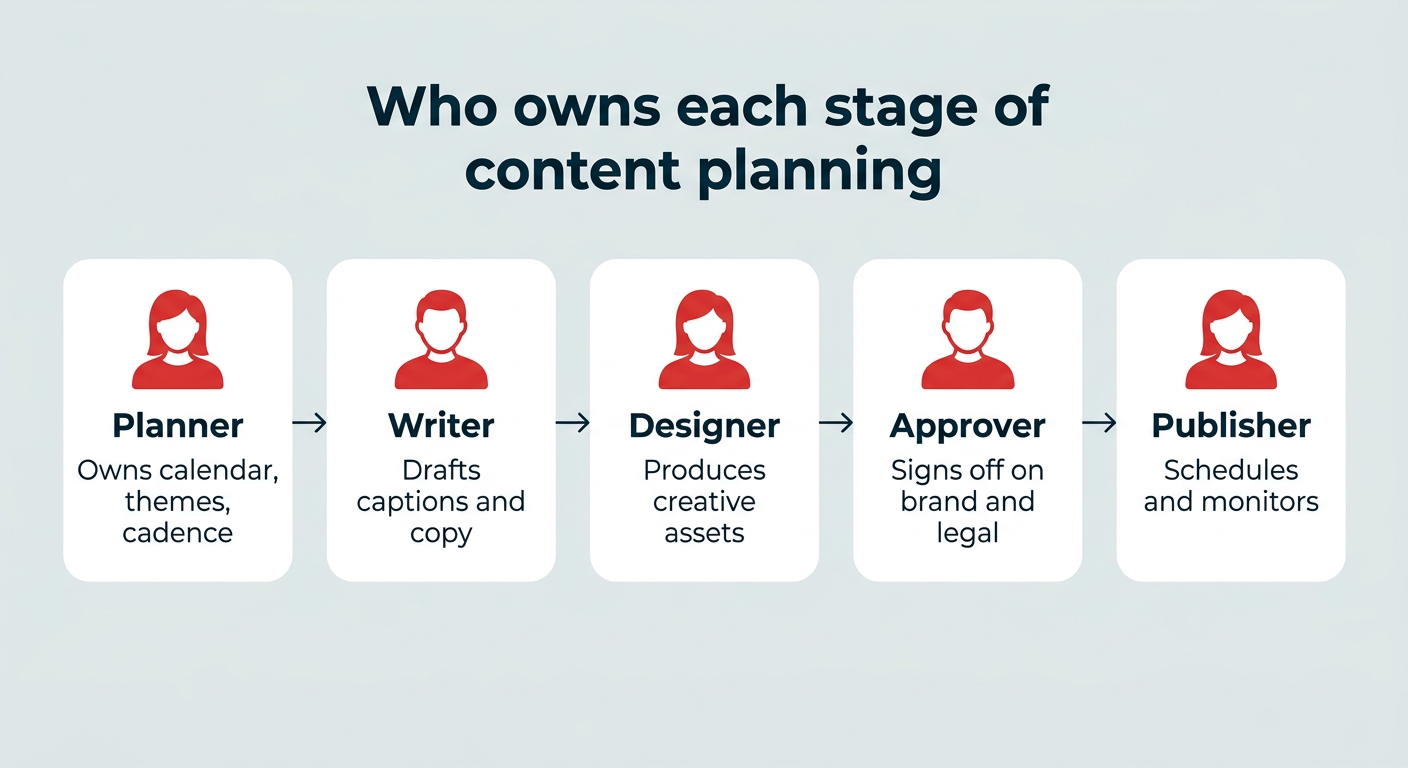
Complex social media operations involve diverse contributors, including copywriters, graphic designers, community managers, legal counsel, and executive approvers. Without explicit role assignments, content production frequently stalls. Establishing clear ownership for each stage of the lifecycle—from initial planning and drafting to design, compliance review, and final publication—is critical. In highly regulated sectors such as finance and healthcare, integrating mandatory legal and compliance reviews into the standard timeline prevents severe regulatory exposure and brand risk.
Step 8: Drafting Captions and Copy
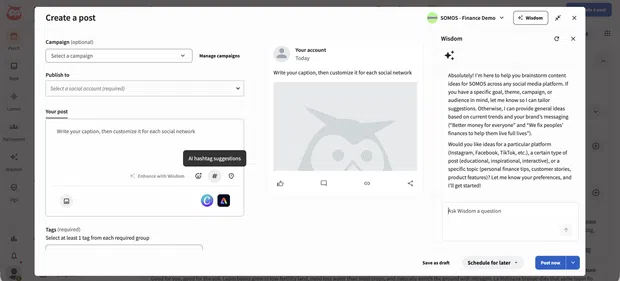
Writing textual content prior to initiating visual design work streamlines the overall production pipeline. Drafting captions in advance allows copywriters to establish the core narrative, integrate necessary tracking links, and optimize text length for specific platform algorithms before handing assets over to creative teams. Modern organizations increasingly utilize advanced AI writing assistants to accelerate initial ideation and draft generation, though human oversight remains essential to ensure brand voice consistency and factual accuracy.
Step 9: Producing and Sourcing Visual Design Assets
Even the most compelling copy requires strong visual assets to capture audience attention in crowded digital feeds. Establishing strict production timelines for graphic design, video editing, and multimedia asset sourcing prevents the bottlenecks that frequently derail publishing schedules. Unified digital operating systems and collaborative planning tools allow multidisciplinary teams to track asset completion, identify pipeline gaps, and execute centralized reviews seamlessly.
Step 10: Advanced Scheduling and Multi-Platform Timing
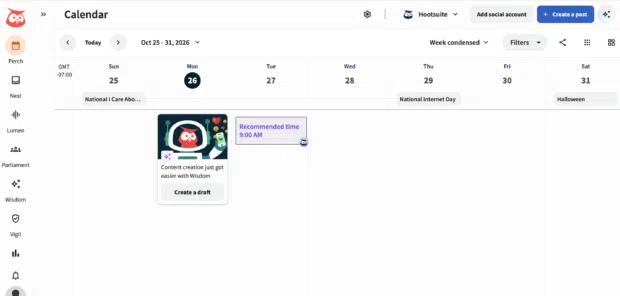
The final phase of the planning workflow involves systematic scheduling across all targeted networks. Consistency is vital, but precise timing heavily influences content visibility. Organizations frequently utilize platform analytics and predictive publishing tools to determine the optimal moments to reach their unique audience segments for specific goals, such as maximizing brand awareness versus driving conversion traffic. Batch-scheduling content weeks in advance via unified enterprise dashboards allows marketing teams to maintain total visibility over cross-platform campaigns, ensuring that promotional messages never collide and that publishing gaps are effectively eliminated.
The Evolving Role of Artificial Intelligence in Modern Content Planning
As digital marketing matures, the integration of artificial intelligence has transitioned from an experimental novelty to a core operational efficiency driver. Recent industry data from organizations such as Gartner highlights a crucial distinction: while the vast majority of marketing professionals actively explore generative AI technologies, a significantly smaller percentage report realizing transformative, measurable business benefits. This disparity underscores the reality that AI serves most effectively as an accelerator for foundational tasks—such as trend discovery, preliminary caption drafting, and timing optimization—rather than a total replacement for human strategic judgment.
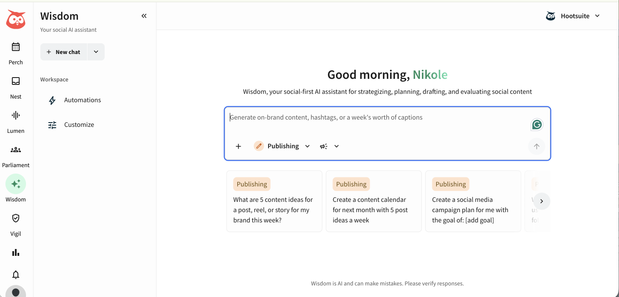
In contemporary marketing operations, AI-driven contextual intelligence tools assist teams by compressing multi-week campaign briefs into structured draft post angles across diverse platforms within minutes. Similarly, advanced social listening algorithms continuously scan global digital conversations to flag emerging industry topics, allowing brands to proactively integrate timely, relevant discussions into their existing calendars without destabilizing their long-term strategies.
However, industry experts maintain a persistent note of caution regarding content quality and brand governance. Consumer research indicates that a substantial portion of digital audiences perceives a decline in content quality driven by unedited generative output. Furthermore, in enterprise environments, the publication of unverified AI-generated claims can introduce catastrophic legal and compliance liabilities. Consequently, successful organizations treat artificial intelligence as a sophisticated drafting assistant while strictly retaining human oversight, editorial control, and rigorous compliance checks at every stage of the workflow.
Measuring, Analyzing, and Iterating for Continuous Improvement
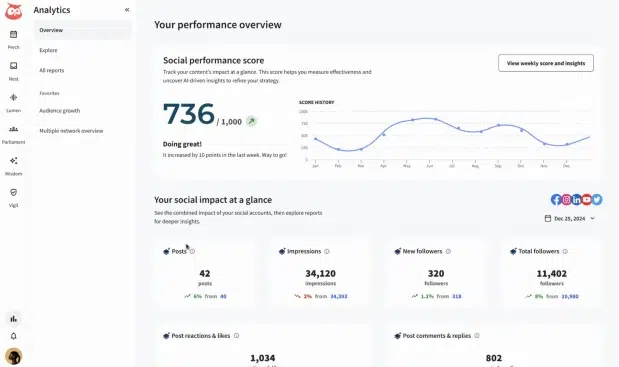
A social media content plan that operates without regular performance measurement is merely a static schedule. To transform a content calendar into a dynamic engine of business growth, marketing teams must systematically track performance against the KPIs established during the initial planning phase.
Effective measurement begins by focusing on a targeted set of metrics that align directly with business objectives, including engagement rates, impression growth, click-through rates, and inbound conversion metrics. Establishing a structured review cadence is critical for long-term success:
- Weekly check-ins allow teams to monitor immediate audience sentiment, capitalize on sudden micro-trends, and swap in timely reactive content.
- Monthly reviews provide a broader lens to identify overarching patterns across specific content themes, formats, and platform algorithms.
- Quarterly evaluations enable leadership to reassess overarching business goals, adjust platform priorities, and refine resource allocation based on cumulative performance data.
By feeding these analytical insights directly back into the planning cycle, organizations can systematically eliminate underperforming content pillars, amplify high-converting formats, and demonstrate clear return on investment to executive stakeholders. Ultimately, rigorous measurement ensures that a content plan evolves continuously, driving sustainable digital growth and reinforcing the strategic value of social media within the broader enterprise ecosystem.