The political landscape of the United States has undergone a significant transformation this week as Mississippi officially elected Scott Colom to the U.S. Senate, breaking a 44-year streak of Republican-exclusive representation in the state’s upper-chamber seats. The race, characterized by a protracted and methodical vote-counting process, has brought the mechanics of American democracy—specifically the administration of provisional ballots—under intense public scrutiny. This electoral milestone serves as a focal point for a broader national conversation regarding public confidence in institutional integrity and the growing influence of media entities on the democratic process.
A Historic Shift in Mississippi
The election of Scott Colom represents a watershed moment for Mississippi’s political infrastructure. For nearly half a century, the state had been a stronghold for Republican senatorial candidates, maintaining a legislative continuity that few other states in the Deep South could parallel. The victory of a Democratic candidate in this environment suggests a potential realignment of voter priorities or, at the very least, a shift in the turnout dynamics that have defined the state’s political trajectory since the late 1970s.
The delay in finalizing the results prompted the Mississippi Free Press to launch a comprehensive educational initiative aimed at demystifying the state’s electoral processes. By breaking down the complexities of how provisional ballots are verified and counted, the outlet highlighted the tension between the public’s desire for rapid results and the legal necessity of ensuring every valid vote is processed accurately. This tension is not unique to Mississippi; it reflects a recurring challenge for election officials nationwide as they navigate the balance between transparency and the rigorous verification standards required to maintain electoral legitimacy.
Public Confidence and Partisan Polarization
Data from the Pew Research Center, collected in the weeks leading up to Election Day, underscores the nuanced nature of voter confidence in the United States. While 80% of registered voters expressed general confidence that legally qualified citizens would be able to cast their ballots, a significant partisan divide exists regarding the security of the process.
Republicans demonstrated a higher degree of faith in the system’s accessibility, with 90% of those favoring Republican candidates expressing confidence in the process, compared to 72% among Democratic supporters. Conversely, when the conversation shifted to the prevention of fraudulent voting by noncitizens, the polarization reversed. Roughly 90% of Democratic supporters expressed confidence that noncitizens would be successfully barred from the ballot box, while only 45% of Republican supporters held the same view. This divergence highlights a deepening divide in how different segments of the electorate perceive threats to election integrity, with each side prioritizing different aspects of security and access.
The Growing Influence of Information Gatekeepers
The role of media in shaping these perceptions cannot be overstated. A recent analysis by the Pew-Knight Initiative reveals that a significant majority of the American public perceives both social media platforms and traditional news organizations as having disproportionate influence over the political process.
Nearly seven-in-ten U.S. adults (69%) contend that social media companies possess "too much" influence in modern politics. News organizations face similar skepticism, with 55% of the public expressing the same concern. These figures are particularly striking when contrasted with the percentage of Americans who believe these institutions exert too little influence—merely 6% for social media and 14% for news outlets. This skepticism suggests a broad-based desire for reform in how information is disseminated and curated, as well as an increasing wariness toward institutions that traditionally serve as the primary sources of political information.
Legal Challenges and the Future of Press Freedom
The intersection of media influence and political power is currently being tested in the federal courts. Recent developments in high-profile defamation litigation have placed the boundaries of journalism and institutional accountability under the microscope.
On Tuesday, a federal judge ruled that President Donald Trump’s $10 billion defamation lawsuit against the BBC may proceed, though the court dismissed the segment of the claim alleging unfair business practices. This case follows a similar, though more constrained, legal battle involving FBI Director Kash Patel, whose $250 million defamation suit against The Atlantic encountered a procedural hurdle when a judge froze most of the legal discovery process.
These lawsuits are unfolding against a backdrop of complex public sentiment regarding press freedom. According to a June 2026 survey, while the majority of Americans view a free press as essential to the health of society, a narrow majority (53%) also believes that preventing inaccurate reporting should be prioritized, even if that prioritization necessitates restrictions on the press. Furthermore, there is a clear expectation that news providers act as a check on power, with 41% of Americans explicitly stating that news organizations should "definitely" keep an eye on powerful figures. This expectation is not evenly distributed; 52% of Democrats hold this view, compared to 31% of Republicans, illustrating that the very purpose of journalism is viewed through a partisan lens.
Data Analysis: The Disconnect in Institutional Perception
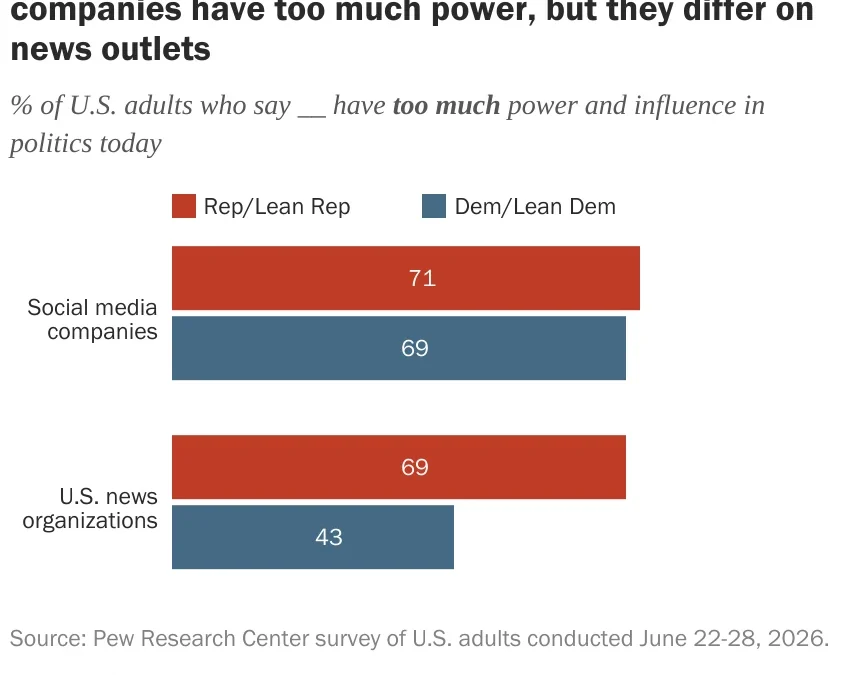
The chart of the week, provided by the Pew-Knight Initiative, offers a stark visualization of the partisan rift regarding institutional power. While both Republicans and Democrats reach a consensus on the overreach of social media—with 71% and 69% respectively agreeing that these platforms have too much influence—the consensus dissolves when discussing traditional news media.
Among Republican and Republican-leaning independents, 69% believe news organizations have too much power in politics. Among Democrats and Democratic-leaning independents, that figure drops to 43%. This data suggests that the "media" is no longer viewed as a monolithic entity by the electorate. Instead, perceptions of news organizations are deeply colored by ideological affiliation, with the institutional "power" of the press being felt and interpreted differently across the political spectrum.
Broader Implications for American Democracy
The events of the past week, from the shifting legislative map in Mississippi to the courtroom battles involving major media outlets, point to a period of institutional reevaluation in the United States.
- Electoral Integrity: The transition in Mississippi indicates that voter demographics and mobilization strategies are evolving. The challenge for election officials will be to maintain the public trust that the current data shows is still relatively high, despite the partisan anxieties surrounding the mechanics of the vote.
- Media Accountability: The legal scrutiny applied to organizations like the BBC and The Atlantic signals a new era in which public figures are increasingly willing to use the judicial system to challenge media narratives. This poses a potential risk to the traditional watchdog role of the press if discovery and reporting are chilled by the threat of high-stakes litigation.
- Public Skepticism: The overwhelming consensus that social media companies hold too much power suggests a looming legislative or regulatory push to reform digital information spaces. Whether such efforts will satisfy a public that is already deeply polarized remains to be seen.
Ultimately, the confluence of these events suggests that the American public is in a state of high vigilance. As the 2026 political cycle concludes and the nation looks toward future election cycles, the ability of democratic institutions—both governmental and journalistic—to adapt to these shifting perceptions will be the definitive challenge of the coming years. The data clearly indicates that while confidence in the system remains, it is fragile, conditional, and increasingly dependent on the perceived alignment of these institutions with the values of the individuals they serve. As the political landscape continues to shift, the bridge between institutional action and public perception will likely remain the most critical, and perhaps the most contentious, space in American life.