In the modern landscape of business-to-business commerce, the mechanics of how corporate buyers discover, evaluate, and select long-term partners are undergoing a profound transformation. A comprehensive new study released jointly by global communications firm Edelman and professional networking platform LinkedIn sheds light on these evolving behaviors. Titled the 2026 B2B Thought Leadership Impact Report, the publication examines the direct influence of high-value industry insights, executive expertise, and original research on corporate purchasing decisions. Surveying over 1,100 management-level professionals across various global markets, the research provides a timely analysis of how modern enterprises navigate an increasingly digitized, automated marketplace while still demanding authenticity, human experience, and proven reliability from their vendors.
The release of this study comes at a critical intersection for corporate marketing and sales departments. As artificial intelligence fundamentally reshapes the top of the funnel—altering how enterprise solutions are searched, aggregated, and recommended—business leaders are finding themselves inundated with generic, algorithmically generated content. Consequently, the Edelman and LinkedIn collaboration offers vital intelligence on how organizations can cut through the noise, build enduring trust, and secure high-value contracts in an economic climate defined by rigorous vendor scrutiny and technological disruption.
Background Context and the Shifting B2B Landscape
To understand the weight of the 2026 findings, one must examine the trajectory of B2B marketing over the past decade. Historically, corporate purchasing was driven by traditional sales outreach, trade show networking, and formal requests for proposals. Over time, digital transformation shifted this burden to buyer-led research, with stakeholders conducting extensive online investigations long before ever speaking to a vendor representative.
By the mid-2020s, the proliferation of generative artificial intelligence introduced a new layer of complexity. AI-driven search engines, intelligent assistants, and automated curation tools began dominating the preliminary discovery phase. Buyers could instantly generate summaries of market categories, vendor capabilities, and comparative analyses without visiting multiple corporate websites. However, this democratization of information created a paradox: while finding products became easier, verifying the true capability, stability, and cultural fit of a potential partner became significantly harder.
Recognizing this market tension, Edelman and LinkedIn designed their ongoing research series to monitor how executives adapt to these shifts. The 2026 report specifically zeroes in on the psychological and operational processes of management-level buyers. It asks a fundamental question: when algorithms can aggregate the entire internet in seconds, what actually drives an enterprise to sign a multi-million-dollar contract with a specific brand?
The Core Findings: Value, Differentiation, and Trust

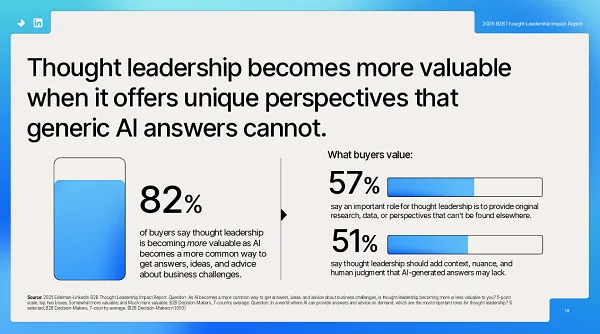
The data compiled from the 1,100 surveyed decision-makers delivers a clear and definitive answer: human expertise, original research, and lived professional experience remain irreplaceable. According to the report, an overwhelming 82% of corporate buyers believe that thought leadership is becoming increasingly valuable in their decision-making processes. Rather than treating expert commentary as a passive marketing exercise, modern executives view it as a primary indicator of a firm’s operational competence.
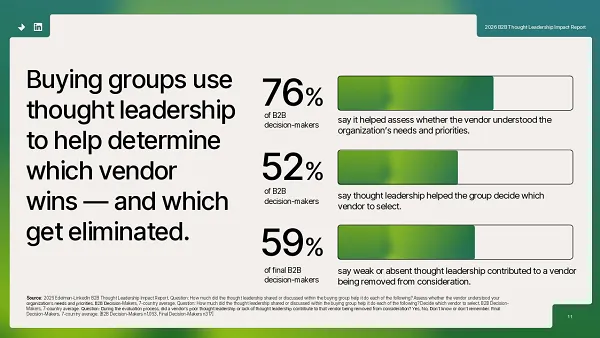
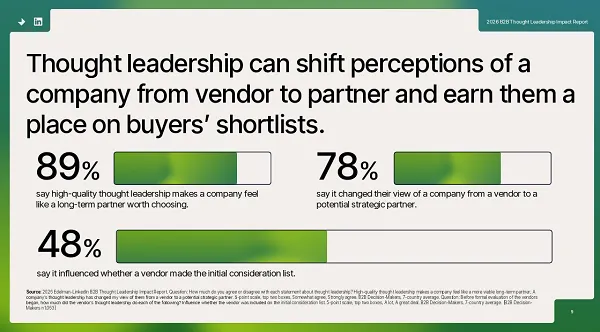
Furthermore, the study underscores the psychological impact of quality content on the vendor selection process. Approximately 89% of respondents stated that high-caliber thought leadership makes a company feel like a genuine, long-term partner worth choosing. In an era where business risks are heavily scrutinized and failed vendor integrations can cost organizations millions of dollars, the reassurance provided by demonstrated industry leadership acts as a powerful de-risking agent.
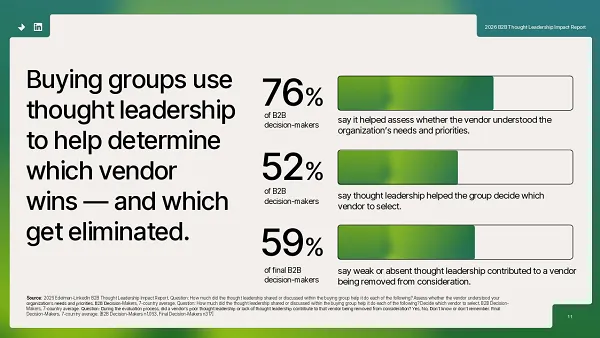
Perhaps most alarmingly for brands that neglect their publishing and executive branding efforts, the data reveals a high cost of invisibility. Companies that fail to produce and share consistent thought leadership content run a severe risk of being eliminated from consideration entirely during the preliminary review phases. When prospective clients assemble their initial longlists, silence is frequently interpreted as a lack of innovation, authority, or stability.
The Interplay Between Artificial Intelligence and Human Insight
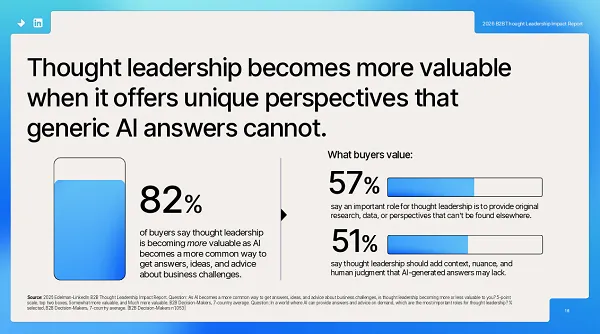
One of the most pressing questions addressed in the 2026 report is how artificial intelligence influences executive purchasing behavior. While AI tools are undeniably playing a larger role in the initial discovery and product research phases, the technology has not replaced the need for authoritative primary sources.
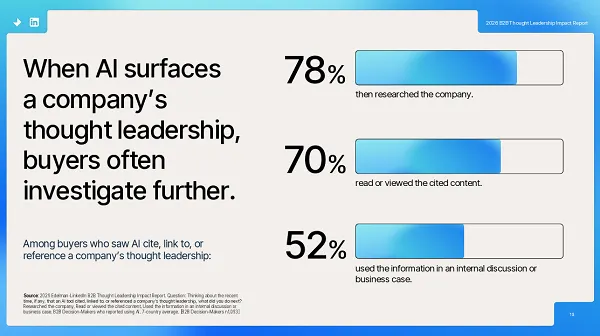
The Edelman and LinkedIn data reveals a multi-step verification process among modern buyers. While executives may use AI systems to generate initial summaries or compile vendor lists, they rarely accept these automated recommendations at face value. Instead, the vast majority of buyers actively validate AI-generated insights by cross-referencing them directly against a brand’s published content, proprietary research, and executive commentary.
This behavior highlights a fundamental limitation of artificial intelligence: AI can synthesize, summarize, and reorganize existing information, but it cannot generate novel, hands-on empirical data, nor can it provide the nuanced context derived from decades of practical, real-world execution. Original industry research, proprietary case studies, and hard-earned executive insights serve as the foundational training data that intelligent systems draw upon—yet it is the human creator who retains ownership of true market innovation. Consequently, brands that rely solely on AI-generated marketing copy find themselves trapped in a loop of recycled generalities, while those investing in authentic thought leadership establish the benchmarks that algorithms ultimately attempt to mirror.
Changing Distribution Dynamics and Private Channels
Beyond the creation of content, the 2026 report sheds light on how B2B buyers consume and distribute professional insights internally. Traditional marketing metrics have historically focused on public social media engagement, such as likes, comments, and public shares on professional platforms like LinkedIn. However, the Edelman and LinkedIn findings suggest that a significant portion of the most valuable content distribution happens away from the public eye.
The data indicates that buyers are increasingly likely to share high-value thought leadership content through private channels—such as internal corporate messaging applications, secure email threads, and closed executive networking groups. When an executive encounters a piece of content that directly addresses a strategic challenge their organization is facing, they frequently route it privately to colleagues, department heads, or C-suite decision-makers with a note recommending action.
This dark social sharing phenomenon implies that public engagement metrics tell only part of the story. A piece of thought leadership may generate modest public visibility while simultaneously driving immense private consensus-building within major enterprise accounts. For content creators and marketing strategists, this necessitates a shift in how campaign success is measured, moving beyond superficial engagement numbers to evaluate the depth and resonance of the arguments presented.
The Power of External Endorsements and Ongoing Partnerships
The report also examines the strategic value of external influencers and industry experts in endorsing business solutions. Historically, influencer marketing was viewed as a consumer-facing tactic, relegated to lifestyle and retail brands. In the B2B sphere, however, the credibility of third-party analysts, respected practitioners, and academic authorities carries substantial weight. When an established industry figure validates a brand’s methodology or product approach, it bridges the trust gap between enterprise vendors and risk-averse buyers.
Moreover, the research highlights that thought leadership is not merely a tool for customer acquisition; it is equally vital for customer retention and relationship reinforcement. Brands must continue producing high-level insights long after a contract is signed. Existing partners look to their vendors for continuous market foresight, strategic guidance, and reassurance that their chosen provider remains at the vanguard of industry evolution. Consistent publishing helps mitigate vendor churn by continually validating the client’s original decision to partner with the firm.
Broader Business Implications and Strategic Imperatives
The overarching takeaway from the 2026 B2B Thought Leadership Impact Report is that differentiation in the digital age requires intentional investment in human capital and intellectual property. As software commoditizes standard operational capabilities, a company’s proprietary knowledge becomes its most defensible competitive advantage.
For corporate leadership, marketing executives, and business developers, the implications of these findings are direct and actionable:
- Prioritize Original Research: Generic commentary no longer moves the needle. Brands must invest in proprietary studies, primary data collection, and empirical research that uncovers new industry realities.
- Elevate Subject Matter Experts: Corporate communications cannot remain anonymous or overly sanitized. Buyers want to hear directly from the engineers, strategists, and executives who are doing the actual work in the field.
- Optimize for Validation: Recognizing that buyers use content to verify AI recommendations, organizations must ensure their digital footprint is robust, transparent, and intellectually rigorous.
- Facilitate Internal Sharing: Crafting content that addresses complex, enterprise-level pain points enables stakeholders to champion your brand within their own private networks and closed communication channels.
Ultimately, while the technological tools available to business buyers will continue to evolve at a rapid pace, the core psychological drivers of commerce remain rooted in trust, shared experience, and demonstrated competence. In a marketplace increasingly saturated with automated efficiency, human expertise stands out as the ultimate differentiator—proving that the most valuable asset a brand can offer is the clarity of its thought.