The financial landscape of the United States has undergone a seismic shift over the last ten years, marked by a decisive departure from physical currency in favor of digital and card-based transaction methods. According to data synthesized from the 2026 Pew Research Center findings and the Federal Reserve Bank of Atlanta’s annual Survey and Diary of Consumer Payment Choice, the American consumer’s relationship with money is increasingly defined by plastic and electronic interfaces. Since 2015, the percentage of Americans who report using cash for all or nearly all of their weekly purchases has been sliced in half, plummeting from 24% to 12%. Simultaneously, the cohort of individuals who eschew cash entirely for their daily transactions has surged, rising from 24% in 2015 to 42% in 2026. This transition is not merely a change in habit but a structural reconfiguration of the domestic economy.
A Chronology of the Decline of Physical Currency
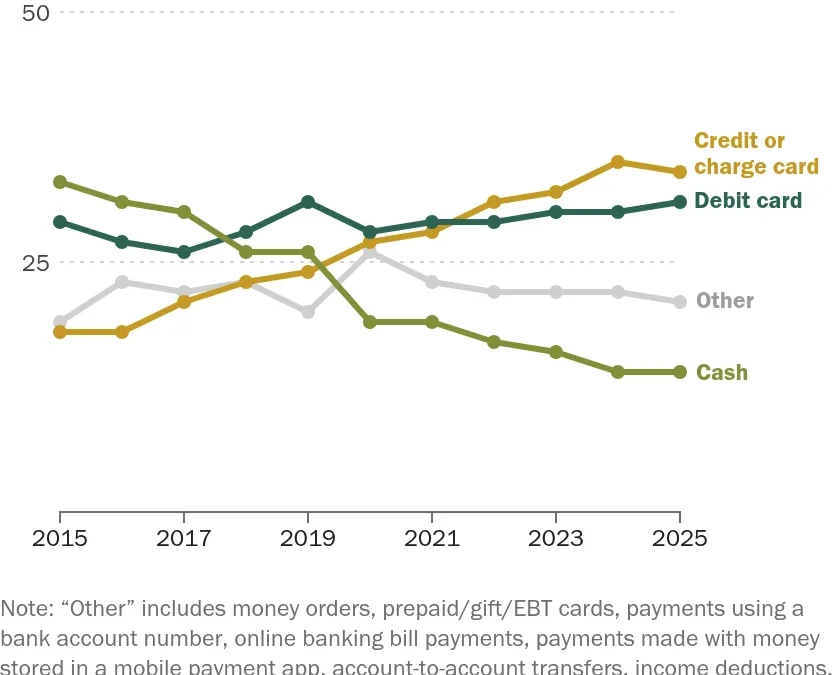
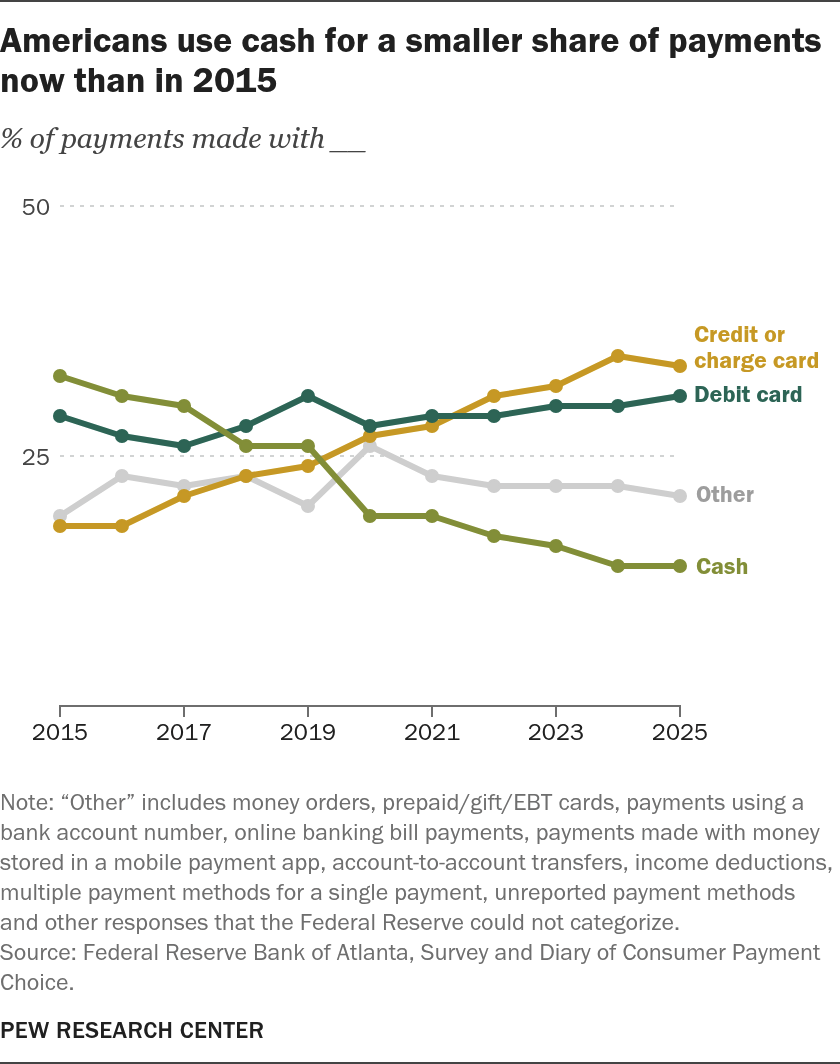
To understand the current state of consumer payments, one must look at the trajectory of the last decade. In 2015, cash remained the dominant force in the American retail environment. At that time, approximately one-third of all consumer payments were conducted in physical currency. Debit cards trailed at 29%, and credit cards accounted for only 18% of transactions. The remainder was distributed among checks, nascent mobile payment apps, and various bank-mediated transfers.
The turning point occurred in 2018, a year that serves as a milestone in this financial evolution. For the first time, debit card usage eclipsed cash usage in the aggregate volume of consumer payments. This shift signaled that the convenience of electronic transfers was beginning to outweigh the anonymity and tangibility of physical notes. The trend accelerated significantly during the 2020 pandemic, which acted as a catalyst for contactless payments and e-commerce growth. By 2022, the hierarchy had shifted again: credit cards surpassed debit cards as the most frequently used payment instrument in the country.
By the most recent reporting in 2025, the landscape had solidified into a new status quo. Credit cards claimed 34% of the payment market share, while debit cards held 31%. Together, these two plastic-based methods accounted for nearly two-thirds of all transactions. Cash, once the undisputed king of the checkout counter, had been relegated to just 14% of transactions, marking it as the third-most common method of payment.
The Dynamics of Transaction Value
The decline of cash is deeply tied to the psychology of spending and the nature of the transaction itself. The Federal Reserve’s data indicates a clear correlation between the payment method and the monetary value of the purchase. In 2025, the average cash transaction was a modest $58. In contrast, debit card transactions averaged $74, and credit card transactions reached an average of $80.
This disparity highlights a functional division in how consumers manage their money. Lower-value, daily discretionary spending remains the primary domain of cash. Conversely, as the transaction size increases, so too does the consumer’s reliance on credit. High-value transactions—those involving significant financial commitments such as bill payments, mortgage servicing, or large online purchases—are increasingly handled via online banking and direct account transfers. These categories of payments often reach between $400 and $700 per transaction, figures that would be cumbersome and impractical to settle in physical cash.
The smallest average transactions, typically hovering around $35, are reserved for prepaid, gift, or Electronic Benefits Transfer (EBT) cards. These instruments serve specific demographic and functional niches, such as government assistance programs or retail-specific gift scenarios, and do not compete directly with the broader, universal utility of credit cards.
Consumer Preference vs. Behavioral Reality
While the shift toward electronic payments is undeniable, it is worth examining whether these behaviors align with consumer preferences. The Federal Reserve’s research suggests that while most Americans have adapted to a card-first economy, their preferences are not uniform across all contexts.
When making in-person purchases, 78% of Americans express a preference for credit or debit cards, while only 16% state a preference for cash. This indicates that the decline in cash usage is not entirely forced by merchants; rather, it is a reflection of a consumer base that prioritizes the convenience, security, and reward structures associated with card payments. However, a significant gap remains between preference and action. Data reveals that 70% of current cash payments are made by individuals who would actually prefer to use another method, primarily credit or debit cards, but may find themselves in situations where they lack access to electronic infrastructure or are dealing with small vendors that require cash.
The domain of bill payment reveals a more complex picture. While 92% of online shopping is done via cards, bill payments are much more divided. Nearly half (47%) of Americans prefer credit or debit cards for their bills, while 40% favor direct online banking or account-to-account transfers. This suggests that for fixed, recurring financial obligations, consumers are more comfortable allowing direct access to their bank accounts than they are for transient, point-of-sale retail transactions.
The Broader Economic Implications
The transition toward a cashless society has profound implications for financial inclusion, privacy, and economic stability. From a retail perspective, the migration away from cash reduces the administrative burden of handling physical currency, such as the costs associated with security, coin and note management, and the risk of theft. Merchants have largely embraced this transition, as credit and debit card processing has become more efficient and affordable.
However, researchers and policymakers often point to the risks associated with this shift. The "unbanked" population—those who do not have access to credit cards or traditional bank accounts—find themselves increasingly alienated in an economy that prioritizes digital transactions. As stores move toward "cashless" policies, individuals who rely on physical currency for budgeting or who lack the documentation to secure a credit line face significant barriers to participation in the modern economy.
Furthermore, the shift to electronic payments creates a massive footprint of data. Every credit card swipe or online transfer leaves a digital trail, providing institutions with granular data on consumer behavior. While this allows for more efficient marketing and fraud detection, it raises substantial questions regarding personal privacy and the centralization of financial data.
The Future of Payment Infrastructure
Looking forward, the rise of "Other" payment categories, which currently account for roughly 21% of transactions, suggests that the evolution is far from complete. This category includes mobile wallet applications, peer-to-peer transfers, and emerging fintech solutions that bypass traditional card networks.
The 2026 data serves as a diagnostic tool for financial institutions and regulators alike. As credit cards solidify their position as the preferred tool for the American consumer, the focus of the financial sector is shifting toward improving the security of these transactions and ensuring that the infrastructure remains resilient against systemic failures.
The decline of cash is not merely a story of technology replacing tradition; it is a fundamental shift in the social contract of trade. As the reliance on physical money wanes, the infrastructure of the American economy is being rewritten in code. While the benefits of speed, tracking, and convenience are clear, the challenge for the coming decade will be to ensure that this digital transition remains inclusive, secure, and respectful of the diverse ways in which different segments of the population manage their financial lives. The data from the past ten years suggests that while cash may not disappear entirely, its role as a primary medium of exchange has effectively reached the twilight of its dominance.