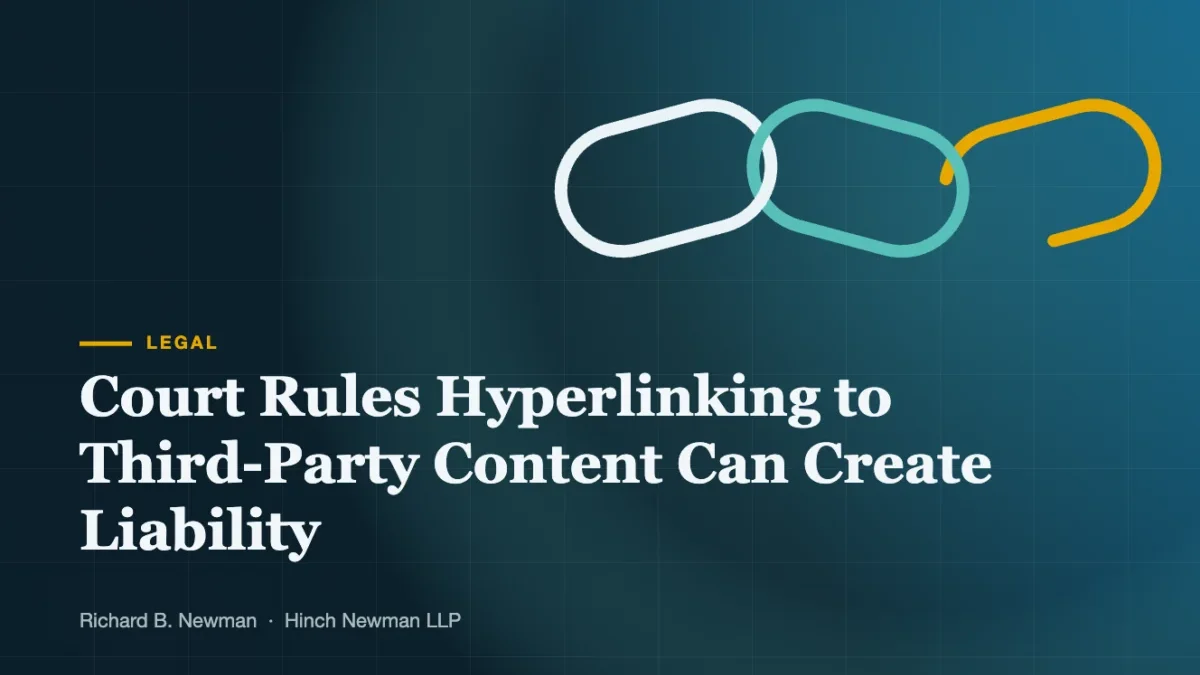
A landmark decision handed down by the United States Court of Appeals for the Tenth Circuit on July 14, 2026, has fundamentally altered the legal landscape regarding digital marketing and corporate liability. In the case of KetoNatural Pet Foods, Inc. v. Hill’s Pet Nutrition, Inc. (No. 24-3185), the appellate court ruled that hyperlinks embedded within a company’s website can, under specific circumstances, effectively incorporate third-party content into the company’s own commercial speech. This interpretation carries significant weight for any entity utilizing external links to substantiate claims, cite studies, or bolster promotional narratives under the Lanham Act.
The core of the dispute centered on whether a corporation can be held legally responsible for false advertising claims when the allegedly deceptive or unsubstantiated information resides on a website owned and operated by a third party, rather than on the company’s own domain. By ruling that intentional hyperlinking can function as an extension of a firm’s promotional message, the Tenth Circuit has established a precedent that demands a more rigorous vetting process for digital outbound links.
The Chronology of the Litigation
The legal friction began when KetoNatural Pet Foods, Inc. initiated a Lanham Act suit against Hill’s Pet Nutrition, Inc., alleging that the latter engaged in false and misleading advertising practices. The controversy specifically concerned nutritional claims made by Hill’s, which the plaintiff argued were deceptive. A critical component of the plaintiff’s argument was that Hill’s had directed its consumer base to external websites through hyperlinks. These destination sites contained information that KetoNatural claimed were false, misleading, or lacked the scientific rigor required for such bold health-related assertions in the pet food industry.
Initially, the lower court grappled with the distinction between "owning" content and merely "referencing" it. In traditional digital media law, the prevailing assumption was often that a hyperlink acted as a mere navigational tool—a digital footnote—rather than an adoption of the linked content. However, as the case progressed through the Tenth Circuit, the appellate panel shifted focus toward the "intentionality" of the link. The court ultimately concluded that when a company curates its website to lead consumers along a specific path of information, it is effectively curating its own promotional message. By choosing to link to third-party studies or articles to support a commercial claim, the company is endorsing that information as part of its own sales pitch.
The Legal Framework: Lanham Act and Commercial Speech
The Lanham Act serves as the primary federal vehicle for false advertising litigation in the United States. It prohibits any person from using in commerce any word, term, name, or symbol which is likely to cause confusion, or which misrepresents the nature, characteristics, or qualities of goods or services. Historically, plaintiffs in these cases focused on the "four corners" of a website—the text, images, and videos hosted directly on the defendant’s server.
The Tenth Circuit’s decision expands this scope. The court reasoned that "commercial speech" is not strictly defined by who hosts the server, but rather by the function the information serves in the marketplace. If a company uses a hyperlink to guide a consumer toward a specific narrative that benefits the company’s brand or product, the destination content functions as a component of the promotional message. Therefore, if the linked content contains false or misleading statements, the linking company may be liable for those statements as if they were printed directly on their own homepage.
Supporting Context: The Shift in Digital Oversight
This ruling arrives at a time when regulatory bodies, most notably the Federal Trade Commission (FTC), have been intensifying their scrutiny of digital marketing ecosystems. In recent years, the FTC has updated its Guides Concerning the Use of Endorsements and Testimonials in Advertising to account for the complexities of modern social media and influencer marketing.
While the KetoNatural case is a private civil action, its reasoning aligns with the growing trend of regulatory "truth in advertising" enforcement. For years, legal experts have warned that the separation between a brand and its affiliates, influencers, or cited scientific sources is becoming increasingly porous. The Tenth Circuit’s decision provides a roadmap for regulators to argue that a company’s entire "digital footprint"—including the sites they encourage consumers to visit—is subject to the same compliance standards as traditional television or print advertisements.
Broader Implications for Digital Marketers
The implications for the digital marketing industry are profound and require an immediate audit of standard operating procedures. For years, the standard practice for many brands has been to link to external scientific journals, news articles, or influencer reviews to provide "social proof" for their products. Under the new ruling, the failure to verify the accuracy of the destination content could expose the linking company to significant litigation risks.
- The "Curated Pathway" Problem: Marketing departments often design "customer journeys" that funnel users toward specific third-party validation. Courts may now look at the entire pathway rather than isolated pages, viewing the sequence of clicks as a singular, unified commercial statement.
- Generative AI and Dynamic Links: The rise of generative AI adds another layer of complexity. If an AI agent on a company’s website autonomously generates a hyperlink to a third-party source, the company may still be held responsible for the content of that link. The "intentionality" requirement identified by the court will likely be the subject of intense future litigation as companies attempt to distance themselves from algorithmic outputs.
- Third-Party Influencer Programs: Affiliate marketing and influencer partnerships frequently involve brands directing traffic to third-party platforms. If those platforms contain exaggerated or false claims that violate the Lanham Act, the brand’s decision to drive traffic there could be interpreted as an adoption of those claims.
Expert Analysis and Compliance Strategies
Richard B. Newman, an advertising practices attorney at Hinch Newman LLP, notes that this decision serves as a stern warning to businesses that treat hyperlinks as passive conduits. "The takeaway is that courts may look to the promotional materials and pathway as a whole," says Newman. "Companies must realize that by deliberately embedding links to third-party content, they may be found to have incorporated that content into their own commercial speech."
To mitigate these risks, legal and marketing teams are encouraged to adopt several proactive measures:
- Rigorous Vetting of Outbound Links: Companies should treat external links with the same level of compliance scrutiny as internal ad copy. If a link points to a study or a third-party review, that content must be verified for accuracy and substantiation.
- Disclaimer Efficacy: While disclaimers stating that a company is "not responsible for third-party content" are standard, the Tenth Circuit’s ruling suggests that such disclaimers may be insufficient if the link is clearly being used to advance a specific promotional narrative.
- Audit of Existing Digital Assets: Marketing departments should conduct an audit of their current web properties to identify high-traffic hyperlinks. Any link leading to content that could be interpreted as a health, safety, or performance claim should be reviewed by legal counsel.
- Contractual Indemnity: When working with third-party sites, influencers, or content creators, brands should ensure their contracts include robust indemnity clauses that account for the legal risks associated with linked content.
Conclusion: The New Era of Digital Liability
The Tenth Circuit’s ruling in KetoNatural Pet Foods, Inc. v. Hill’s Pet Nutrition, Inc. signals the end of an era where digital marketers could assume that a hyperlink provided a "safe harbor" from the content hosted elsewhere. In the modern digital economy, where the user experience is defined by the seamless movement between websites, the law is increasingly viewing the web as a single, integrated environment.
As companies continue to integrate complex digital marketing strategies—including influencer networks, affiliate programs, and AI-driven content—the obligation to maintain the truthfulness of the entire marketing ecosystem becomes paramount. The decision serves as a reminder that in the eyes of the law, where you lead your consumer is just as important as what you say to them directly. For digital marketers, the message is clear: the links you provide are now, legally speaking, part of the story you are telling. Ensuring the accuracy of that story—from the first click to the final destination—is no longer just a best practice; it is a fundamental legal requirement.