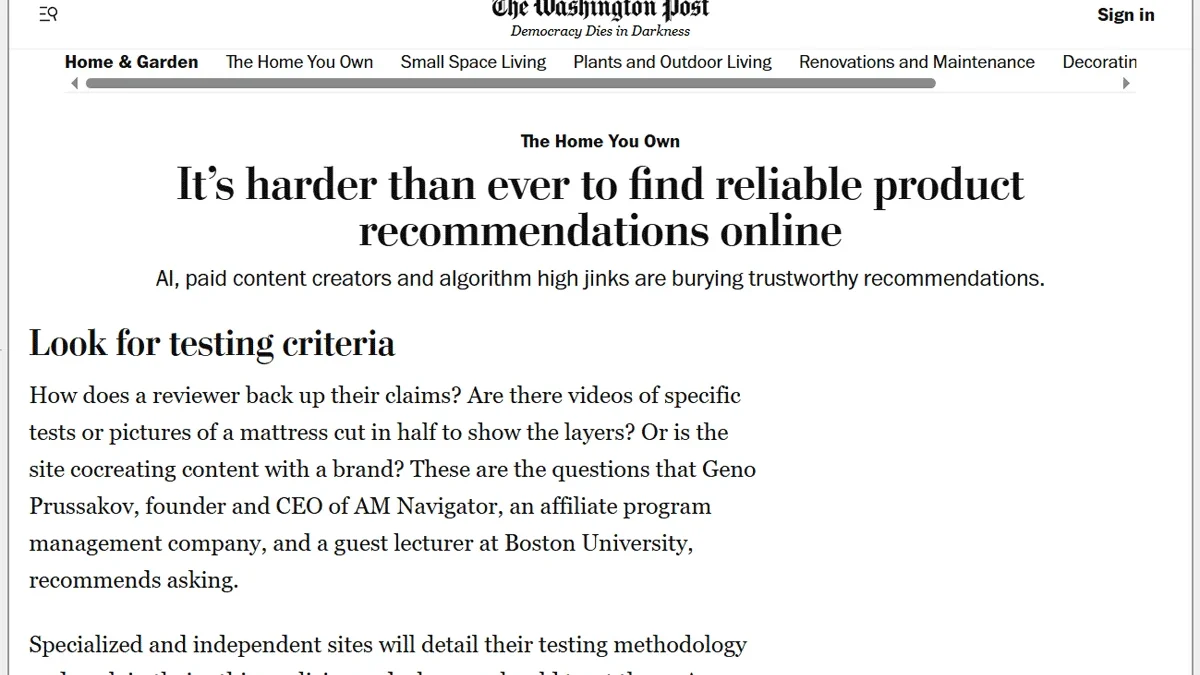
The modern digital landscape has fundamentally transformed how consumers discover, evaluate, and purchase products online. No longer reliant solely on traditional advertisements or word-of-mouth recommendations, modern shoppers increasingly turn to established media outlets for guidance. Major publishers—ranging from legacy newspapers and broadcast networks to digital-native lifestyle brands—now routinely publish comprehensive product roundups, gift guides, and comparative reviews. Earlier this year, prominent affiliate marketing expert and agency executive Geno Prussakov was approached by The Washington Post to provide industry insights regarding how consumers and industry observers should critically evaluate these online product recommendation lists published by high-authority media organizations. While Prussakov’s initial commentary offered a concise perspective for the publication’s readership, the broader implications of media monetization and affiliate commerce demand a far more rigorous, comprehensive examination.
The intersection of journalism, search engine optimization (SEO), and commerce has created a powerful economic engine. Over the past decade, major media companies have realized that their hard-earned brand authority and domain reputation can be effectively monetized. By leveraging their high ranking in search engine results pages (SERPs) for commercial keywords, publishers capture high-intent traffic and direct consumers toward online retailers through affiliate links. This practice has become a vital revenue stream for news organizations facing declining print subscriptions and volatile digital advertising markets. However, this commercial evolution has sparked ongoing debates regarding editorial independence, consumer trust, and the transparency of product rankings.
The Evolution of Big Media Monetization and Search Authority
For years, the separation between church and state—the traditional firewall between a publication’s editorial department and its advertising or business operations—was sacrosanct. Today, that boundary has increasingly blurred as publishers integrate e-commerce teams directly into their newsrooms. The monetization of search engine authority is perhaps the most visible manifestation of this shift. When a household-name media outlet publishes a listicle ranking the "best mattresses of 2025" or the "top-rated espresso machines," that article often dominates the top positions on major search engines due to the publication’s immense domain authority.
This dominance is not accidental. Major media brands invest heavily in SEO infrastructure, keyword research, and dedicated commerce desks staffed by product reviewers, testing editors, and affiliate managers. The economic model relies heavily on affiliate marketing, where the publisher earns a commission percentage on every sale generated through outbound tracking links embedded within the review content. Consequently, the commercial viability of these operations depends on maintaining high search rankings and convincing the reading public that the recommendations are both unbiased and thoroughly vetted.
Behind the Scenes: How Publishers Vet Products and Maintain Standards
Despite the clear financial incentives driving media-publisher product roundups, industry professionals argue that most major media outlets approach commerce content with a high degree of operational seriousness. Protecting a multi-decade or multi-century brand reputation is paramount; a single scandal involving fake reviews or paid-for placements can cause irreparable reputational damage and trigger a drop in search visibility. Based on industry practices observed by digital commerce management agencies such as AM Navigator, major media publishers typically employ rigorous internal protocols before endorsing products to their audiences.
First, many publishers establish dedicated testing laboratories or rely on expert panels. Rather than simply aggregating specs from manufacturer websites, publications with robust commerce operations physically acquire, test, and compare products side-by-side. For instance, tech and appliance reviewers will spend weeks putting consumer electronics through standardized stress tests, while fashion and lifestyle editors evaluate textiles for durability, comfort, and ethical sourcing.
Second, editorial independence guidelines are frequently codified into formal company policies. While the commerce team works closely with affiliate networks and merchant managers, the writers and testers are often insulated from direct financial negotiations. In many reputable newsrooms, the editorial staff tasked with selecting and reviewing products does not negotiate commission rates or placement fees; those business-to-business discussions are handled entirely by specialized monetization or business development teams.
Third, media outlets increasingly rely on rigorous data analytics to refine their selections. Rather than relying solely on subjective preference, editors analyze return rates, consumer satisfaction metrics, customer service responsiveness, and long-term reliability data. By factoring in actual consumer experiences post-purchase, publishers aim to protect their credibility and minimize the inclusion of subpar products that could trigger reader backlash or product returns.
Finally, compliance with regulatory standards, such as those enforced by the Federal Trade Commission (FTC), has become standard operating procedure. Reputable publishers prominently display affiliate disclosure statements near the top of their commerce articles, explicitly notifying readers that the publication may earn a commission if they click through and make a purchase. This transparency is designed to maintain legal compliance while fostering an atmosphere of candid disclosure with the readership.
The Financial Realities: When Financial Arrangements Influence Rankings
Despite stringent internal guidelines and ethical frameworks, industry observers acknowledge that the commercial pressures of affiliate publishing can occasionally compromise objectivity. The fundamental tension of media-driven commerce lies in the fact that higher commissions or guaranteed placements can directly impact a publisher’s bottom line.

Financial arrangements between advertisers and publishers can manifest in several ways. In some instances, brands negotiate enhanced affiliate commission rates, offering publishers a larger cut of the sale price in exchange for prominent placement within a highly competitive gift guide or seasonal roundup. In other cases, advertisers may offer exclusive discount codes, custom co-branded landing pages, or Earnings Per Click (EPC) guarantees—commitments that ensure a publisher makes a minimum financial return regardless of conversion performance.
Furthermore, "pay-to-play" models, while officially discouraged by top-tier journalistic standards, occasionally infiltrate lower-tier digital media properties or sponsored content hubs. In these scenarios, placement fees are exchanged directly for inclusion in product roundups, effectively turning editorial real estate into paid advertising space disguised as objective journalism. While elite legacy publications fiercely guard against this practice to protect their brand equity, the proliferation of digital publishers has made it increasingly difficult for consumers to distinguish between strictly tested reviews and commercially manipulated placements.
Strategic Consumer Advice: How to Evaluate Online Product Recommendations
Given the complex financial incentives and varying standards across the digital publishing ecosystem, consumers must adopt a proactive, critical mindset when consulting online product roundups. Industry experts recommend a series of practical evaluation steps to ensure purchasing decisions are grounded in objective reality rather than marketing hype.
-
Cross-Reference Multiple Independent Sources: Never rely on a single publication’s recommendation. If a product is consistently ranked at the top across three or four completely independent, reputable testing sites, the likelihood of genuine quality is significantly higher.
-
Scrutinize the Testing Methodology: Look closely at how the publisher evaluated the product. Did they handle and test the physical item, or did they simply aggregate specifications and user reviews from online retailers? Legitimate reviews typically feature original photography, video demonstrations, and detailed descriptions of testing environments and criteria.
-
Check for Affiliate Disclosures and Transparency: Transparency is a strong indicator of editorial integrity. Reputable publishers clearly state their monetization methods and provide insight into their selection criteria. If an article lacks any form of disclosure or reads like a thinly veiled promotional brochure, approach its conclusions with skepticism.
-
Evaluate User Reviews and Long-Term Feedback: Media roundups capture a product’s performance at a specific moment in time, often based on short-term testing units. Before making a final purchasing decision, check aggregate customer reviews on independent platforms, Reddit communities, and consumer advocacy sites to gauge real-world, long-term durability and customer service experiences.
Broader Industry Implications and the Future of Media Commerce
The monetization of search authority and affiliate commerce by big media publishers represents a permanent structural shift in the modern publishing economy. As traditional advertising revenues continue to face headwinds from algorithmic changes and shifting consumer habits, commerce content has evolved from a supplementary revenue experiment into a core economic pillar for digital journalism.
However, this reliance on affiliate revenue introduces long-term risks for both publishers and consumers. For publishers, an over-reliance on search engine traffic makes their business models highly vulnerable to algorithmic updates implemented by search engine giants like Google. A single core update that demotes a publisher’s commercial ranking can devastate quarterly revenue projections almost overnight. Furthermore, the constant pressure to capture commercial search traffic can lead to a homogenization of content, where numerous publishers write identical articles targeting the exact same high-volume keywords, ultimately diluting the unique voice and investigative value of the media brand.
For consumers, the ongoing commercialization of media necessitates a higher level of digital literacy. As artificial intelligence-generated content and automated product roundups flood the internet, discerning authentic, expert-driven journalism from commercially driven listicles becomes increasingly challenging. The long-term health of the digital marketplace will depend heavily on the commitment of major media outlets to maintain rigorous editorial standards, transparent disclosures, and genuine consumer-first testing methodologies. Ultimately, while big media product recommendations can serve as a valuable starting point for consumer research, they must be utilized as one tool among many in the modern purchasing journey.