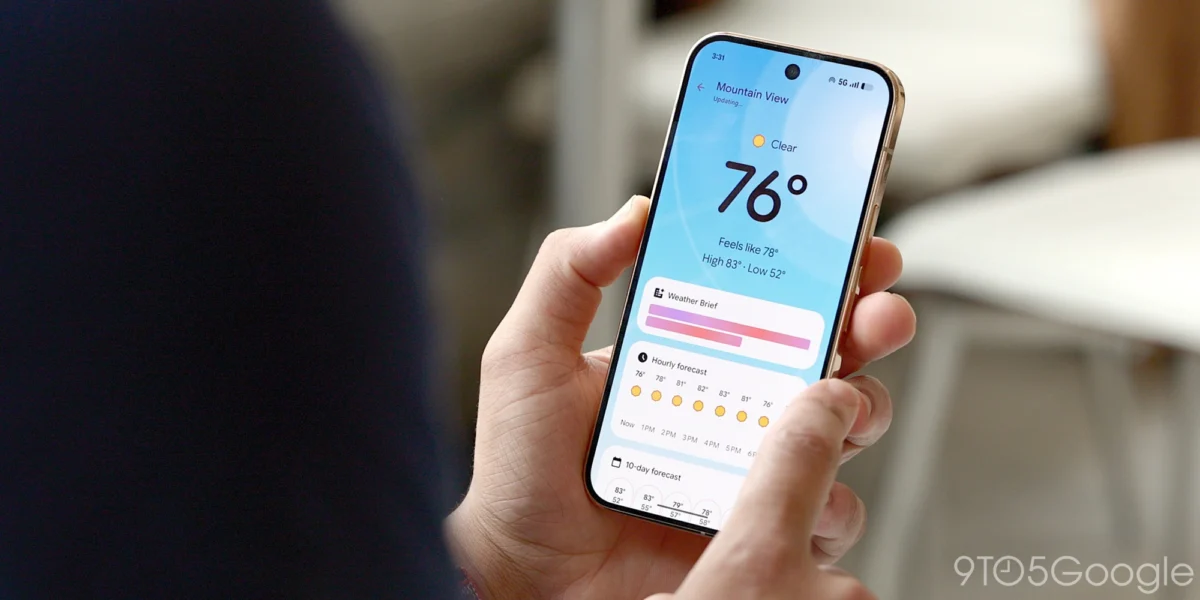
Google has officially released the latest iteration of its Pixel Weather application, version 1.1.20261012.x, introducing a suite of interface enhancements and a significant new feature designed to improve the accuracy of localized meteorological forecasting through user participation. This update marks a strategic pivot for the Pixel-exclusive utility, shifting it from a passive data consumption tool toward a more interactive, community-driven platform. The rollout, which began over the weekend, represents the latest effort by the Mountain View-based technology giant to refine its Android-native software ecosystem as it prepares for broader integration within its mobile hardware lineup.
Interface Refinements and Aesthetic Adjustments
The most immediate change users will notice upon updating to the latest version of Pixel Weather is a subtle but impactful design shift regarding how severe weather alerts are presented. Historically, the application utilized a high-contrast, bright red background for card containers whenever a city experienced an active weather warning. While effective for drawing attention, these red blocks often disrupted the visual harmony of the application’s Material You-inspired design language.
In this latest release, Google has opted for a more subdued, integrated aesthetic. The bright red backgrounds have been removed, replaced by the standard pill-shaped containers that utilize the user’s chosen Dynamic Color theming. Under this new design, the warning status is conveyed through the text itself, which remains colored in a distinctive red to maintain visibility without overwhelming the interface. This visual consistency has been applied across both the application’s homepage and the dedicated city-specific pages. Additionally, the “Google Weather” source attribution tag at the bottom of the interface now adopts the system’s theme, further streamlining the app’s overall look and feel.
The Introduction of Crowdsourced Weather Reporting
The most substantive addition to the Pixel Weather experience is the “Report current weather” feature. This functionality is intended to bridge the gap between satellite-based meteorological modeling and ground-level reality. Often, broad-scale weather models struggle to account for hyper-local microclimates, such as localized snow squalls, sudden fog patches, or flash flooding that may affect a specific street or neighborhood while remaining undetected by regional radar stations.

The “Report current weather” card now appears at the bottom of the primary location feed, allowing users to move it to a more prominent position if they desire. When a user interacts with this feature, they are prompted with the prompt: “Share the current weather condition to improve local forecasts.” Upon selecting “Submit a report,” users are taken to a dedicated submission sheet. While the current implementation allows for two distinct pieces of input data—typically related to current sky conditions and precipitation—it is clear that the underlying architecture is designed to collect actionable telemetry.
Google has explicitly addressed privacy concerns surrounding this feature. According to the official documentation, the data collected includes the user’s current device location and specific diagnostic information. To mitigate privacy risks, Google has confirmed that this feedback is not linked to the user’s primary Google account, effectively anonymizing the data at the point of ingestion. This approach aligns with the company’s increasing focus on privacy-centric data collection, utilizing “differential privacy” techniques to ensure that the aggregate data improves accuracy without compromising individual user identity.
Chronology of Pixel Weather Development
The evolution of Pixel Weather has been a core component of Google’s broader software strategy over the past eighteen months. Following the initial transition away from the legacy Google Weather experience—which was previously embedded within the Google Search app—the standalone Pixel Weather app has seen a rapid release cadence:
- Q3 2026: Initial rollout of the standalone Pixel Weather app, designed exclusively for Pixel devices, featuring high-fidelity animations and modular cards.
- Early Q4 2026: Integration of advanced forecast modeling, allowing for more granular hour-by-hour updates and refined precipitation alerts.
- October 2026: Implementation of the current update (v.1.1.20261012.x), introducing crowdsourced reporting and visual standardization of alert cards.
This timeline reflects a broader shift within Google’s Android division toward creating “first-party” experiences that are more robust than third-party alternatives. By bringing weather data processing in-house and now introducing a feedback loop, Google is effectively creating a real-time ground-truth sensor network consisting of millions of Pixel devices worldwide.
Supporting Data and Meteorological Context
The reliance on crowdsourced weather data is a trend observed across the meteorological sector. Organizations like the National Weather Service (NWS) and private weather networks have long utilized “Skywarn” spotters and voluntary weather reporting systems to verify data. However, the scale at which a mobile OS can operate is significantly larger.

According to industry data on hyper-local forecasting, accuracy can improve by as much as 15–20% when real-time ground-level reports are integrated into numerical weather prediction (NWP) models. By utilizing the barometers, light sensors, and GPS coordinates inherent in modern smartphones, Google is well-positioned to reduce the “latency of reality,” where forecasts lag behind rapidly changing atmospheric conditions.
Official Stance and Privacy Implications
Google’s communication regarding the new reporting feature emphasizes the dual goal of data accuracy and user protection. The company stated, “Submit a report if the weather conditions don’t look right.” This invitation to the user base serves two purposes: it provides a mechanism for users to feel involved in the app’s performance, and it creates a massive, distributed testing environment for Google’s internal forecast algorithms.
The decision to exclude the Google account identity from the data collection process is a critical move, particularly as regulators in the European Union and North America continue to scrutinize the collection of geolocation data. By decoupling location history from user identity, Google aims to circumvent potential backlash while still obtaining the high-fidelity location data necessary to improve localized forecast models.
Broader Impact and Implications
The implications of this update are significant for the future of the Pixel ecosystem. As mobile devices become increasingly powerful, the hardware is moving away from being a mere conduit for third-party services and toward being a sophisticated, integrated platform. The ability to collect and process real-time environmental data turns the Pixel user base into a global network of distributed sensors.
Furthermore, this update suggests that Google is preparing for a future where “Ambient Computing” becomes the standard. If a user’s phone can report current weather conditions automatically or via simple input, that data could eventually inform other parts of the Google ecosystem—such as smart home thermostats, automated lighting, or navigation routing—creating a more cohesive and responsive digital environment.

From a competitive standpoint, this update positions Pixel Weather as a direct challenger to established weather utilities like The Weather Channel or AccuWeather. While those services have long relied on professional-grade hardware and partnerships, Google’s strategy of leveraging the ubiquity of the Android platform provides a volume of data that few competitors can match. If successful, the crowdsourced reporting feature could set a new industry standard for how mobile weather applications are expected to perform, effectively raising the bar for accuracy and user engagement.
As the deployment continues, the industry will be watching to see how Google manages the potential for “noise” in the data. Crowdsourced systems are notoriously susceptible to erroneous reports or malicious input. It is expected that Google will deploy machine learning filters to cross-reference user reports against satellite and radar data, ensuring that only valid and consistent reports are used to refine forecast models.
In conclusion, the update to version 1.1.20261012.x of Pixel Weather is more than a simple cosmetic refresh. It represents a strategic investment in data collection and user-centric software design. By combining subtle UI improvements with a sophisticated crowdsourced reporting mechanism, Google is taking a calculated step toward more precise, localized, and privacy-conscious meteorological forecasting, signaling a new chapter in the capabilities of the Pixel software suite.