The digital landscape is constantly evolving, pushing the boundaries of what’s possible in web-based experiences. A recent groundbreaking project, dubbed "ZERO," has emerged, showcasing an exceptionally innovative approach to interactive narrative and web performance optimization. What began as a conceptual pitch has blossomed into a fully realized, immersive journey that not only captivates users with its unique mechanics but also sets a new benchmark for efficient asset delivery and real-time rendering on the web. This article delves into the intricate engineering and artistic decisions that brought ZERO to life, from its unconventional entry point to its meticulously crafted narrative progression and the sophisticated technical underpinnings that enable its remarkable performance.
The project’s inception was far from a traditional presentation. Instead, the team, led by Atul Khola, opted for a tangible proof of concept. Their core idea revolved around an immersive scrolling experience designed to challenge the conventional educational pathways. Within a mere 48 hours, they developed the signature "draw a zero" interaction, a dynamic entry mechanism that immediately distinguishes ZERO from the myriad of passive websites. This initial prototype, significantly accelerated by the judicious use of AI in generating foundational code, was instrumental in securing the project. The AI’s contribution wasn’t in replacing human ingenuity but in amplifying it, allowing the team to rapidly iterate on early concepts and focus their efforts on refining the user experience and visual fidelity, particularly the ethereal frost effect that elegantly unfurls the narrative.
A Narrative Unveiled: Six Stages, Five Gates
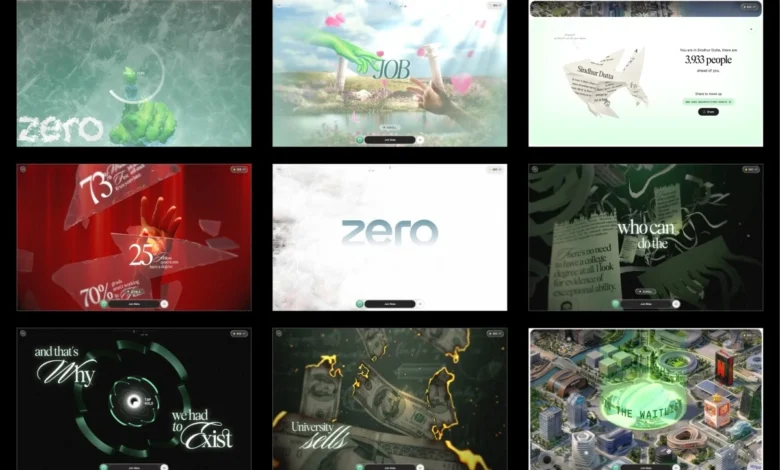
ZERO’s narrative is intricately woven across six distinct scrolling stages, each punctuated by five interactive "gates" that either momentarily pause or dynamically redirect the user’s journey. These gates are not mere transitions but active elements of the storytelling, demanding user engagement through actions like drawing a zero, holding to shatter glass, or holding to propel through a symbolic tunnel.
The narrative arc commences by presenting the allure of the traditional academic route: diligent study, academic achievement, and the promise of securing a position within a prestigious corporation. This idealized scenario is dramatically disrupted at the first gate. As the user is prompted to shatter a pane of glass, this symbolic act visually deconstructs the established pathway. The subsequent stage lays bare the stark realities of unemployment statistics, scattered like debris across the fractured glass. Stage three further dismantles the perceived value of a degree, depicting it as mere paper as money incinerates and certificates are shredded. This culminates in a visual transition into a tunnel ingeniously shaped like the ZERO logo. The journey then ascends, emerging above the clouds into stage four, where a city constructed from the literal headquarters of real-world corporations unfolds. The experience culminates in stage five, which cedes control entirely to the user. Here, an interactive city map allows for free exploration, placing the user at the nexus of potential career paths.
Architectural Foundation: The Virtual Scroll
A cornerstone of ZERO’s technical achievement lies in its deliberate departure from the browser’s native scrolling mechanism. The project eschews traditional scroll-triggered animations and oversized DOM elements. Instead, it employs a sophisticated virtual scroll system. User input from both mouse wheels and touch gestures are meticulously translated into a virtual scroll value, which then smoothly interpolates towards its intended target. This singular virtual scroll value acts as the central nervous system for the entire experience, dictating everything from asset loading and animation sequences to shader timing, text overlays, and visual transitions.

This architectural decision is further compartmentalized through a segment-based system. Each stage and interactive element is designed as a self-contained module, possessing its own optional lifecycle hooks. These include functions for initialization (enter), progress scrubbing within the segment (scrub), continuous updates (update), and cleanup (teardown). This modularity has proven invaluable for maintainability and debugging, especially as development progressed. Critically, the system ensures that navigating to any stage initiates the lifecycle of all preceding segments, guaranteeing a consistent and predictable user experience, as if the user had naturally scrolled through the entire sequence.
3D Asset Preparation: Optimizing for the Web
The development of ZERO spanned four intensive months, with a significant portion dedicated to the meticulous preparation of its 3D assets. The initial source files, originating from production Blender scenes, were substantial, featuring uncompressed geometry, 8K textures, and baked animations, collectively exceeding a gigabyte in size. The early stages involved strategic decisions regarding the optimal format for each asset to ensure web compatibility and performance.
Geometry is delivered using DRACO compression, with self-hosted decoders integrated directly into the project. The Draco and KTX2/Basis transcoders are bundled locally within the public/vendor/ directory, a crucial lesson learned after experiencing disruptions caused by external CDN slowdowns. The team emphasizes that relying on third-party servers for essential decoding tools creates a vulnerability, as the entire asset pipeline becomes dependent on their availability.
Textures presented the most significant challenge and opportunity for performance gains. While PNG files might appear small on disk, they are fully decompressed into GPU memory. A 2048² texture, regardless of its file size, consumes approximately 16MB of VRAM. The adoption of KTX2 with ETC1S compression proved transformative. These textures remain compressed even on the GPU, drastically reducing memory footprint and accelerating upload times.
The Compression Previewer: A Crucial Internal Tool
The lossy nature of ETC1S compression posed a challenge for local previewing. Achieving the right balance between compression and visual fidelity often involved a laborious trial-and-error process. To streamline this, the team developed an internal dashboard featuring a custom converter and previewer. This tool allows for side-by-side comparison of compressed and uncompressed images and videos, enabling granular adjustment of ETC1S settings on an asset-by-asset basis. This granular control ensures that compression is applied more aggressively where it’s imperceptible, while preserving critical detail in hero assets. Furthermore, mipmaps were selectively disabled where they offered no discernible benefit. This seemingly simple tool had a profound impact on the final build’s efficiency, highlighting a often-overlooked aspect of WebGL workflows.
The principle of asset consolidation extended to texture atlases. For instance, all hand textures were meticulously packed into a single 4×4 atlas, with individual meshes referencing their specific section through UV offsets and scaling. This same approach was applied across various elements, including text sprites, certificates, paper shreds, clouds, and glass shards. What began as over fifty individual images was ingeniously reduced to a dozen consolidated atlases. Gradient backgrounds, often resource-intensive, were largely replaced by concise GLSL shader code. These optimization efforts were critical in reducing the initial build size of 35-40MB down to under 10MB, with the interactive world map strategically isolated in its own loading group to avoid delaying the initial experience.

Mitigating Texture Upload Bottlenecks
While download size is a critical metric, the process of uploading compressed textures to the GPU on the main thread can introduce significant performance hiccups. A large texture upload can easily halt rendering for 50 milliseconds, leading to noticeable frame drops. To circumvent this, ZERO employs a multi-pronged strategy for texture uploads:
-
Queued Uploads During Idle Time: Texture uploads are strategically placed in a queue and executed only when the browser’s main thread has spare capacity, as identified by
requestIdleCallback. This ensures that resource-intensive uploads do not interfere with critical rendering tasks. -
Synchronous Flushes During Transitions: At predictable moments, such as when a new stage is about to render or during gate transitions, the upload queue is flushed synchronously. This proactive approach guarantees that all necessary textures are already on the GPU before they are needed on screen, eliminating the jarring stutters associated with first-time texture rendering during scrolling.
Adaptive Quality Management: Ensuring Consistent Experience
Recognizing the inherent diversity of user devices, ZERO incorporates an adaptive quality manager. This system continuously monitors the renderer’s performance, tracking frame times using a rolling buffer. If rendering speed dips below a predefined threshold (approximately 45 frames per second), the system dynamically reduces visual quality. Conversely, if performance improves and remains stable, it gradually scales quality back up. A built-in cooldown mechanism prevents constant oscillations between quality levels.
The adaptive quality tiers primarily affect visual polish, not the core narrative experience. They adjust parameters such as pixel ratio, blur sample count, geometric detail for elements like coins, and text resolution. This ensures that the story remains consistent and engaging across a wide spectrum of devices, from high-end flagships to budget-friendly smartphones. Targeted optimizations are also employed, such as temporarily lowering the pixel ratio and disabling blur effects during the glass shatter interaction. The performance cost is strategically masked within the gesture itself.
A significant portion of the final development month was dedicated to profiling and optimizing on a budget Android device. The team meticulously identified and resolved performance bottlenecks, including a particularly stubborn 157ms frame spike, until the experience ran with seamless fluidity.

Shader Craftsmanship: Enhancing Visual Fidelity
The visual richness of ZERO is significantly attributed to its sophisticated shader implementation. A post-processing chain orchestrates a series of passes, each contributing to the final rendered frame. This chain includes:
- Render Pass: The primary rendering of the 3D scene.
- Background Pass: Generates procedural backgrounds.
- Frosting Pass: Handles the "draw a zero" frost effect and its subsequent melt.
- Lens Blur Pass: Implements depth-of-field effects, dynamically gated by quality tiers.
- Foreground Pass: Applies final touches like grain and tone mapping.
Crucially, the glass, text, and shatter passes are initialized lazily and "warmed up" during idle periods, preventing them from impacting the loader’s performance critical path.
Each pivotal moment in the experience features a custom-built shader designed for its specific effect. While AI assisted in generating initial versions, extensive refinement and rework were undertaken to achieve the desired aesthetic and performance.
The Frost Unlock Shader: This effect utilizes a ping-pong buffer and four passes (horizontal, vertical, and two diagonals) to expand the drawn stroke. The propagation of brighter neighboring pixels creates an octagonal growth pattern. This expansion is modulated by the brightness of a frost texture, imbuing the edge with a crystalline quality. Upon completion of the stroke, its centroid serves as the origin for a radial melt effect.
Lighting Hands Without Lights: To circumvent the performance cost of real-time lighting on skinned meshes and to precisely match the original artwork, lighting information was baked into textures. Two texture slots are employed, with the incoming slot updated for each keyframe and smoothly cross-faded to achieve lighting transitions. Alpha premultiplication is applied before blending to prevent dark halos around transparent edges. Both lighting textures are stored within a single atlas, simplifying texture switching by only requiring updates to UV offsets and blend factors.
Burning Money Effect: This visually striking effect employs a noise-driven distance field to dissolve each banknote over time. Just before the "burn" reaches a particular area, a thin, glowing HDR ember rim appears, followed by the charred surface. The fragment shader discards fragments early if they have not yet reached the burn threshold, optimizing performance by minimizing expensive computations.
Shredding Certificates: Each vertex stores a "strip index," defining its belonging to a particular shred. As a shred front progresses from left to right, each strip detaches and falls independently with its own rotation, creating a realistic tearing effect. Lighting normals are analytically generated from the same wave function driving the animation, eliminating the need for a normal map.

The Tunnel Effect: The tunnel is generated by extruding the cross-section of the ZERO logo. A brightness pulse travels through the tunnel, its movement dictated by the geometry’s world-space Z coordinate. This ensures a seamless effect, even with repeating tunnel sections.
Focus-Pulling Text: Narrative text utilizes a seven-tap hexagonal blur, comprising a center sample and six surrounding samples. The blur radius is dynamically controlled by the reveal progress, allowing the text to sharpen gradually as it enters view. As this effect runs within a deferred text pass, the blur is entirely skipped when no text is visible, preventing unnecessary rendering overhead. A critical observation during development was the necessity of explicitly setting several shaders to highp float. Many mobile GPUs, including Adreno and Mali, interpret mediump as a true 16-bit float, which can lead to subtle but significant bugs, such as synchronized movement of certificate strips or visible banding in the burn effect, issues that do not manifest on desktop environments. This underscores the vital importance of testing on actual mobile devices from the project’s outset.
Interaction Design: Intuitive Engagement
The source material for ZERO comprised images and videos rather than explicit interaction specifications, necessitating the bespoke design of each gate’s behavior. The majority of these gates employ a configurable press-and-hold system. A shared configuration defines the timing of prompt appearance and the duration of the hold, while each gate customizes its visual feedback through a set of defined hooks. During the hold period, the entire frame gradually transitions to a dark red hue. Upon the glass shattering, the color abruptly snaps back within approximately 200 milliseconds, creating a visceral sensation of the shards breaking away the darkness. Longer transition times were found to be perceptibly less impactful.
Synchronization of the shatter sound effect with the first rendered frame, rather than a timer, is another crucial interaction design choice. On slower devices, timer-based audio playback can lead to the sound preceding the visual animation, diminishing the perceived synchronicity of the effect.
The Payoff: An Interactive World
The project’s climax is the final launch sequence, which transitions the user into an expansive open sky. As stage four progresses, clouds recede to reveal the city below, with the ZERO tower prominently positioned at its center. A luminous halo appears above the tower, signifying the final gate, before the camera gracefully settles into the interactive map interface.
Stage five marks the handover of control to the user. The interactive city map allows for seamless panning and zooming. Each marker on the map opens a detailed card, presenting the role, scenario, and relevant tools, alongside a prominent "Join Beta" button. The persistent join bar also serves as the waitlist signup mechanism. Having guided the user through its compelling narrative, ZERO concludes by empowering them to explore its world at their own pace.

Reflections and Future Implications
The development of ZERO underscored a fundamental lesson: asset preparation and GPU upload optimization warrant as much attention as the rendering pipeline itself. Tools such as the compression previewer, self-hosted decoders, the upload queue, and the adaptive quality manager, while perhaps less glamorous, were instrumental in transforming over a gigabyte of source assets into a sub-10MB experience that performs flawlessly even on budget mobile hardware.
The role of AI in this project was precisely as it should be – a powerful catalyst for initial generation. It proved invaluable in rapidly producing the foundational code for the prototype that ultimately secured the project. However, the true substance of ZERO lies in the subsequent human-driven efforts: the meticulous refinement of interactions, the enhancement of visual fidelity, the rigorous performance profiling, and the countless nuanced decisions that emerge only through testing on real-world devices. AI can accelerate code creation, but the development of a polished, interactive experience remains intrinsically linked to careful iteration and astute engineering judgment. The success of ZERO offers a compelling blueprint for future web-based interactive narratives, demonstrating that ambitious visual experiences are achievable without compromising performance, even on the most accessible devices.