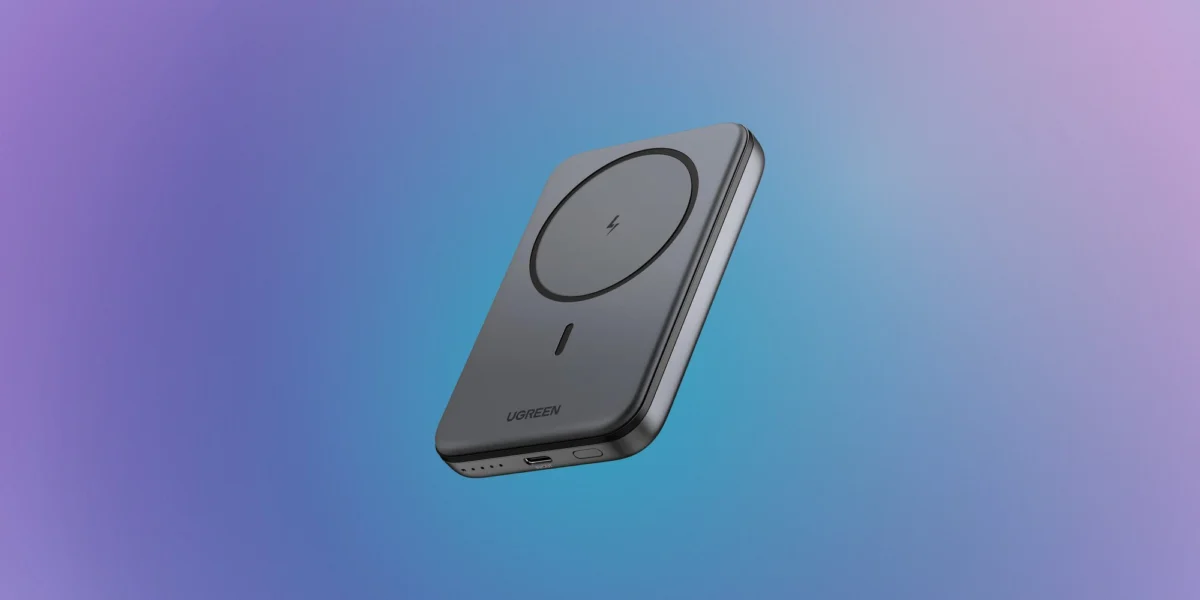
The consumer electronics market has reached a fever pitch this week as retailers and manufacturers finalize their Black Friday and Cyber Monday promotional cycles. Among the most notable hardware discounts currently available is the UGREEN 10,000mAh magnetic power bank, which has seen its price reduced to $29.69 on Amazon. This reduction represents a 37% discount from its standard retail price, positioning it as a significant value proposition in the portable charging segment. As global smartphone battery capacities remain largely static due to physical size constraints, the reliance on external portable power solutions has become a standard necessity for mobile users, driving competition among manufacturers like UGREEN, Anker, and Belkin.
The Evolution of Portable Power Technology
For the better part of the last decade, the portable power bank industry was dominated by high-capacity, "brick-style" lithium-ion batteries. Devices offering 20,000mAh to 30,000mAh were the industry standard for travelers and power users. However, these units often required dedicated storage, such as backpacks or carry-on luggage, due to their significant weight and dimensions.
The industry trajectory shifted significantly with the introduction of magnetic wireless charging standards, most notably Apple’s MagSafe technology, followed by similar implementations in the Android ecosystem, such as the Google Pixel’s "Pixelsnap" compatibility. These magnets allow for a seamless "snap-and-go" charging experience, removing the need for tangled cables and bulky adapters. UGREEN’s current offering reflects this shift toward convenience-first design, prioritizing a form factor that aligns with the rear chassis of modern smartphones while providing enough energy to essentially double the operational runtime of a flagship mobile device.
Market Context and Promotional Chronology
The current price reduction occurs within the context of the annual Black Friday shopping event, a period that historically accounts for a substantial percentage of annual consumer electronics revenue. In recent years, retailers have expanded this window into a "Cyber Week" phenomenon, with deals beginning as early as the first week of November.

Historical pricing data for the UGREEN 10,000mAh magnetic power bank shows that it typically retails between $40 and $47. The current $29.69 price point represents the lowest entry barrier for this specific model in the current fiscal year. Industry analysts suggest that these aggressive pricing strategies are intended to clear inventory ahead of the end-of-year fiscal reporting while capturing market share in the rapidly growing magnetic power bank segment.
Unlike previous generations of power banks, which competed primarily on total capacity, current market competition is driven by three key metrics:
- Form Factor: Slimness and weight optimization for "on-the-phone" use.
- Magnetic Strength: The use of high-gauss magnets (e.g., 10N ratings) to ensure device security.
- Versatility: The ability to offer both wireless charging and high-speed wired charging simultaneously.
Technical Specifications and Performance Metrics
The UGREEN unit in question features a 10,000mAh lithium-polymer battery. In practical terms, this provides roughly 1.5 to 2.5 full charges for most contemporary smartphones, depending on the device’s internal battery capacity (which typically ranges between 4,000mAh and 5,000mAh for modern flagships).
The device utilizes a dual-mode charging architecture. When used in its wireless capacity, it provides a 7.5W output, which is the industry standard for Qi-compatible magnetic wireless charging. This is optimized for maintaining battery health while providing consistent power throughout the day. For users requiring a faster replenishment of their device’s battery, the unit features a USB-C Power Delivery (PD) port. When connected via a high-quality USB-C cable, the output increases to 20W. This dual-capability allows for a "pass-through" scenario where the power bank can charge itself while simultaneously charging a smartphone, or it can charge two devices—one via the magnetic wireless pad and one via the wired connection—at the same time.
Industry Implications and Consumer Behavior
The proliferation of affordable, high-capacity magnetic chargers is indicative of a broader trend in mobile technology: the shift away from wired dependency. As consumers upgrade to devices with more power-intensive displays and 5G connectivity, the demand for "always-on" power solutions has surged.

Market research from groups such as Grand View Research suggests that the portable power bank market is expected to maintain a compound annual growth rate (CAGR) of over 6% through 2030. This growth is being driven by the increased usage of mobile devices for professional productivity, mobile gaming, and high-resolution video streaming. Manufacturers are responding by focusing on safety certifications, such as Over-Voltage Protection (OVP) and Temperature Control, to ensure that the increased density of batteries does not pose a fire risk. UGREEN, as a major player in this space, has consistently aligned its product development with international safety standards, including UL and CE certifications, which are vital for maintaining consumer trust in the lithium-ion space.
Broader Impact on the Accessory Ecosystem
The impact of these price drops is not limited to individual consumers; it affects the entire third-party accessory ecosystem. By lowering the cost of entry for magnetic charging, companies like UGREEN are effectively forcing competitors to innovate or lower their margins. This leads to a virtuous cycle for the consumer, where features that were considered "premium" two years ago—such as integrated kickstands, digital capacity displays, or 10N magnetic alignment—are now becoming standard in sub-$30 products.
Furthermore, the integration of these devices into the Google and Apple ecosystems highlights the importance of hardware interoperability. As long as a phone features a magnetic ring or a compatible case, it can utilize these power banks, breaking down the proprietary barriers that once defined mobile charging. This "democratization" of hardware accessories allows for a more unified experience across diverse operating systems, including Android and iOS.
Analysis of Future Trends
Looking ahead, the next phase of development for portable power banks will likely focus on GaN (Gallium Nitride) technology, which allows for smaller, more efficient, and cooler-running charging components. While the current generation of 10,000mAh banks is efficient, the integration of GaN could allow for even thinner profiles and faster charging speeds without increasing the weight of the unit.
Additionally, as the industry moves toward more sustainable manufacturing processes, we may see a rise in modular power banks that allow for battery cell replacement or easier recycling, addressing the environmental concerns associated with lithium-ion waste. For now, however, the current Black Friday sales cycle underscores a period of high efficiency and low cost for the average mobile user.

The availability of a 10,000mAh magnetic power bank at this price point serves as a clear indicator that the market for mobile accessories has reached a level of maturity where high-quality, high-capacity charging is no longer a luxury, but a commoditized utility. For consumers, the decision to invest in such hardware is increasingly based on brand reliability and physical design rather than price alone, though promotional events like the current UGREEN sale continue to serve as a significant catalyst for purchasing decisions.
In summary, the current promotional period provides an optimal entry point for consumers looking to move away from heavy, cumbersome power banks in favor of integrated, magnetic solutions that better suit the fast-paced, mobile-centric lifestyle. As technical specifications continue to improve and prices stabilize at lower levels, the reliance on external power will likely become even more seamlessly integrated into the daily routine of the average mobile device user.