As organizations increasingly rely on digital channels to drive customer engagement, the market for social media management software has expanded rapidly, reaching an estimated $33.46 billion. Within this ecosystem, Sprout Social has long maintained a prominent position as a comprehensive platform for enterprise and mid-market organizations. However, as marketing operations scale and global social media advertising budgets approach $338.75 billion, many marketing leaders find themselves reevaluating their technology stacks. This reassessment is frequently driven by specific platform limitations, notably Sprout Social’s per-seat pricing structure—starting at $199 per seat per month billed annually for the Standard plan and scaling to $299 per seat for the Professional tier—alongside premium paywalls for advanced social listening and gaps in enterprise-grade governance.

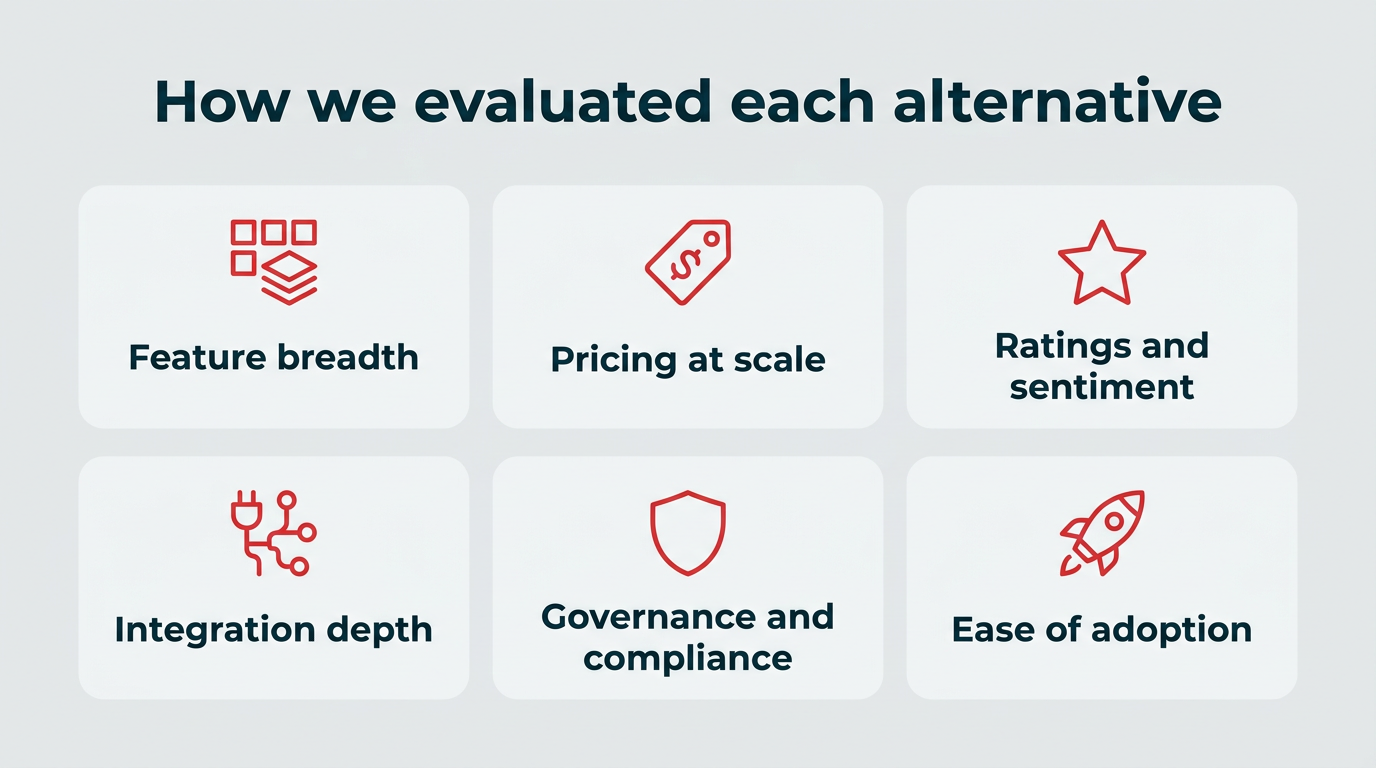
To navigate these shifting enterprise requirements, marketing decision-makers are increasingly scanning the market for viable alternatives. Evaluating these software solutions requires looking beyond basic scheduling tools to examine critical metrics such as enterprise security compliance, cross-channel social listening depth, artificial intelligence integration, approval workflows, and total cost of ownership across growing teams.
Market Evolution and Core Pain Points Driving Software Migration
The friction points that typically prompt organizations to initiate a market scan usually center on financial scalability and operational utility. As mid-market and enterprise companies expand their social media teams, linear per-seat pricing models can cause software expenditures to escalate unpredictably. For a ten-person social team, platforms charging upwards of $200 per user per month create substantial monthly overhead, particularly when premium features like dedicated social listening and complex approval trees are sequestered behind higher pricing tiers.
Furthermore, regulatory compliance has emerged as a primary operational hurdle. Organizations operating within highly regulated sectors—such as financial services, pharmaceuticals, and healthcare—require rigorous security controls, immutable audit trails, and strict content governance policies. Platforms lacking out-of-the-box integration with established compliance, archiving, and customer relationship management systems often force IT and marketing departments to build costly, custom workflows. Consequently, software evaluations for 2026 place a premium on platforms that seamlessly blend enterprise governance with intuitive daily execution.
Comprehensive Evaluation of Leading Enterprise and Mid-Market Alternatives
Choosing the optimal social media management tool requires mapping platform capabilities against specific organizational structures, budget constraints, and industry demands. The competitive landscape encompasses robust enterprise operating systems, dedicated research suites, and agile tools tailored for smaller teams or specialized agencies.

1. Hootsuite Social OS
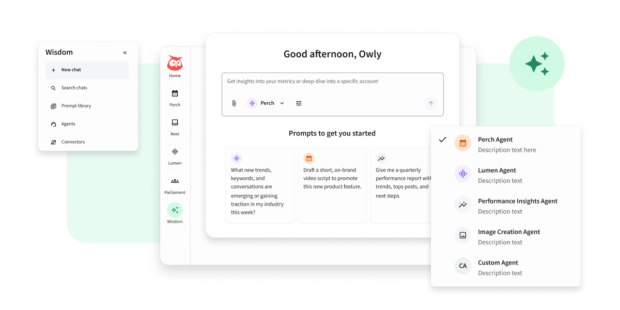
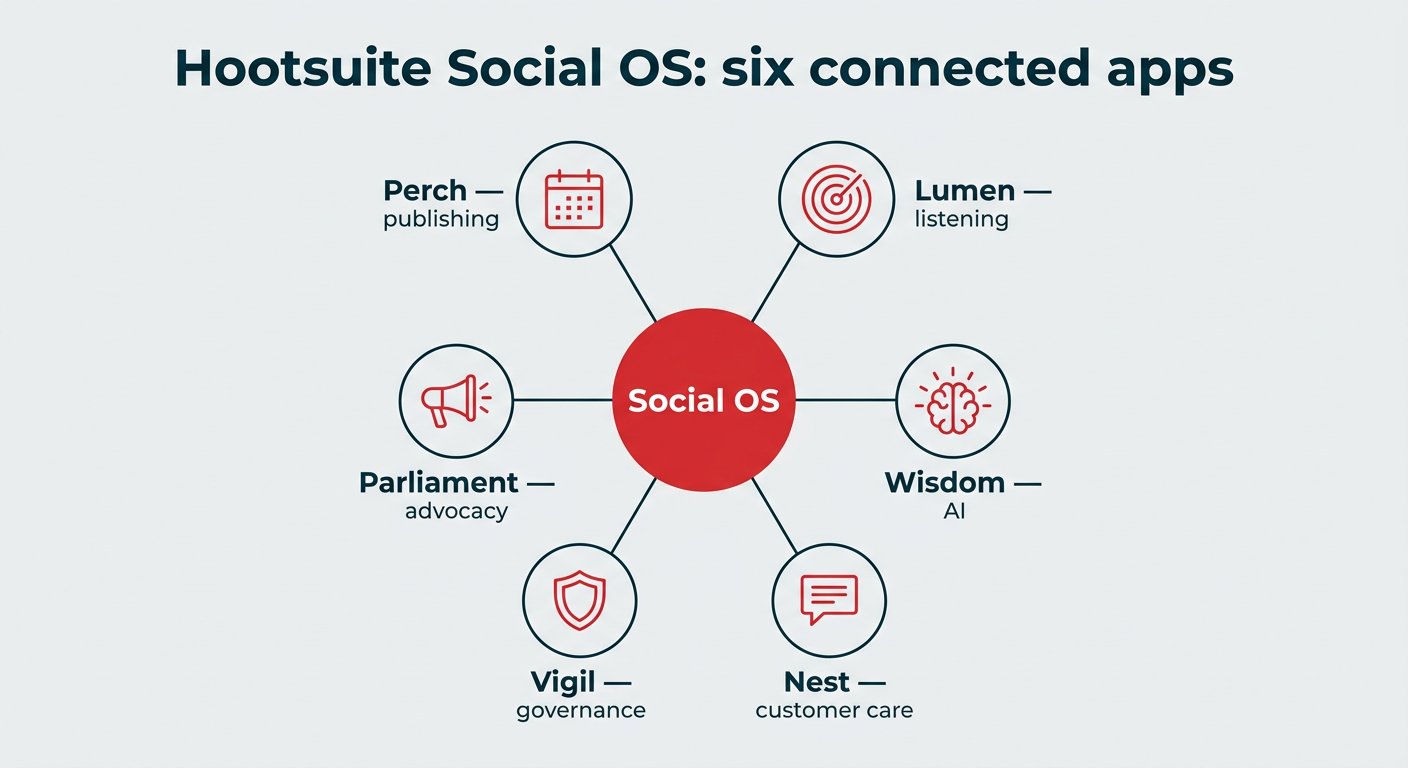
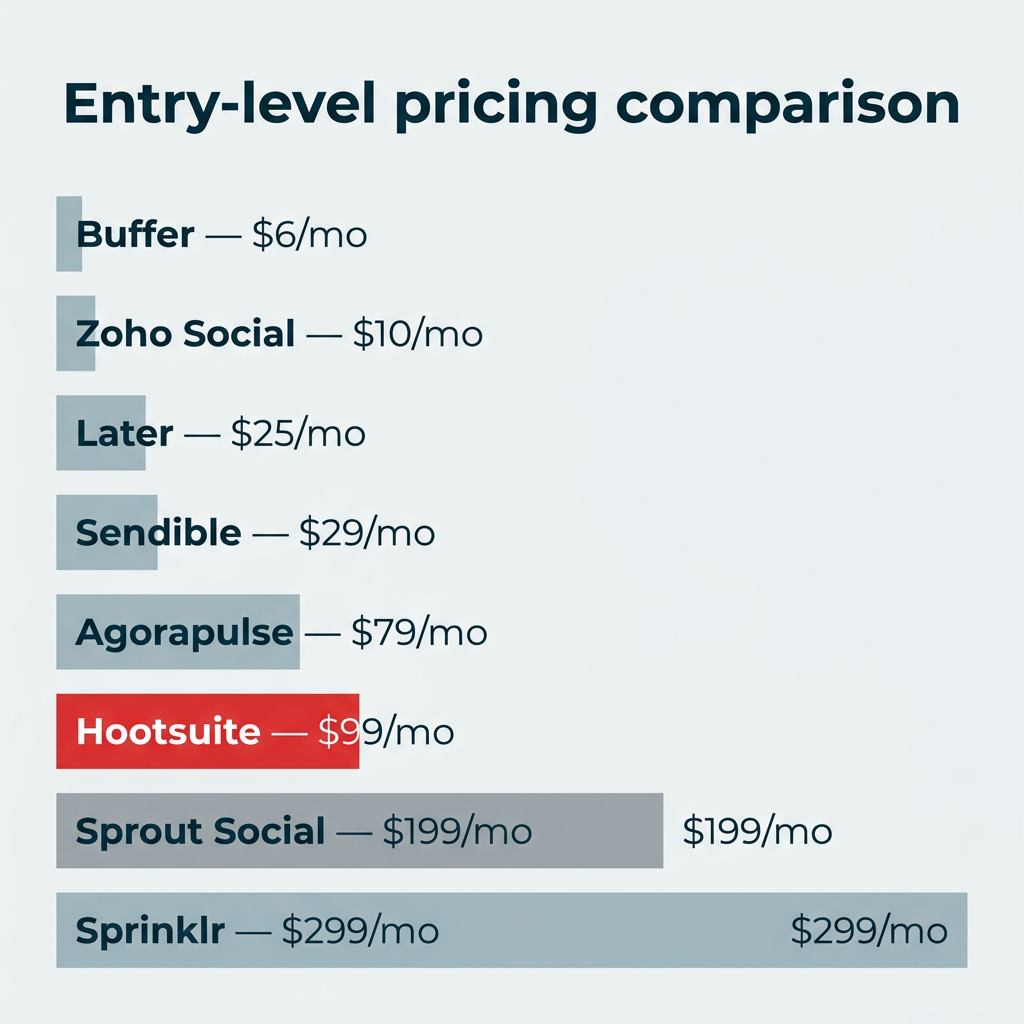
Positioned as a comprehensive enterprise alternative, Hootsuite Social OS integrates publishing, analytics, advanced social listening, customer care, and multi-layered governance into a single connected framework. Supporting major platforms including Facebook, Instagram, X, LinkedIn, TikTok, Pinterest, and YouTube, the system is engineered to eliminate data silos. Its architecture relies on interconnected modules—such as Lumen for listening across more than 150 million sources and 187 languages, Wisdom for AI orchestration, and Vigil for enterprise governance—making it a preferred solution for regulated industries requiring stringent security and compliance protocols. Entry-level pricing starts at $99 per user per month.

2. Agorapulse
Tailored primarily for mid-sized marketing teams and growing agencies, Agorapulse emphasizes a clean, unified social inbox alongside straightforward campaign reporting. While it does not match the deep consumer intelligence or heavy enterprise governance of platforms like Hootsuite or Sprinklr, it delivers robust scheduling, monitoring, and built-in ROI tracking at a competitive starting price of $79 per user per month billed annually.

3. Sprinklr
Sprinklr operates as a unified customer experience management (CXM) platform designed for massive, global enterprises. Consolidating customer interactions across more than 30 channels, it bridges social media marketing, customer care, and brand intelligence. While its AI-powered analytics and deep audience segmentation capabilities are extensive, the platform demands significant implementation time and dedicated administrative resources, making it best suited for multinational corporations with complex operational requirements. Self-serve social tiers begin at $299 per month, with enterprise pricing available upon request.
4. Brandwatch
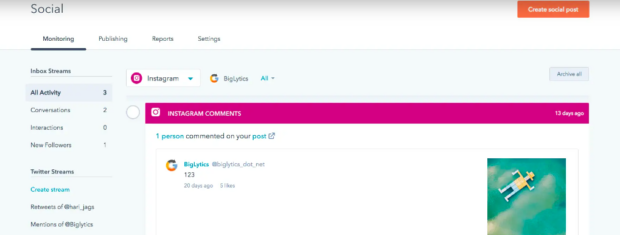
For organizations where market research, brand health tracking, and deep consumer intelligence outweigh day-to-day publishing needs, Brandwatch serves as an industry-standard option. Its Consumer Intelligence platform tracks millions of digital conversations to extract actionable qualitative data. However, because its primary focus is research and insights rather than multi-channel publishing workflows, enterprises often pair it with a dedicated social management tool or utilize integrated ecosystems where listening feeds directly into content creation.
5. Emplifi
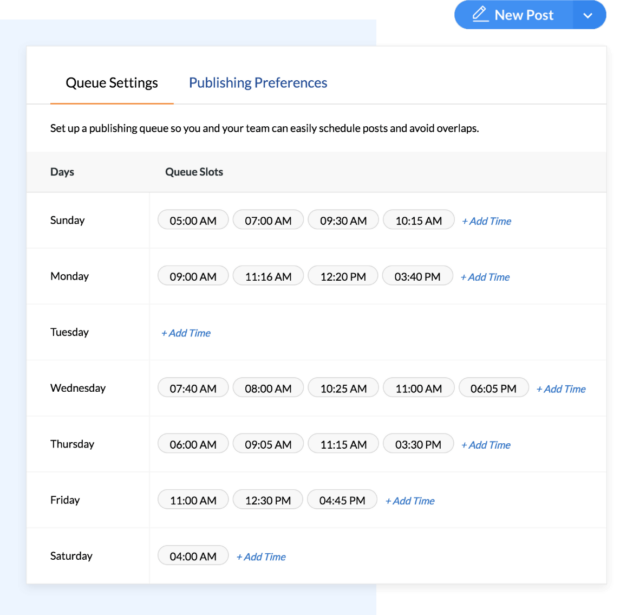
Emplifi bridges the gap between social media marketing, social commerce, and customer care, appealing strongly to retail, e-commerce, and consumer brands that treat digital platforms as direct revenue-generating channels. The platform integrates influencer marketing management and shoppable social tools into a unified customer experience suite, though it offers lighter governance and AI orchestration capabilities compared to dedicated enterprise operating systems.

Comparative Pricing and Total Cost of Ownership Analysis
Analyzing software expenditures requires looking past base entry fees to model out expenses across realistic team sizes and deployment scales. While smaller point solutions offer low monthly fees, enterprise platforms demand a careful calculation of user counts, required feature tiers, and administrative overhead.

| Tool | Best For | Starting Price (2026) | Pricing Model | G2 Rating |
|---|---|---|---|---|
| Hootsuite | Enterprise teams and regulated industries | $99/user/month | Per user | 4.3/5 |
| Agorapulse | Mid-size marketing teams | $79/user/month | Per user | 4.5/5 |
| Sprinklr | Large enterprises | $299/month (Self-Serve) | Per seat / Custom | 4.1/5 |
| Brandwatch | Enterprise research and insights teams | Custom pricing | Custom | 4.4/5 |
| Emplifi | Retail and commerce-led brands | Custom pricing | Custom | 4.3/5 |
| Khoros | Multinational corporations | Custom pricing | Custom | 3.8/5 |
| HubSpot | Teams utilizing HubSpot CRM | $890/month (Marketing Hub) | Per suite (3 seats included) | 4.4/5 |
| SocialBee | Small teams with categorized content | $29/month | Flat rate | 4.8/5 |
| Sendible | Digital marketing agencies | $25–$29/month | Flat rate | 4.5/5 |
| Zoho Social | Users within the Zoho CRM ecosystem | $10/month | Flat rate | 4.6/5 |
| Buffer | Small teams and individual creators | Free ($6/ch. paid) | Per channel | 4.3/5 |
| Later | Visual content creators and Instagram focus | $25/month | Flat rate | 4.5/5 |
When modeling total cost of ownership for a ten-person team, the financial divergences become stark. A standard enterprise deployment on Sprout Social can approach nearly $2,000 per month, whereas comparable enterprise capabilities through platforms like Hootsuite reduce monthly operational expenditures significantly while retaining advanced listening and governance frameworks. Conversely, solo creators and micro-businesses can leverage streamlined tools like Buffer, Zoho Social, or SocialBee for nominal monthly fees or utilize limited free tiers.
Strategic Framework for Selecting a Social Media Management Platform
Choosing the appropriate software solution necessitates a disciplined, multi-step procurement process aligned with long-term organizational goals:
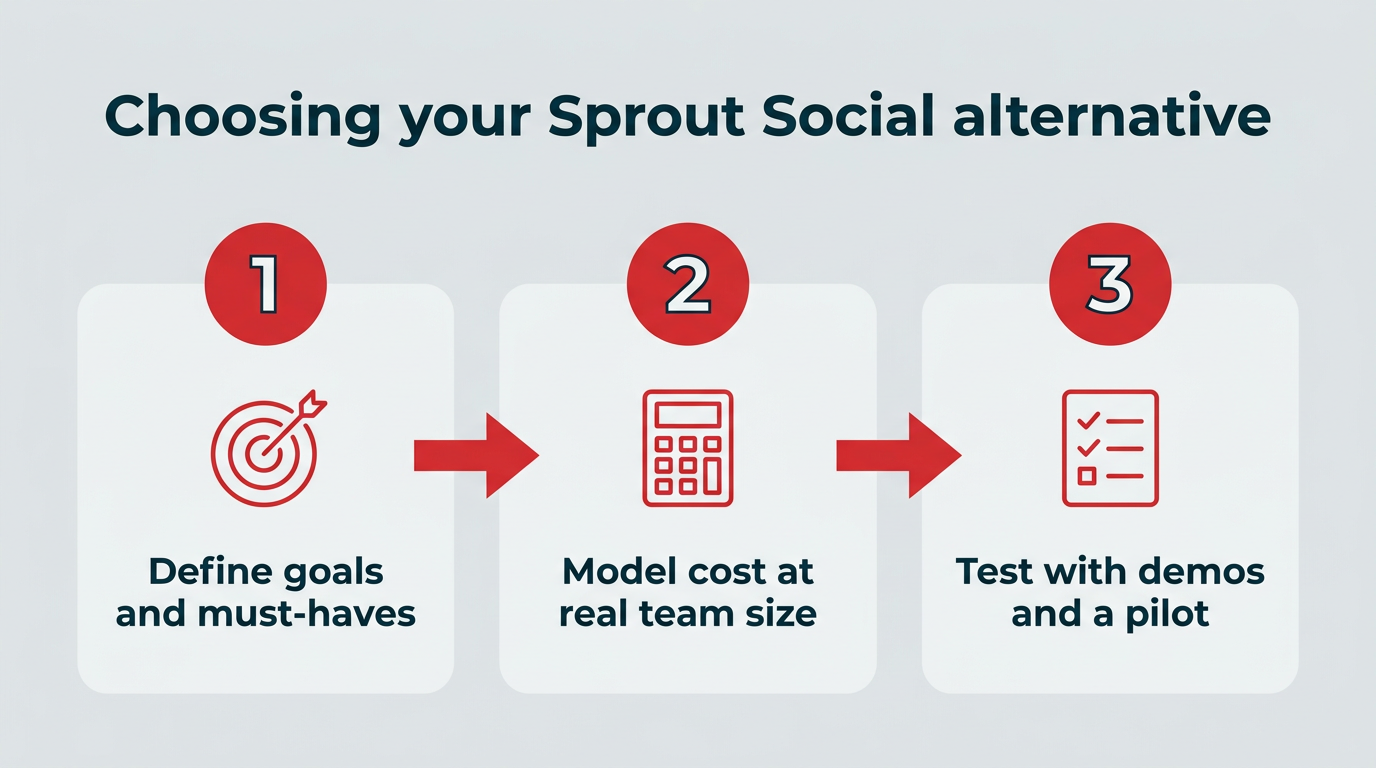
- Define Core Objectives and Feature Requirements: Distinguish strictly between non-negotiable operational requirements—such as regulatory compliance, multi-channel publishing, or automated approval workflows—and secondary preferences. This prevents feature creep from inflating software budgets.
- Audit Team Scale and Account Volume: Account for current headcount, projected hiring over the next 12 to 18 months, and the total volume of social profiles that require active monitoring and publishing.
- Execute Pilots and Leverage Free Trials: Capitalize on trial periods—such as Hootsuite’s 30-day trial or shorter agency-focused evaluation windows—to test platform usability, reporting accuracy, and cross-departmental collaboration under live operational conditions.
Ultimately, aligning social media software with organizational maturity ensures that digital marketing operations remain secure, financially sustainable, and capable of scaling in an increasingly competitive global marketplace.