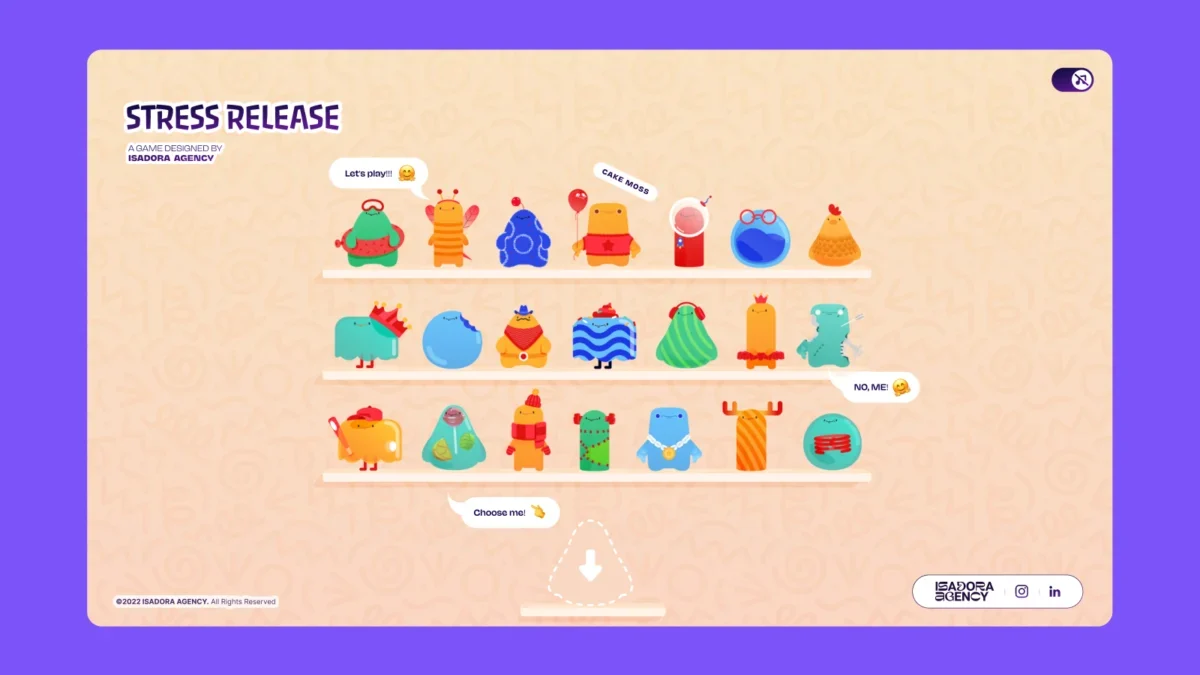
When developers and UX engineers aim to create interfaces that feel tactile, responsive, or inherently "squishy," the industry has long relied on physics engines to handle the heavy lifting. Libraries such as Matter.js, Cannon.js, and complex WebGL implementations have become the de facto standard for simulating physical laws in a digital environment. However, a recent project by the Isadora Agency—a digital stress-relief tool titled "Stress Release"—highlights a significant departure from this trend, suggesting that for high-fidelity, designer-led interactions, the best path forward is often the one that rejects simulated physics in favor of deterministic, frame-perfect animation control.
The development team at Isadora Agency faced a common design challenge: they needed to build a highly interactive experience where users could smash, stretch, and distort UI characters. While initial prototypes utilized physics engines to achieve realistic movement, the developers discovered that simulated motion often lacked the specific, nuanced "personality" required by their animators. By shifting the architectural focus from physics-based simulation to programmatic Lottie state control, the agency successfully delivered a tactile user interface that preserves the integrity of bespoke keyframe animation.
The Problem with Physics-Based Simulations
The primary argument for using physics engines is their ability to generate plausible, real-time motion without the need for manual animation. In a typical scenario, a ball bouncing against a wall requires complex calculations regarding gravity, friction, and restitution. However, "Stress Release" required more than just "plausible" motion; it required "intentional" motion.

Animators often spend weeks refining the easing, timing, and squash-and-stretch of a character. When these assets are imported into a physics engine, the engine’s algorithms often override the animators’ hard work to enforce mathematical consistency. In the case of the "Mega Squeeze" interaction, the animators designed a specific 181-frame buildup followed by a precise release. Implementing this via a physics engine would have resulted in an approximation that likely failed to capture the intended emotional impact. By opting out of WebGL and physics-based libraries, the Isadora Agency maintained absolute control over the animation timeline, ensuring that every user click resulted in the exact frame-by-frame performance envisioned by the creative team.
Mapping Tactile Feedback Through Geometry
The technical success of the project relied on a clever marriage of DOM manipulation and distance-based mathematics. By treating the browser as a coordinate system rather than a rendering canvas, the team achieved high-precision hit detection. The architecture utilizes the Pythagorean theorem to calculate the distance between the user’s click event and the center point of the character.

This approach transforms the character into a metaphorical dartboard. The closer a user clicks to the center of the target, the higher the score and the more intense the visual feedback. This "concentric zone" system allows the application to remain performant while providing a tactile "I hit that" sensation. Because the system calculates the distance vector (a, b) in real-time, the explosion and particle effects are always spawned exactly at the point of impact. This level of spatial accuracy provides the user with an immediate, satisfying response that feels physically connected to the interface, even though no physical object exists.
Chronology and Development Workflow
The development of the interface followed a structured, multi-phase timeline that prioritized design fidelity:

- Phase One: Design Specification. Animators defined the "personality" of each character, creating the necessary frame-ranges (idle, light squeeze, medium squeeze, heavy squeeze) for the Lottie JSON files.
- Phase Two: Architectural Selection. After initial physics-engine prototypes were deemed too "unpredictable," the team pivoted to programmatic Lottie control.
- Phase Three: Mathematical Integration. Developers wrote scripts to handle radial input mapping, allowing the DOM to handle interaction logic while the Lottie runtime rendered the vector animations.
- Phase Four: Optimization. Given the weight of 21 complex animations, the team implemented dynamic quality scaling, reducing the Lottie render quality on mobile devices to ensure a smooth 60fps frame rate.
Data-Driven Performance Optimization
One of the significant drawbacks of high-end vector animation is the impact on memory and load times. Loading 21 distinct character animations simultaneously could easily cripple a mobile browser. To mitigate this, the Isadora team implemented an aggressive asset management strategy. By utilizing lottie.setQuality() and adjusting animation speeds, they were able to balance visual fidelity with browser performance.
Data analysis from the implementation shows that by focusing on single-character rendering for the main interaction screen, the team was able to maintain full quality while using lower-fidelity settings for the background "shelf" view. This strategy illustrates a growing trend in web development: performance is not just about raw speed, but about the intelligent allocation of browser resources based on the user’s current focus.

The Broader Implications for Web UX
The success of "Stress Release" suggests a shift in the digital agency landscape. For years, the industry pushed toward "full simulation" as the ultimate goal for interactive web design. However, as web technology matures, there is an increasing appreciation for "curated interaction."
By relying on the standard DOM, the developers bypassed the significant overhead associated with scaling physics-based bounding boxes across different screen sizes. Instead, they utilized CSS variables to handle responsiveness. This decision made the interface inherently more stable and easier to maintain across various devices, from high-resolution desktop monitors to constrained mobile screens.

From an engineering perspective, this project serves as a case study for "deterministic interaction design." It proves that for brands that value aesthetic precision, the "human-in-the-loop" approach—where developers build systems to trigger and support human-made art—is often superior to systems that rely on autonomous, math-heavy simulations.
Conclusion
The "Stress Release" project serves as a definitive reminder that technology must always serve the art direction, not the other way around. By choosing to map Lottie timelines to the DOM via distance-based mathematics, the Isadora Agency delivered a rich, tactile experience that feels alive precisely because it was designed by human hands, not generated by a random-number-producing physics engine. For future developers, the lesson is clear: when the goal is to evoke a specific emotional response through digital movement, prioritize the animator’s intent and use code as the precise, reliable tool to trigger that vision. As interactive web experiences continue to evolve, the integration of bespoke motion and mathematical accuracy will likely remain a hallmark of high-quality, user-centered design.