As digital marketing enters a new era defined by sophisticated automation and stringent privacy regulations, navigating the landscape of Facebook ad tools has become a critical operational challenge for brands of all sizes. Meta’s end-to-end artificial intelligence campaigns achieved a staggering $60 billion annual run rate in 2025, completely transforming how advertisers approach audience targeting, creative asset generation, and campaign budgeting. In this environment, relying solely on native interfaces is often insufficient for enterprise-scale operations, giving rise to a robust ecosystem of third-party platforms designed to enhance efficiency, reduce manual oversight, and consolidate multi-channel data.

Understanding the modern Facebook ad tech stack requires examining how native infrastructure and external software integrate through Meta’s Application Programming Interface (API). While foundational platforms like Meta Ads Manager remain indispensable for campaign deployment, specialized tools now address specific pain points such as cross-platform attribution, high-volume creative production, rule-based automation, and unified social media management.
Evolution of Facebook Advertising Infrastructure

The evolution of digital advertising tools over the past decade reflects a profound shift from manual parameter setting to machine-learning-driven optimization. Historically, media buyers manually configured detailed audience parameters, placement selections, and budget allocations. However, tightening data privacy laws—initiated by iOS privacy updates and subsequent global regulatory frameworks—severely disrupted traditional tracking and attribution models.
In response, Meta heavily invested in artificial intelligence infrastructure, culminating in the widespread adoption of the Advantage+ suite. These automated solutions leverage machine learning to dynamically adjust ad delivery based on real-time user behavior, effectively shifting the advertiser’s role from tactical micro-management to strategic asset curation. Consequently, third-party software developers have adapted by creating tools that complement Meta’s AI rather than compete with it, focusing on creative scoring, visitor identification, cross-channel reporting, and workflow consolidation.
Categorization and Functional Breakdown of Facebook Ad Tools
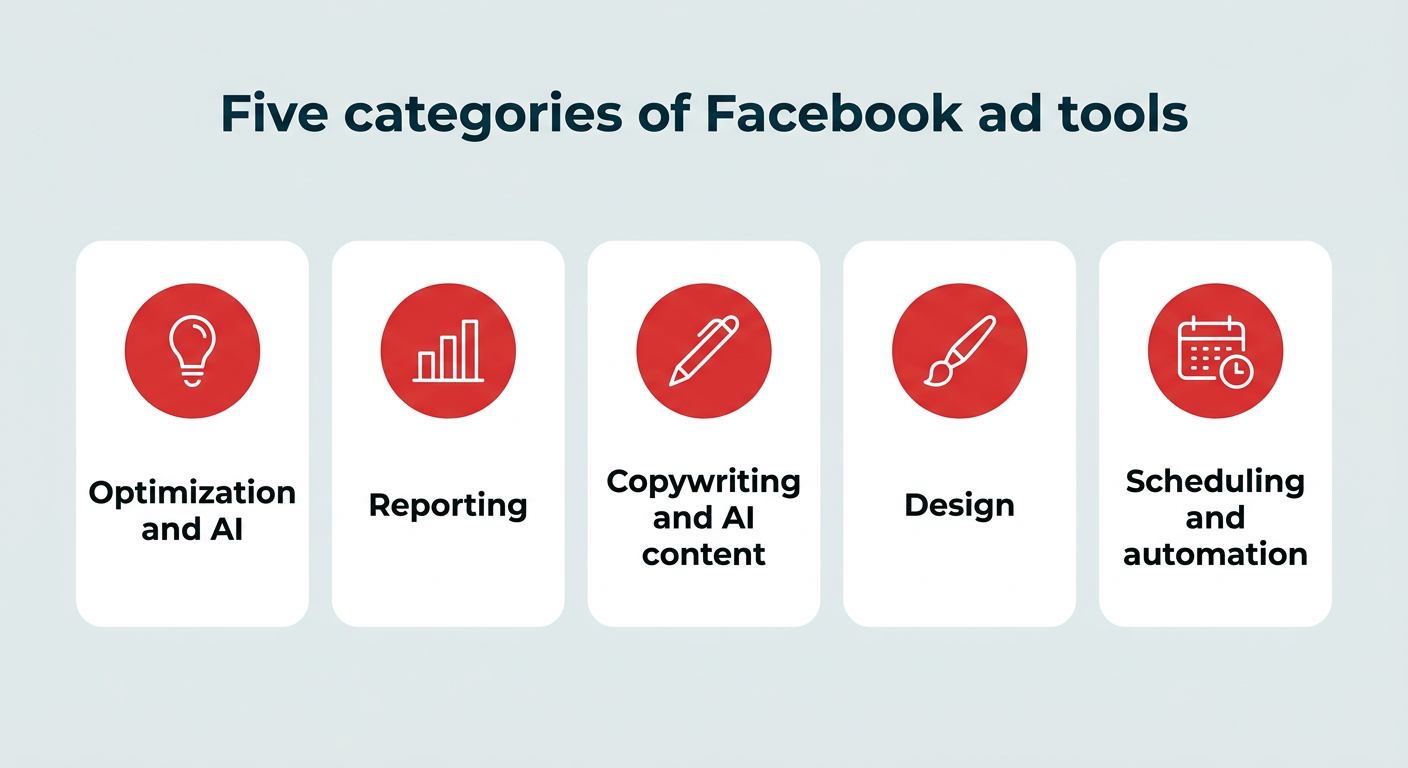
To prevent software bloat and unnecessary overhead, marketing teams typically categorize Facebook ad tools into five core functional areas: optimization and AI, reporting and attribution, copywriting and content generation, design automation, and scheduling and rule-based management.
Optimization and Artificial Intelligence Tools
AI-driven optimization platforms are designed to interpret complex performance data and execute tactical adjustments at a speed human operators cannot replicate.
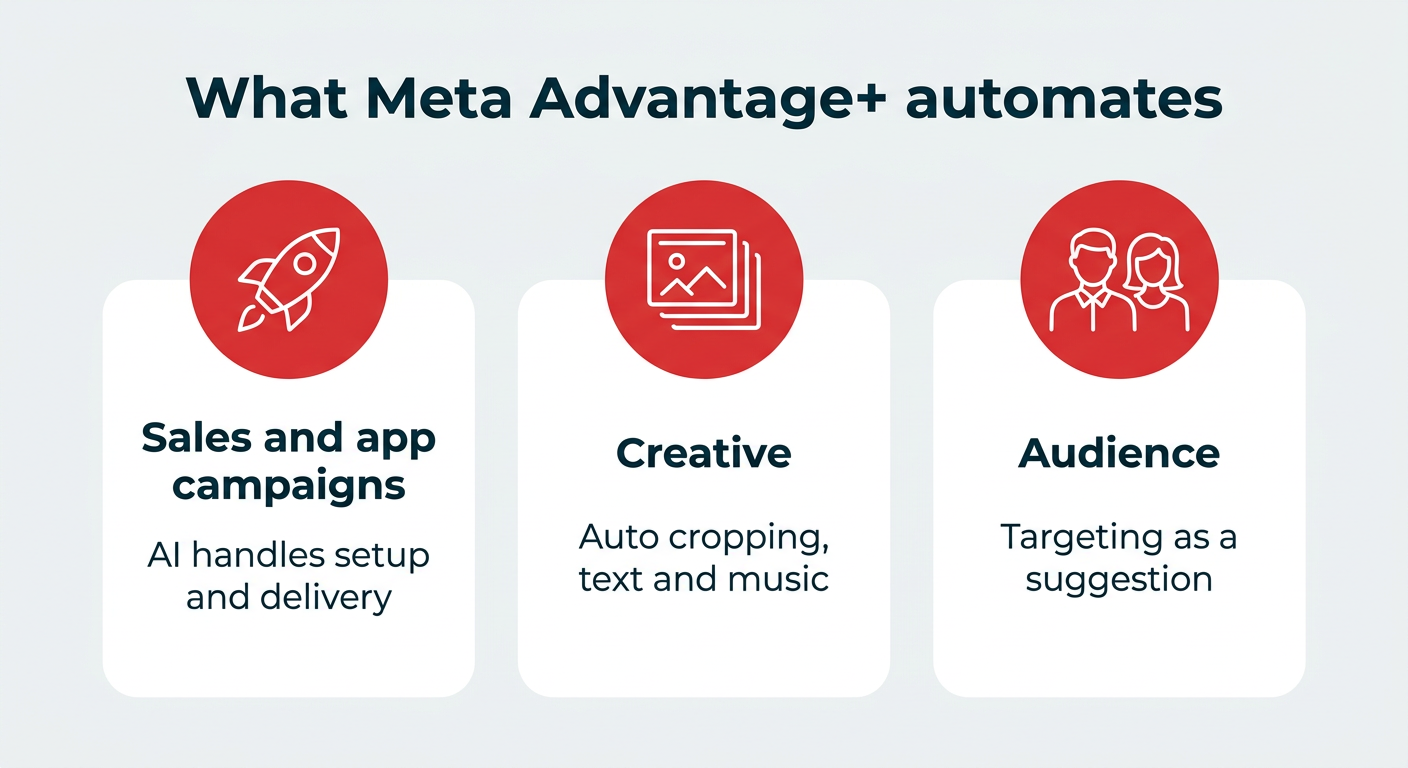
Meta Ads Manager (incorporating the Advantage+ suite) serves as the native foundational layer for all Facebook and Instagram advertising. Features such as Advantage+ shopping and app campaigns allow Meta’s algorithms to automate setup and delivery decisions, while Advantage+ creative applies automated enhancements like cropping, localized text variations, and dynamic audio adjustments. Data released by Meta indicates that campaigns utilizing generative AI features experienced an 11-percent higher click-through rate on average compared to traditional manual setups.
Complementing native solutions, platforms like Hootsuite Social OS bridge the gap between organic community management and paid media execution. By allowing marketing teams to view paid and organic content within a single dashboard, platforms of this caliber eliminate the operational friction of toggling between disparate tabs. Furthermore, integrated social listening and analytics tools provide a holistic view of return on investment across multiple social networks.

Specialized performance platforms such as Madgicx utilize advanced machine learning to audit individual ad accounts, delivering instant, actionable recommendations for budget reallocation and audience expansion. Similarly, Customers.ai focuses on website visitor retargeting, employing identity-resolution technology to build warmer custom audiences for Meta campaigns, though advertisers must continuously monitor regional compliance with shifting data privacy standards. For teams seeking rapid visual iteration, AdCreative.ai generates and scores ad creatives before capital is committed, ensuring high-volume performance marketing without sacrificing brand alignment.
Advanced Reporting and Multi-Source Attribution

Accurate measurement remains one of the most persistent hurdles for digital marketers operating across fragmented media channels. While native reporting provides adequate visibility into platform-specific metrics, enterprise organizations frequently require consolidated dashboards that place Facebook performance side-by-side with search engine marketing, email campaigns, and CRM data.
Enterprise reporting solutions such as TapClicks and Funnel address this complexity by aggregating data from dozens of marketing sources. Funnel, for instance, specializes in data normalization—automatically reconciling mismatched field names and currency types across platforms to deliver clean, transparent ROI models. These tools enable marketing leadership to evaluate true customer acquisition costs and campaign profitability without manual data wrangling in spreadsheets.

Copywriting, Content Creation, and Design Automation
The demand for fresh ad creative has accelerated exponentially, requiring scalable solutions for copywriting and visual design.

Generative AI applications have fundamentally streamlined the copywriting workflow. Tools like OpenAI’s ChatGPT allow media buyers to rapidly brainstorm campaign angles and generate multiple ad copy variations. Within dedicated social ecosystems, specialized AI layers—such as Wisdom by Hootsuite—enable teams to repurpose top-performing organic social media posts directly into high-converting ad variations, drawing on industry-specific best practices to meet campaign objectives.
On the visual design front, accessibility and brand consistency are paramount. Canva has established itself as an industry standard for scalable design, incorporating Magic Studio AI features that allow users to generate imagery from text prompts, remove backgrounds, and utilize Magic Resize to instantly adapt a single design into every required Facebook and Instagram placement dimension. For large-scale advertisers operating across international markets, platforms like Smartly.io automate dynamic creative optimization, producing hundreds of localized variations from a single master concept.

Scheduling, Rules, and Cross-Platform Automation
Managing continuous ad spend requires rigorous guardrails to protect budgets from underperforming assets. Rule-based automation tools provide these safeguards.

RevealBot empowers media buyers to establish highly specific, conditional automation rules—such as scaling budgets when specific weather thresholds or sales milestones are met—while supporting bulk asset uploads. Similarly, Adzooma unifies campaign management across Meta, Google, and Microsoft Ads, delivering automated opportunity alerts that prompt users to pause inefficient ads or reallocate budgets without requiring logins to multiple ad servers.
Strategic Evaluation and Tool Selection Framework

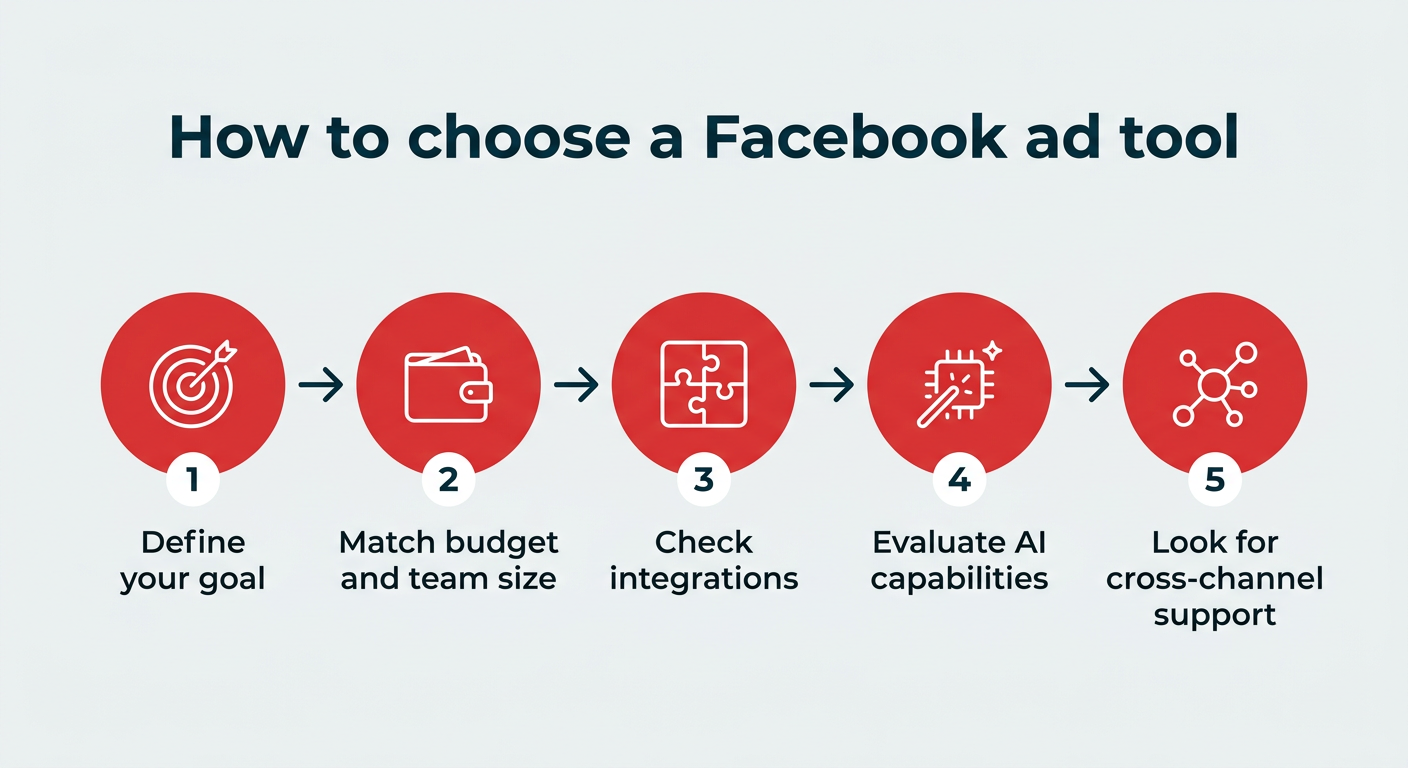
When selecting Facebook ad tools, marketing directors are advised to prioritize consolidation over feature accumulation. Evaluating software based on identified operational gaps—rather than expansive feature lists—prevents redundant subscriptions and reduces cognitive fatigue among team members.
Organizations must systematically review their technical stack against five primary criteria: integration capabilities with existing CRM and analytics infrastructure, data privacy compliance, team onboarding overhead, reporting transparency, and total cost of ownership relative to projected ad spend. For most growing businesses, a combination of native infrastructure (Meta Ads Manager and the Ad Library), a robust design suite (Canva), and a centralized management platform (such as Hootsuite Social OS) provides an optimal balance of control, efficiency, and measurable return on investment.

Implications for the Future of Digital Marketing
The increasing dominance of automated delivery and generative AI in Facebook advertising signals a permanent departure from manual media buying. As algorithms assume greater responsibility for audience targeting and creative placement, the competitive advantage for marketing teams will no longer lie in tactical execution, but in strategic oversight, creative concepting, and cross-channel data interpretation.

Organizations that successfully integrate unified management tools will be best positioned to navigate this automated landscape. By reducing administrative overhead and securing a centralized view of performance, modern marketing teams can focus on high-level strategy, ensuring that every dollar of ad spend contributes measurably to overarching business growth.