The landscape of public relations is undergoing a profound transformation as artificial intelligence shifts from a passive tool to an autonomous, goal-oriented participant in professional workflows. This transition, marked by the emergence of "agentic AI," represents a fundamental change in how communications strategy is executed, monitored, and scaled. Unlike conventional generative AI, which relies on direct human prompts to produce specific outputs, agentic AI systems are designed to operate autonomously, using reasoning, planning, and tool-use capabilities to achieve complex objectives on behalf of their users.
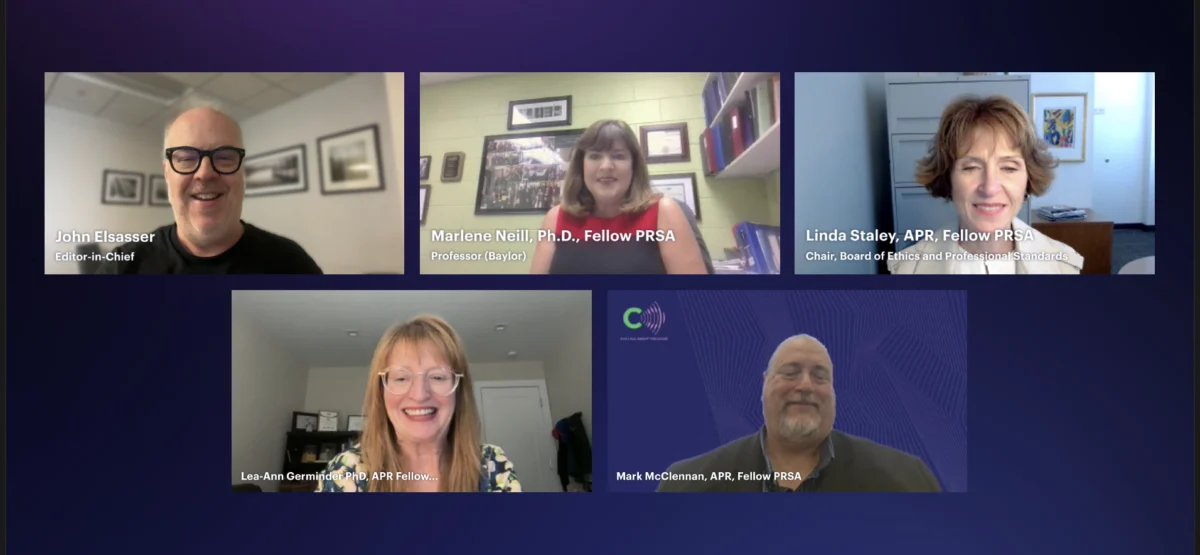
This technological pivot served as the focal point for the September 24 edition of "Strategies & Tactics Live," the monthly LinkedIn livestream hosted by the Public Relations Society of America (PRSA). During the broadcast, a panel of industry experts—Mark McClennan, APR, Fellow PRSA; Linda Staley, APR, Fellow PRSA; Dr. Marlene Neill, APR, Fellow PRSA; and Dr. Lea-Ann Germinder, APR, Fellow PRSA—discussed the critical intersection of advanced automation and professional ethics. The event occurred during September, which is designated as Ethics Month by the PRSA, a timing that underscores the urgency of addressing how these sophisticated tools interact with long-standing industry standards.
The Rise of Agentic Systems
The distinction between traditional Large Language Models (LLMs) like ChatGPT or Claude and the new generation of AI agents is significant. While LLMs are primarily conversational or creative assistants, agentic AI functions as a digital worker. These systems are capable of continuous monitoring of media landscapes, real-time content distribution, stakeholder engagement, and the orchestration of complex, multi-step workflows.
Mark McClennan, who led the development of the PRSA’s July 2024 advisory on AI agents, emphasized that these systems possess capabilities that extend far beyond text generation. "Agents pursue goals and complete tasks on behalf of the end-user, often using capabilities such as reasoning, planning, memory, tool-use, and adaptation," McClennan noted. He further explained that these systems can effectively supervise other, smaller agents, creating an automated ecosystem that can manage communications functions with minimal human intervention.
Chronology of Ethical Guidance
The PRSA has been proactive in addressing the rapid integration of AI into professional practice. The organization’s timeline regarding AI governance has accelerated significantly over the past 24 months:
- Early 2023: The initial wave of generative AI adoption prompts widespread concern regarding plagiarism, copyright, and the loss of human oversight in content creation.
- Late 2023: The PRSA begins internal discussions on how to update its historic Code of Ethics to account for non-human contributors.
- July 2024: The Board of Ethics and Professional Standards releases a formal advisory specifically targeting "Agentic AI." This document provides the foundation for the September 2024 discussions, outlining clear prohibitions against using AI to impersonate individuals or simulate public consensus.
- September 2024: The "Strategies & Tactics Live" event serves as the primary forum for disseminating these guidelines to the broader PR community, emphasizing the need for ethical literacy.
Data and The "Perfect Storm"
The adoption of AI in the PR sector is not merely a theoretical exercise but a functional imperative driven by market pressures. According to recent industry surveys, nearly 70% of communication professionals have experimented with AI tools to improve efficiency. However, this push for productivity has created what Dr. Marlene Neill, a professor at Baylor University, describes as a "perfect storm."
Dr. Neill’s analysis points to a dangerous disconnect: while organizations are aggressively pushing for faster, cheaper content production, they are frequently failing to provide the corresponding training or ethical frameworks required to manage these tools safely. "These are ingredients that could result in a serious crisis for an organization," Neill warned. She emphasized that the lack of institutional guardrails is a primary vulnerability, as AI agents operating without human oversight can inadvertently propagate misinformation, reinforce systemic biases, or violate consumer trust—all of which can cause irreparable reputational damage.
The Preservation of Human Value
A recurring theme during the panel was the definition of value in an automated economy. As AI takes over technical tasks, the role of the PR professional is not being eliminated, but rather being forced to evolve. Linda Staley, chair of the PRSA’s Board of Ethics and Professional Standards, argued that the industry must look toward the core principles of the PRSA Code of Ethics, which has served the society since its inception, as a roadmap for the future.
"If we’re able to use AI to do many of the tasks that we used to do, then what is our value to our employers?" Staley asked. Her conclusion is that value lies in the distinctly human components of the profession: ethical judgment, the capacity for nuanced reasoning, and the ability to build and sustain genuine human trust. AI, she reminded the audience, has no moral compass; it lacks the capacity for accountability, as it possesses no reputation to protect and no professional obligations to uphold.
Ethical Literacy as a Mandatory Skill
The consensus among the panelists was that technical proficiency is insufficient without a foundation of "ethical literacy." Dr. Lea-Ann Germinder highlighted that the duty of a communications professional has shifted. It is no longer enough to serve the organization’s bottom line; in the age of AI, the responsibility extends to serving humanity.
This shift requires practitioners to adopt a posture of skepticism—a return to basic journalistic values. Dr. Neill reinforced this, noting that when AI provides information, the burden of verification rests entirely on the human user. Professionals must question the data, verify the accuracy of outputs, and ensure that the use of AI is transparent.
The PRSA’s guidance is clear on this front: if the use of an AI agent materially affects a communication or its impact on a stakeholder, it must be disclosed. Transparency is the bedrock of the profession, and concealment—whether through the simulation of consensus or the impersonation of individuals—remains a violation of core ethical standards.
Broader Implications for the Communications Industry
The integration of agentic AI presents a paradox: it offers the potential for unprecedented efficiency while simultaneously creating risks that are larger than those posed by human error alone. The "black box" nature of some AI systems means that their decision-making processes are often opaque, making it difficult for PR professionals to audit why a specific action was taken.
For global communications firms and internal corporate teams, the implications are three-fold:
- Governance: Organizations must develop internal AI policies that go beyond IT security to address the ethical implications of autonomous content creation and stakeholder interaction.
- Training: The gap between AI capability and employee literacy must be bridged through formal education programs that emphasize both technical use and ethical decision-making.
- Accountability: Because AI cannot be held liable for ethical breaches, the accountability must be explicitly assigned to the human supervisors who authorize the agents’ goals.
The future of public relations will be defined by those who can harness the power of autonomous agents while remaining firmly in control of the ethical consequences. As the PRSA panelists collectively agreed, AI is not a replacement for the communications expert; it is a tool that necessitates a higher degree of professional rigor. The ability to distinguish between what an AI can do and what it should do will become the primary competitive advantage for the next generation of public relations leaders.
Ultimately, the message from the industry’s leadership is one of guarded optimism. By grounding the use of AI in the timeless principles of integrity, accuracy, and public service, the communications profession can navigate the risks of the agentic era. The challenge lies in ensuring that as the tools of the trade become more intelligent, the humans wielding them remain even more vigilant.