In the modern digital landscape, corporate trust is at an all-time premium, prompting organizations worldwide to rethink how they engage with target audiences. Traditional corporate messaging, once the cornerstone of marketing strategies, now frequently struggles to cut through the digital noise. Consumers and B2B buyers alike increasingly look past brand-managed social handles, seeking authenticity that only individuals can provide. This paradigm shift has accelerated the adoption of employee advocacy programs—structured initiatives designed to encourage workers to share vetted company content across their personal social media profiles.

Recent data underscores the urgency of this transition. According to comprehensive market research from Edelman, 88% of consumers state that trusting a brand is an evaluation criterion on par with traditional factors like quality and value. Furthermore, employers currently rank as the most trusted institutional entity, standing at an impressive 78% trust rating. By channeling this inherent credibility through the personal networks of a company’s workforce, organizations are effectively transforming their internal teams into their most powerful, organic marketing channels.
Understanding the mechanics of these programs requires examining the critical distinction between informal sharing and structured advocacy. While informal advocacy remains entirely spontaneous—driven by an employee’s personal desire to highlight a workplace win—structured programs introduce strategy, consistency, and intent. Modern enterprise tools, such as the Parliament application integrated within the Hootsuite Social OS, streamline this process by offering curated content feeds, compliance governance, and gamification leaderboards that reward active participation while protecting brand guidelines.

The Business Case: Why Enterprises Are Investing in Advocacy
The widespread corporate pivot toward employee advocacy is not driven by mere vanity metrics, but by measurable, bottom-line business outcomes. Companies across sectors are discovering that empowering employees to act as brand ambassadors yields superior results across brand awareness, talent acquisition, lead generation, and pipeline development, all at a fraction of the cost of traditional paid media campaigns.
To contextualize these benefits, industry experts point to the expansive reach inherent in employee networks. Victoria Samways, Marketing and Brand Manager at Major Tom, notes the sheer mathematical advantage of distributed networks. With LinkedIn serving as a primary B2B battlefield, a single employee typically commands hundreds of professional connections. When multiplied across an enterprise workforce numbering in the hundreds or thousands, the resulting potential audience exponentially eclipses the follower count of any corporate brand page.
1. Exponential Expansion of Brand Reach and Awareness
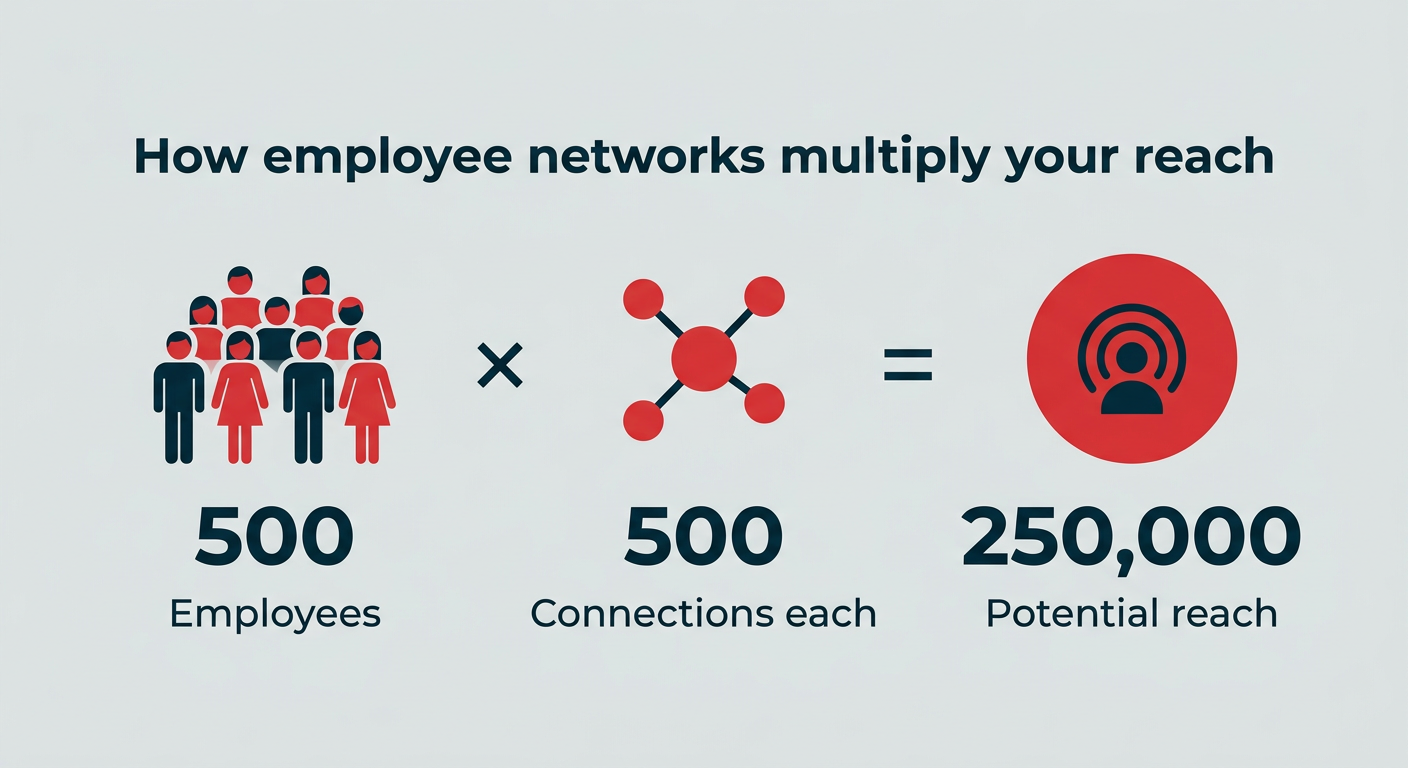
The mathematics of employee advocacy are straightforward yet profound. Consider an organization with 500 employees, where each staff member maintains an average of 500 professional connections on LinkedIn alone. This dynamic grants the enterprise direct access to a potential secondary audience of 250,000 individuals—many of whom will never actively follow a corporate brand handle. By activating these personal networks, brands bypass traditional paid barriers to secure high-visibility impressions built on pre-existing relational trust.
2. Amplifying Talent Acquisition and Employer Branding
Recruiting top-tier talent in competitive industries demands more than a polished careers page promising an exceptional corporate culture. Prospective candidates increasingly look for proof. When employees routinely share authentic glimpses of daily operations, team milestones, internal culture, and project wins, they offer an unvarnished view of the employee experience. Data from major enterprise implementations demonstrates that advocacy-driven employer branding can dramatically boost inbound applicant volume, shifting recruitment paradigms from passive sourcing to magnetic attraction.
3. Boosting Organic Engagement and Algorithmic Favorability
Social media algorithms consistently favor personal profiles over corporate handles. Independent analyses of hundreds of thousands of social posts indicate that personal accounts routinely achieve significantly higher engagement rates than corporate pages, resulting in a steady stream of likes, comments, and algorithmic elevation. This heightened engagement compounds over time, driving greater visibility and overall return on investment for digital marketing strategies. Real-world implementations mirror these findings; teams launching webinar campaigns or product initiatives through advocacy frameworks frequently report that employee channels emerge as top-performing drivers of net-new registrations, often rivaling paid social budgets.
4. Direct Sales Pipeline and Revenue Attribution
Beyond top-of-funnel awareness, employee advocacy plays an instrumental role in modern social selling. When prospective buyers receive industry insights or product case studies from trusted professional connections rather than an institutional vendor, the sales cycle is frequently accelerated. Industry research indicates that a substantial majority of formal advocates attribute closed business and new revenue streams directly to their social sharing activities. Enterprise-level deployments utilizing precise tracking parameters have successfully tied hundreds of thousands of dollars in new sales pipeline directly back to advocacy-driven campaign shares.
Step-by-Step Framework for Building a Scalable Program
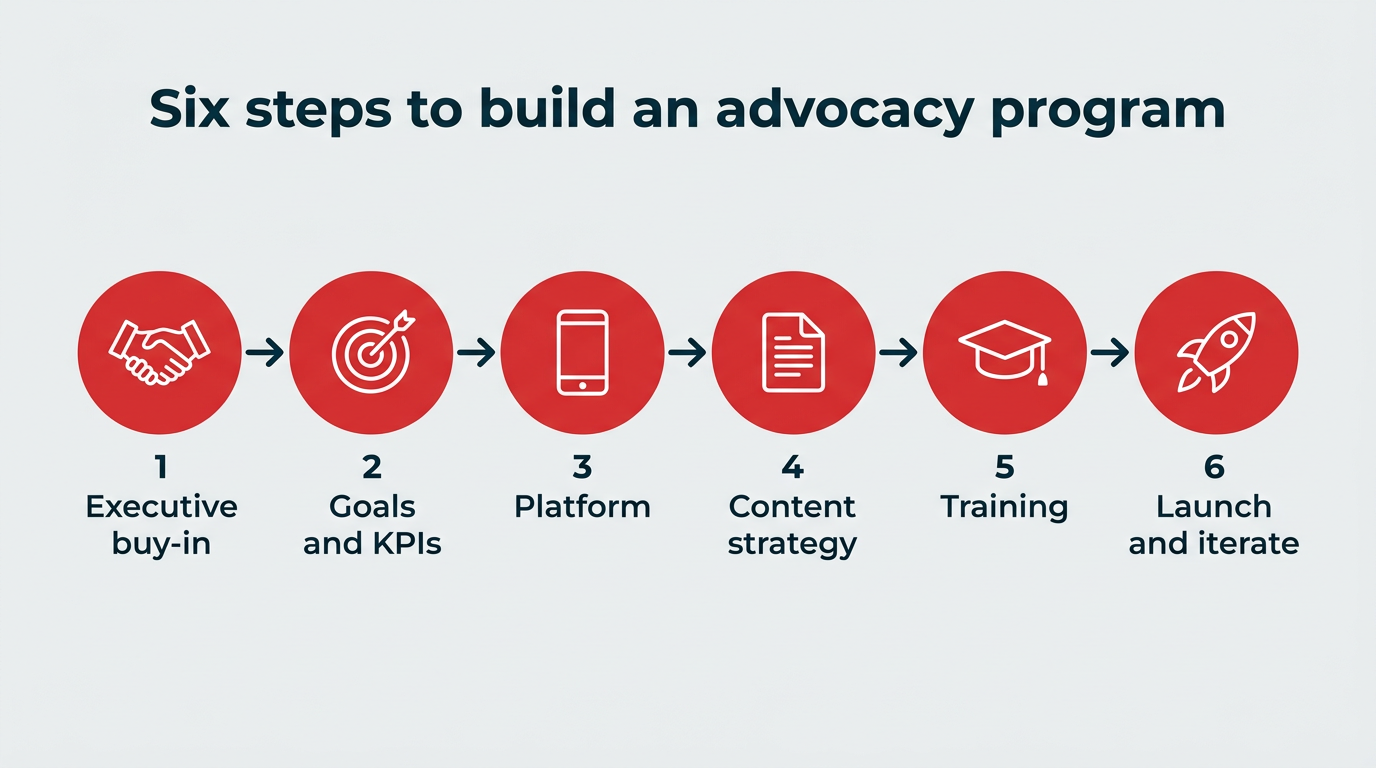
Establishing a successful, long-lasting employee advocacy initiative requires a methodical approach. Organizations that rush deployment without adequate groundwork often witness initial enthusiasm fade within months. Industry best practices suggest a disciplined, six-step implementation framework.
[1. Executive Buy-In] ➔ [2. Goal Setting] ➔ [3. Platform Selection] ➔ [4. Content Strategy] ➔ [5. Training & Onboarding] ➔ [6. Launch & Iterate]Securing Executive Buy-In
Leadership support dictates whether an advocacy initiative receives adequate budgeting and visibility or quietly stagnates as an underfunded side project. Stakeholders must be presented with advocacy as a strategic business investment rather than an experimental marketing tactic. Proposing an initial 60- to 90-day pilot focused on a single department allows leadership to evaluate tangible metrics before authorizing a broader enterprise rollout.

Defining Core Key Performance Indicators (KPIs)
A successful program requires laser-focused objectives. While advocacy can theoretically support brand awareness, recruitment, and sales simultaneously, trying to optimize all four out of the gate dilutes effectiveness. Programs must tie specific goals—such as career site referrals, UTM-tracked lead generation, or earned media value—to measurable metrics reported on a monthly cadence.
Selecting the Right Enterprise Tool
Scaling an advocacy initiative beyond a small pilot demands dedicated technological infrastructure. Spreadsheets and messaging apps fail as programs grow. Enterprises must evaluate platforms based on content curation capabilities, approval workflows, compliance controls, analytics integration, and mobile accessibility. Integrating these tools into existing operational dashboards ensures that advocacy functions seamlessly alongside broader publishing and listening workflows.
Crafting a Shareable Content Strategy
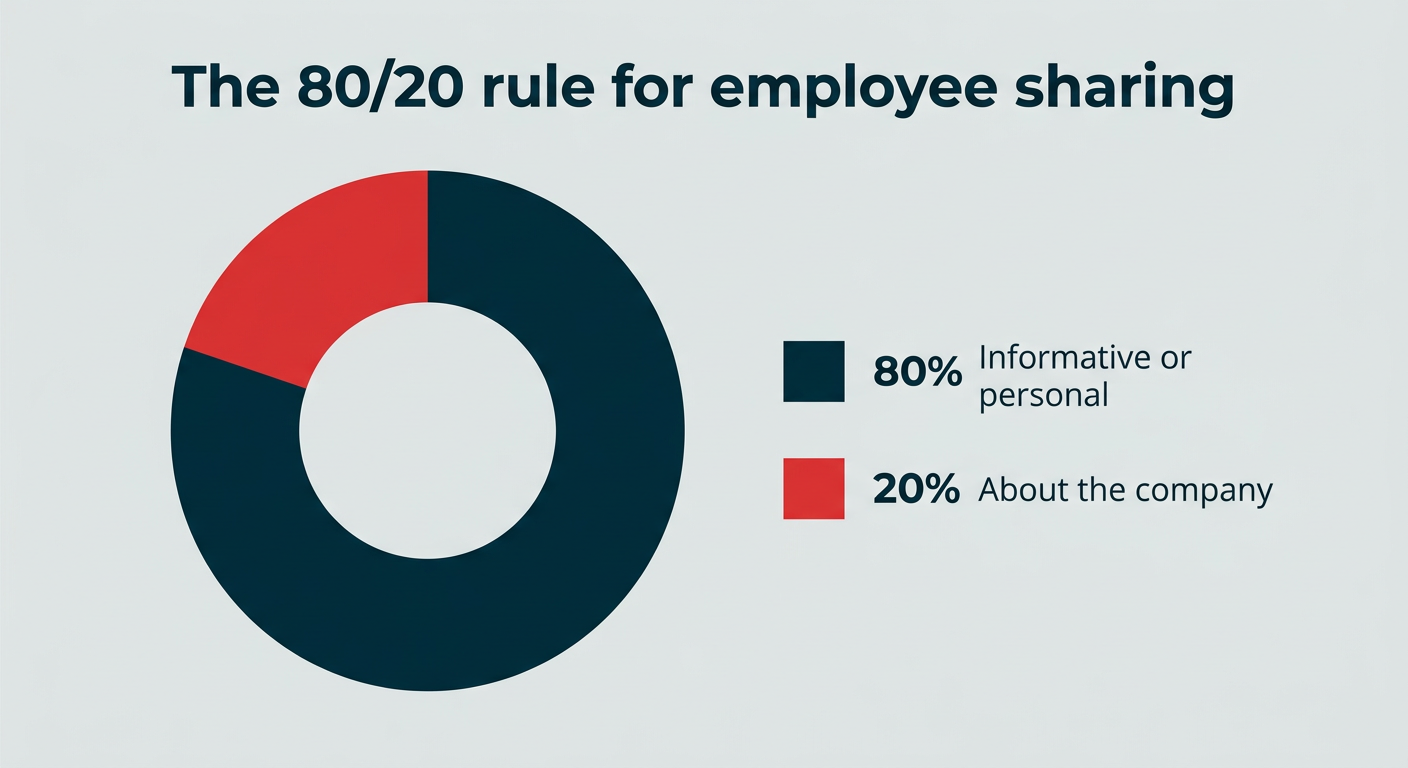
Content must resonate with the personal professional interests of the workforce. Successful programs universally adopt balanced frameworks, such as the widely recognized 80/20 rule: approximately 80% of shared material consists of industry insights, educational resources, and culture highlights, while only 20% is explicitly promotional. Furthermore, employees must always be given the creative freedom to add their own commentary rather than blindly reposting corporate copy.
Comprehensive Training and Compliance
Hesitation among employees rarely stems from an unwillingness to participate; rather, it is born from uncertainty regarding corporate social media policies and personal brand protection. Structured onboarding—such as formal social media universities or brand bootcamps—removes this friction, teaching staff profile optimization, voice development, and disclosure compliance.
Launching, Incentivizing, and Iterating
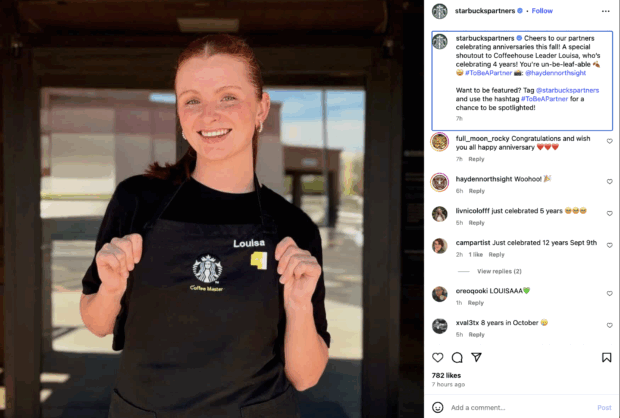
Program rollouts are most effective when initiated with a cohort of enthusiastic early adopters who can generate initial momentum. Sustained participation is subsequently maintained through gamification, leaderboards, and formal recognition programs that reward consistent engagement. Regular content audits ensure the resource library remains fresh, relevant, and aligned with evolving company milestones.
Global Enterprise Case Studies: Proof in Practice
Across diverse global industries, major corporations have operationalized employee advocacy to achieve unprecedented digital reach and business impact.
- Hootsuite: Utilizing its proprietary advocacy framework, the company aligns cross-departmental content councils with gamified recognition programs, successfully driving substantial year-over-year revenue growth directly attributed to employee-shared initiatives.
- Armanino: This major accounting and consulting firm deployed structured content hubs combined with intensive social media bootcamps, empowering hundreds of active advocates to customize thought leadership pieces, resulting in millions of organic impressions.
- Dell Technologies: Managing one of the world’s largest enterprise advocacy ecosystems, Dell mandates comprehensive social media training before employees engage with curated product updates and corporate responsibility initiatives, yielding hundreds of thousands of annual shares.
- Athletico: Operating within the healthcare sector, this organization achieved a remarkable 95% adoption rate during its pilot week by pairing engaged staff with structured, ready-to-share content libraries.
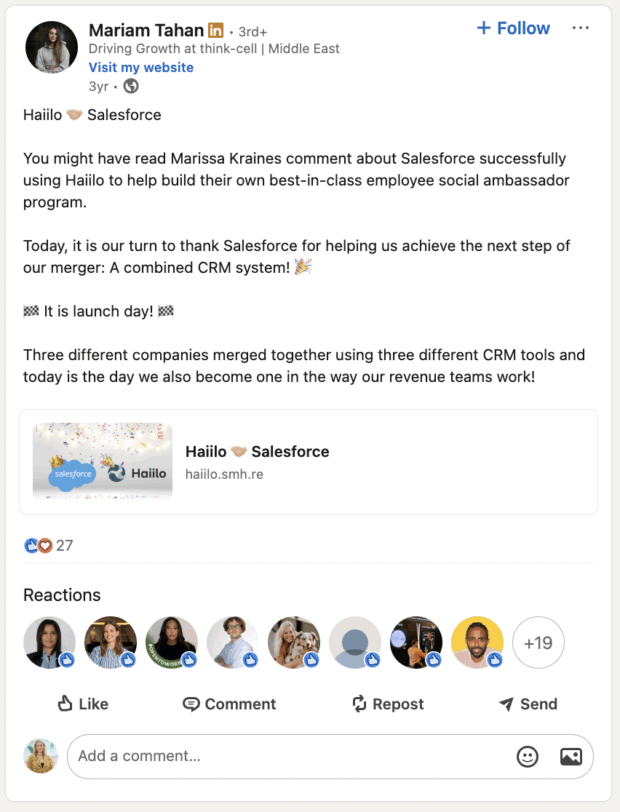
- Salesforce: By integrating advocacy platforms with automated channel subscriptions and multilingual copy personalization, Salesforce realized exceptional program return on investment, cementing global brand awareness and recruitment efficiency.
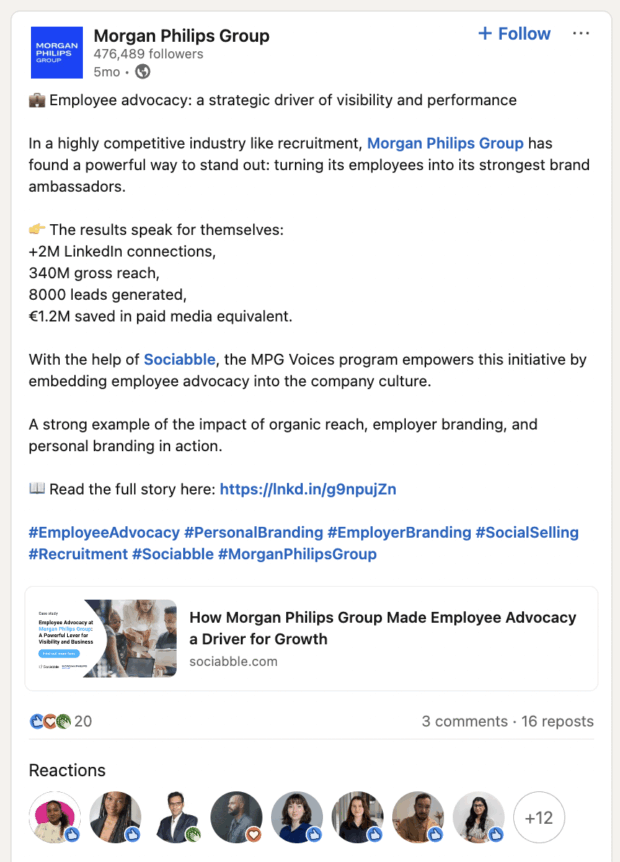
- Morgan Philips Group: Leveraging specialized advocacy technology, this recruitment leader empowered global consultants to share domain expertise, generating thousands of qualified leads and substantial earned media value equivalents.
- DaVita: Focused heavily on healthcare recruitment, DaVita utilized ambassador networks to share authentic teammate experiences, resulting in triple-digit percentage surges in qualified job applicants on professional networking platforms.
- Croda: Operating within the complex chemicals and life sciences sector, Croda centralized dozens of digital channels to amplify sustainability messaging, successfully driving thousands of web conversions and strengthening key B2B relationships.
- Adobe: By aligning curated content libraries with individual employee passions and design roles, Adobe achieved multi-million-person expansions in total social reach, proving that personal storytelling enhances corporate credibility.
Measuring Success and Analytical Attribution
Evaluating the efficacy of an employee advocacy program requires balancing activity metrics with hard business outcomes. Relying exclusively on raw share counts fails to capture the true value delivered to the enterprise.
| Metric Category | Specific Measurement | Typical Benchmark / Outcome |
|---|---|---|
| Participation | Program Adoption Rate | High initial uptake (frequently exceeding 90% in pilot phases) |
| Performance | Engagement Lift | Double-digit percentage increases compared to brand-owned handles |
| Value | Earned Media Value (EMV) | Hundreds of thousands to millions in paid media equivalents |
| Conversion | Referral Traffic | Thousands of unique website clicks driven by advocate shares |
| Revenue | Pipeline Attribution | Six-figure direct contributions to closed-won or active sales pipelines |
| Recruitment | Applicant Volume | Triple-digit percentage increases in career site traffic and applicants |
To maintain executive confidence, program administrators must embed UTM tracking parameters into every link housed within the central content library from day one. Without rigorous attribution tracking, proving return on investment risks devolving into speculation. By bridging the gap between brand marketing and individual human connection, modern employee advocacy programs have firmly established themselves as an indispensable pillar of contemporary corporate communication and growth strategy.