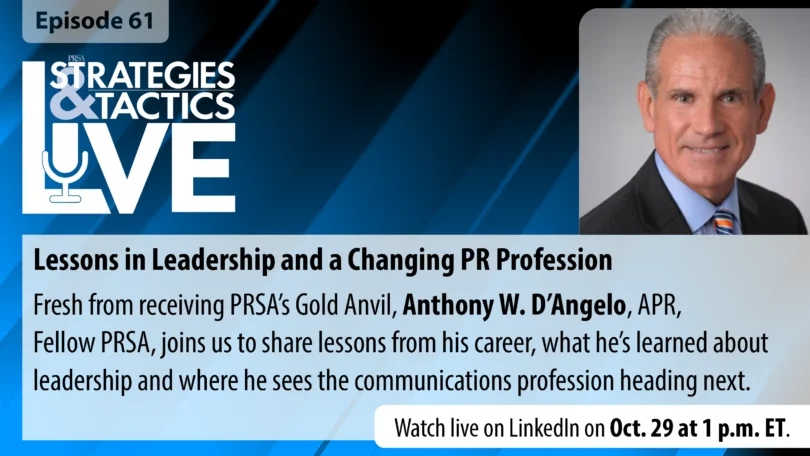
The public relations industry stands at a critical juncture, navigating the dual challenges of rapid technological disruption and an evolving definition of effective leadership. At the heart of this transition is Tony D’Angelo, APR, Fellow PRSA, a veteran communicator whose career spans decades of corporate, agency, and academic leadership. On October 18, 2026, at the PRSA ICON 2026 conference, D’Angelo was honored with the Gold Anvil Award—the Public Relations Society of America’s highest individual distinction. This award recognizes a lifetime of professional achievement, mentorship, and significant contributions to the field. Following this recognition, D’Angelo sat down with John Elsasser, editor-in-chief of Strategies & Tactics, to discuss the enduring principles of the profession and the looming challenges posed by artificial intelligence.
A Career Defined by Service and Strategy
Tony D’Angelo’s career trajectory is characterized by a shift from tactical execution to a philosophy centered on people-centric leadership. Currently serving as a professor of practice, chair of the public relations department, and director of executive education at Syracuse University’s S.I. Newhouse School of Public Communications, D’Angelo has long been a fixture in the industry. Before his transition to academia, he held high-level corporate communications positions at major global entities, including ITT and Carrier. His tenure as the 2018 PRSA chair cemented his reputation as a transformative figure who prioritizes collaboration over hierarchical control.
When reflecting on his rise through the ranks, D’Angelo emphasizes that his most significant professional breakthrough occurred when he stopped focusing on his individual output and began prioritizing the collective success of his teams. “When you do that, and you bring that perspective to leadership, the better a leader you will be,” D’Angelo stated. “And that can be immensely rewarding.”
The Principles of Engagement: Lessons from the Past
During the October 29 edition of Strategies & Tactics Live, a monthly livestream series on LinkedIn, D’Angelo revisited the foundational wisdom of PR legend Patrick Jackson, APR, Fellow PRSA. Jackson’s famous adage, “People want to be engaged, not told; served, not sold,” serves as a cornerstone for D’Angelo’s own professional philosophy.
This principle is particularly relevant in the modern era of organizational change. D’Angelo observed that many leaders make the mistake of attempting to force-feed solutions to their employees rather than fostering an iterative, collaborative environment. By dictating outcomes, leaders often stifle the very innovation they seek to encourage. D’Angelo argues that effective communication is inherently dialogic—it requires an environment where all voices are welcomed and where the leader acts as a facilitator rather than a commander.
The Distinction Between Management and Leadership
A central theme of D’Angelo’s discourse is the fundamental difference between management and leadership. Drawing on the common industry aphorism, he noted that “a good manager does things right, and a good leader does the right thing.”
The distinction, according to D’Angelo, lies in the ability to identify and cultivate potential in others. He credits his own mentors for pushing him beyond his self-imposed limits. “The best leaders bring out the extra in someone,” he said. “Maybe they don’t even know they have it. I’ve had leaders who, to my undying gratitude, stretched me. It wasn’t always comfortable, but I am so glad it happened.”
For professionals seeking to advance within their organizations, particularly those interacting with the C-suite, D’Angelo suggests that courage must be backed by competence. He advocates for the strategy of “speaking softly, with loud data.” In the modern boardroom, anecdotal evidence is rarely sufficient to sway executive decision-making. Instead, communicators must ground their recommendations in rigorous data analysis. When a communicator combines deep expertise with empirical evidence, they gain the credibility necessary to provide uncomfortable—yet necessary—counsel to top-tier leadership.
Navigating the Data-Driven Era
The profession has undergone a seismic shift since D’Angelo began his career. The advent of digital and social media, now accelerated by artificial intelligence, has fundamentally changed the landscape of public relations. Where previous generations of practitioners struggled to gather enough information, today’s communicators are faced with an abundance of data.
“With the advent of digital and social media, now supercharged by artificial intelligence, we’re surrounded by actionable data,” D’Angelo noted. “We’ve had to learn to swim in it. And I think that’s a good thing. It’s given us opportunities for measurement and analysis that didn’t exist before.”
However, this data abundance comes with a hidden cost: the phenomenon of “cognitive offloading.” D’Angelo expressed concern that an over-reliance on generative AI platforms like ChatGPT and Claude is hindering the development of critical thinking skills among the next generation of communicators. He warns that when professionals outsource the thinking process to algorithms, they lose the ability to synthesize information, construct nuanced arguments, and adapt to complex human scenarios.
Preparing the Next Generation: The Human Advantage
At Syracuse University, D’Angelo is actively working to address the integration of AI in the workplace. His approach in the classroom is designed to ensure that students do not become obsolete as automation increases. The central question he poses to his students is, “How are you going to add value to these AI platforms?”
D’Angelo believes the answer lies in the mastery of core professional skills: writing, editing, and strategic thinking. AI can generate content, but it cannot replace the judgment of a professional communicator who understands audience psychology, ethical considerations, and the nuances of brand reputation. As AI takes over routine tasks, the premium on human judgment and high-level strategy will likely increase.
Broader Implications for the Communications Industry
The recognition of D’Angelo with the Gold Anvil Award by the PRSA represents more than just a nod to a distinguished career; it serves as a milestone for the industry as it grapples with the transition from traditional media relations to AI-integrated, data-heavy strategic communication.
Data provided by recent industry reports underscores the validity of D’Angelo’s concerns regarding AI. While 75% of communication departments now report using AI for basic content generation, only 30% report having a comprehensive strategy for managing the potential risks of algorithmic bias and misinformation. D’Angelo’s emphasis on “professional communication” suggests that the future of the field will be defined by those who can treat AI as a secondary tool rather than a replacement for human intellect.
Furthermore, his focus on the human element of leadership provides a vital counterpoint to the dehumanizing potential of digital efficiency. As organizations increasingly rely on automated systems for internal communication and project management, the role of the human leader in fostering culture and engagement becomes even more critical.
Conclusion: A Legacy of Mentorship
As D’Angelo continues his work at the S.I. Newhouse School, his influence extends far beyond his academic role. His philosophy of service-based leadership, his commitment to data-driven decision-making, and his cautionary stance on cognitive offloading provide a roadmap for the future of the communications industry. By prioritizing the growth of others, embracing the complexity of modern data, and holding fast to the necessity of professional, human-led strategy, he remains a guiding force for both seasoned practitioners and those just entering the field.
The Gold Anvil Award is a testament to a career built on the belief that communication is not merely about transmitting information, but about the profound, human-centered work of building relationships, fostering understanding, and guiding organizations through change. As D’Angelo often reminds his students and colleagues, the ultimate measure of a communicator’s success is not the volume of the noise they create, but the quality of the engagement they inspire. In an age of artificial intelligence, that human touch is not just an asset; it is the most vital competitive advantage a professional can possess.