The rapid evolution of generative artificial intelligence has fundamentally altered how consumers and business buyers discover brands online, introducing a paradigm shift that traditional search engine optimization (SEO) frameworks alone can no longer navigate. In an era where conversational agents like OpenAI’s ChatGPT, Google’s Gemini, and Perplexity synthesize information directly for users, marketing teams face a novel challenge: securing visibility inside dynamic, AI-generated answers. Identifying content gaps for AI visibility starts with addressing a question traditional audits routinely miss: where could a brand meaningfully contribute to an AI-generated answer, but remains entirely unmentioned or uncited?
As modern search trends continue to reshape consumer discovery, finding a content gap is no longer as straightforward as identifying a missing article on a keyword planner. A company might possess a highly relevant webpage that AI search engines completely overlook, or an AI assistant might mention the brand while relying entirely on an independent third-party website for supporting information. Consequently, blindly scaling content production without diagnosing the underlying mechanics of AI retrieval can lead to wasted resources and stagnant digital performance.
Understanding the Anatomy of AI Visibility Gaps

To successfully capture and retain market share within conversational search ecosystems, digital marketers must first distinguish between traditional SEO content gaps and artificial intelligence visibility gaps. A traditional content gap analysis typically compares a website’s keyword coverage and search engine result page (SERP) performance against competing domains, illuminating topics and queries where competitors rank, but the target website does not.
In contrast, AI visibility analysis evaluates a completely different set of outcomes. A webpage can maintain a top-three ranking on Google while remaining entirely absent from a ChatGPT or Perplexity response. Furthermore, AI assistants frequently introduce complex scenarios where a brand is explicitly named, yet the underlying citation directs the user to a review aggregator, a news article, or a competitor’s blog rather than the brand’s proprietary domain.
Marketers must categorize these visibility challenges diagnostically. A page may cover a relevant topic comprehensively but lack both a direct, extractable answer and sufficient authoritative evidence to warrant a direct citation from an automated retrieval system. Therefore, the overarching objective is not merely to plug holes in an editorial calendar, but to identify and rectify structural deficiencies within the broader answer ecosystem.
Parsing AI Mentions Versus AI Citations

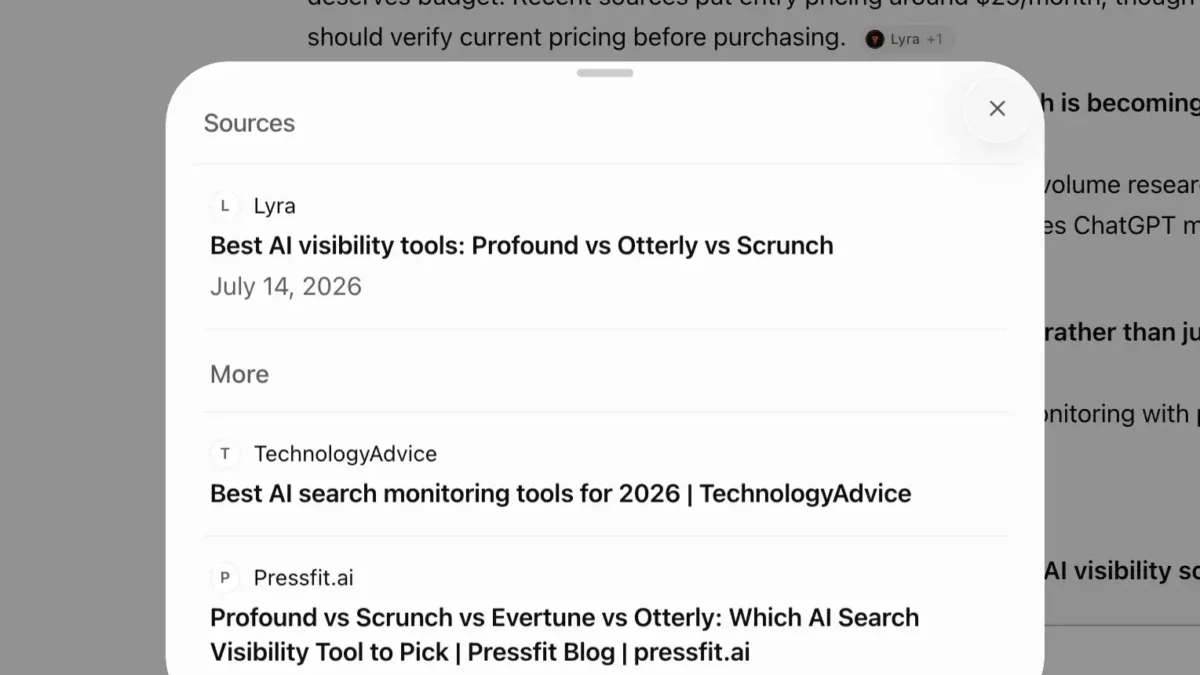
A foundational step in modern visibility optimization is differentiating between an AI mention and an AI citation. An AI mention occurs when a generative response explicitly names a brand, product, or company. Conversely, an AI citation occurs when the system provides a source reference, footnote, or hyperlink supporting the data presented within the response.
For example, when an AI assistant responds to a query regarding the top project management software for creative agencies, it may recommend a specific platform while citing an independent review site for pricing tiers and feature comparisons. While the brand has successfully achieved mention visibility, its own product documentation or landing pages are absent from the underlying source architecture.
Conversely, a direct citation to a brand’s website indicates that the generative engine has surfaced that domain as a primary source of truth. However, industry analysts note that a citation alone does not automatically guarantee brand recommendation, click-through engagement, or downstream revenue generation. Marketers are strongly advised to record mentions and citations separately in their analytics frameworks. Combining these metrics into a singular visibility score obscures whether an optimization opportunity requires enhancing brand inclusion, improving source selection, or refining technical extractability.
A Four-Step Blueprint for AI Content Gap Analysis

Conducting a rigorous AI visibility content gap analysis requires a systematic, four-phase methodology: collecting relevant prompt tracking data, classifying mentions and citations, mapping findings to existing content inventories, and prioritizing gaps based on business value and required remediation effort.
Step 1: Pulling Prompt Tracking Data
Establishing where a brand appears—and where it conspicuously vanishes—begins with curating a defined set of prompts that mirror the actual language prospective customers use during discovery, evaluation, and purchasing cycles. Rather than isolating individual keyword variations, marketers must group prompts by overarching topic and intent. Leveraging specialized Answer Engine Optimization (AEO) tools allows marketing teams to monitor prompts across multiple LLM-driven platforms simultaneously, tracking how a brand fares alongside competitors.
Step 2: Tracking Mentions and Citations Systematically

Once prompt groups are established, teams must run these queries through prominent AI answer engines, recording the exact brands mentioned and the specific URLs cited as sources. Maintaining a centralized data repository enables digital strategists to isolate patterns. If a brand is consistently mentioned across queries, but feature data is invariably supplied by third-party directories, the immediate operational fix involves updating product documentation and structured data rather than authoring top-of-funnel thought leadership pieces.
Step 3: Mapping Prompts to Existing Assets
Prompt-to-page mapping determines whether an organization already houses content that answers the questions surfaced during tracking. For every priority prompt group, marketing teams must audit product pages, documentation portals, case studies, comparison guides, and blog archives. Each candidate asset must be rigorously evaluated for topical depth, accuracy, alignment with user intent, and structural extractability. If an asset addresses the core topic but fails to align with the specific framing deployed by the AI assistant, targeted updates are required.
Step 4: Prioritizing Gap Remediation

Not all visibility gaps carry equal commercial weight. Content gaps must be prioritized according to business relevance, the strength of the observed visibility pattern, and the resource investment required to implement a fix. High-impact topics directly aligned with core revenue-generating services should take precedence over peripheral queries that yield minimal downstream conversion potential.
Optimizing for Extractability and LLM Value
To bridge the gap between missing visibility and active citation, content must be engineered for optimal extractability. Large language models favor information that is structured clearly and logically, allowing retrieval systems to parse, understand, and reuse data without forcing users or algorithms to stitch together scattered statements. Incorporating clear headings, descriptive bullet points, summary definitions, and robust schema markup significantly enhances a page’s machine readability.
Simultaneously, content must offer substantive originality signals that LLMs prioritize over generic summaries. Proprietary research, verifiable statistics with transparent methodologies, firsthand case studies, and expert commentary provide the unique value inputs that automated engines seek when constructing comprehensive answers.

Measuring Success and Mitigating Common Pitfalls
Measuring the efficacy of AI content optimization requires tracking specialized metrics over time, including brand mention presence, citation presence, AI share of voice, and AI-referred web traffic. Because generative outputs inherently fluctuate from run to run, maintaining baseline measurements and evaluating longitudinal trends is essential for accurate attribution.
Marketers must actively avoid common pitfalls, such as chasing every anomalous prompt variation, over-optimizing structural formatting at the expense of human readability, or treating every missing mention as an automatic mandate to publish a new article. By focusing deliberately on high-impact informational needs and aligning content strategies with genuine customer intent, organizations can secure durable, long-term visibility across the rapidly expanding landscape of artificial intelligence search.