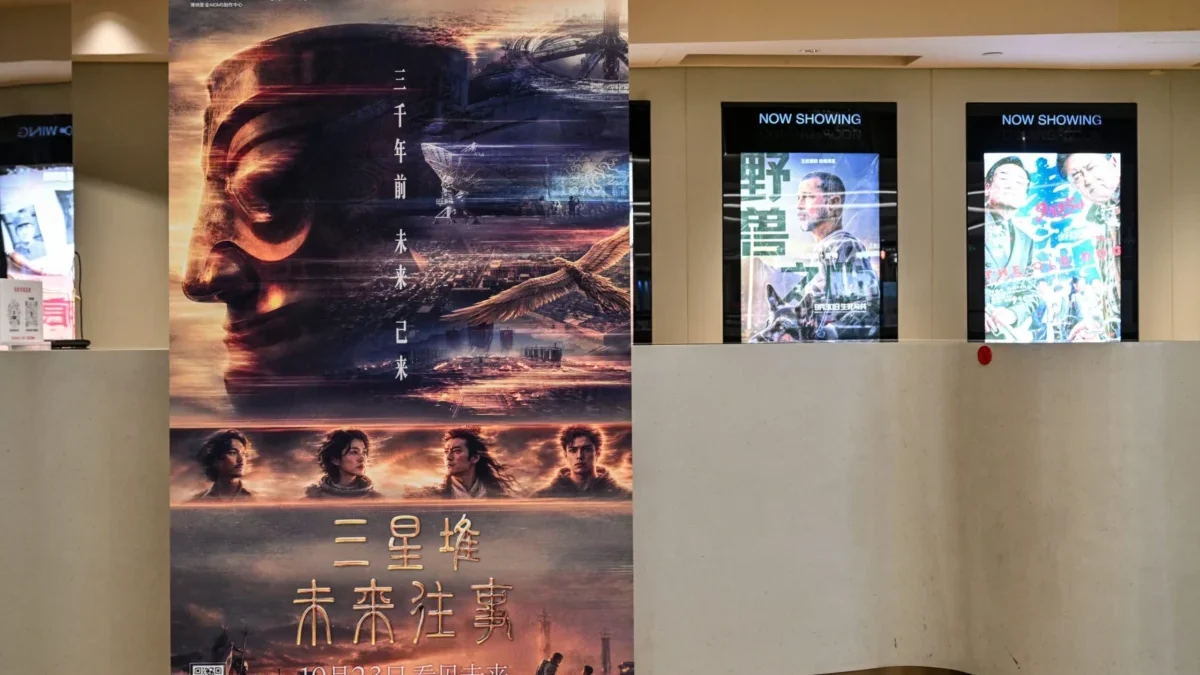
The debut of Sanxingdui: Future Past, marketed as China’s first fully AI-generated feature film, has served as a sobering reality check for the global film industry. While the rapid advancement of generative AI has revolutionized the production of micro-content and social media narratives, the transition to the silver screen has proven to be a difficult hurdle. Produced by the Bona Film Group, the sci-fi thriller arrived in theaters with significant anticipation, only to face a tepid reception that suggests audiences are not yet ready to embrace synthetic storytelling as a replacement for traditional cinematic craftsmanship.
The film, which follows an archaeologist navigating a dystopian future under the thumb of artificial intelligence, was intended to be a landmark achievement in technological integration. However, according to data from the ticketing platform Maoyan, the film generated a meager $180,000 in box office revenue through its opening period. Given its reported production budget of $1.5 million, the project represents a significant financial disappointment, highlighting a fundamental friction between the low-cost agility of AI production and the high-value expectations of theater-going audiences.
A Chronology of the AI Film Experiment
The trajectory of AI in Chinese media has been marked by a two-speed evolution. In the span of just 18 months, the landscape shifted from experimental tech-demos to a dominant industry standard for short-form content.
In early 2025, the proliferation of generative AI tools began to disrupt the micro-drama sector—a lucrative industry built on serialized, bite-sized episodes designed for consumption on mobile platforms like TikTok and its Chinese counterpart, Douyin. By the first quarter of 2026, the shift had reached a saturation point: data from industry analysts at Caixin indicated that over 95% of the 120,000 micro-dramas released during that period were generated primarily through AI workflows. This represented a near-total reversal from the previous year, when AI-assisted content was effectively non-existent.
The production of these micro-dramas has plummeted in cost, with some series now being produced for as little as $3,000. This efficiency convinced industry leaders, including the executives at Bona Film Group, that the same model could be scaled for the big screen. Sanxingdui: Future Past was the culmination of this logic. After months of development, the film received its official theatrical release permit, marking a milestone in regulatory acceptance. However, when the film finally hit screens in late 2026, the transition from 60-second social media clips to a feature-length narrative failed to resonate with the public.
The Audience Verdict: A Divided Reception
The reaction on Chinese social media platforms like Xiaohongshu has been starkly polarized. The digital divide is not merely about the quality of the visual output, but the emotional connection between the narrative and the viewer.
Some viewers expressed a sense of dissonance, with one user noting that the film’s synthetic aesthetic was “traumatizing” and lacked the human nuance expected in a professional production. Conversely, proponents of the technology pointed toward the democratization of cinema. One user commented that the greatest takeaway from the film was the potential for creative freedom, arguing that by stripping away the massive financial barriers to entry, AI allows independent creators to tell stories that would otherwise never be funded by traditional studios.
This dichotomy suggests that while AI is an excellent tool for the "disposable" entertainment of social media, it struggles to maintain the sustained engagement required for a 90-minute feature film. The current iteration of AI struggles with "the illusion of reality"—a term used by Hollywood directors to describe the subtle, often imperceptible choices made by human creators that ground a story in human experience.
Official Responses and Industry Defense
Bona Film Group, while acknowledging the lackluster box office performance, has maintained that the project was a success in terms of research and development. Jiang Defu, the company’s chief operating officer, framed the film not as a commercial product, but as a necessary trial.
"We are the first to try it, the first to get a theatrical release permit, and the first to be tested by the audience," Jiang stated in an interview with the industry outlet Yuli. He emphasized that the act of bringing an AI-generated film to a commercial theater was a significant logistical and technical hurdle that should be viewed as an industry-wide experiment. By testing the boundaries of the current legal and technical frameworks, Bona Film Group believes they have provided a blueprint for future creators, even if that blueprint currently lacks the audience appeal to be commercially viable.
The Global Context: A Contested Frontier
The struggle to integrate AI into cinema is not unique to China; it is a global flashpoint. In the United States, the role of AI in film was a central pillar of the 2023 labor strikes involving the Writers Guild of America (WGA) and the Screen Actors Guild (SAG-AFTRA). Creative professionals are demanding contractual protections to ensure that AI serves as a tool for human enhancement rather than a mechanism for human replacement.
Major Western studios have adopted a more covert approach. In October 2026, Netflix released the crime thriller Animals, directed by Ben Affleck. Affleck openly admitted to using AI to augment various aspects of the production, though he remained intentionally vague about the extent of its involvement. His reasoning—that filmmakers should protect the "illusion of reality"—suggests that Hollywood is leaning toward using AI for "invisible" technical assistance (such as background textures, lighting adjustments, or post-production cleanup) rather than the wholesale generation of plots and performances.
Analysis: Implications for the Future of Filmmaking
The failure of Sanxingdui: Future Past offers several critical insights for the future of the film industry:
- The Quality Gap: As noted by Stanley Rosen, a professor at the University of Southern California specializing in Chinese film, the public remains highly skeptical of AI in major feature films. Audiences have become accustomed to the high-fidelity spectacle of films like Avatar or the domestic hit Nezha 2. Unless AI can achieve parity with these high-budget, artisan-crafted experiences, it is unlikely to displace traditional filmmaking in the theatrical market.
- Strategic Realignment: The financial losses associated with this experiment will likely force production companies to "tread more carefully." Rather than pushing for fully AI-generated features, studios will likely pivot toward a hybrid model. This involves utilizing AI to reduce costs in pre-production (storyboarding, concept art) while keeping human directors, screenwriters, and actors at the helm of the creative process.
- The Streaming Shift: If AI-generated films do find a sustainable audience, it is unlikely to be in the theater. Streaming platforms, which prioritize volume and diverse content libraries, are better suited for lower-budget, experimental AI projects. The subscription model allows for a higher tolerance for varying levels of quality, making Netflix or Amazon Prime more logical homes for these productions than the high-stakes, high-ticket environment of the multiplex.
Conclusion: The Human Element Remains Essential
The current state of generative AI is characterized by its ability to synthesize existing patterns, but it has yet to replicate the chaotic, unpredictable nature of human creativity that makes cinema a compelling art form. The lesson from Sanxingdui: Future Past is not that AI has no place in the film industry, but rather that it cannot simply be substituted for the complex collaboration between director, writer, and audience.
As the industry moves forward, the focus will likely shift toward "co-piloting," where AI is used to handle the labor-intensive aspects of filmmaking, freeing up human creators to focus on the narrative soul of their projects. For now, the theater remains a sanctuary for human-centric storytelling, and the audience has made it clear that they are not yet ready to trade the soul of a film for the speed of an algorithm. The financial failure of this pioneering project serves as a reminder that in the arts, efficiency is rarely a substitute for empathy.