In a landmark development for the global technology sector, Anthropic officially priced its initial public offering on Wednesday at $83 per share. This figure surpasses the company’s initial guidance range of $70 to $78, signaling robust institutional appetite for what is poised to be one of the most significant public listings in financial history. Trading under the ticker symbol ANT on the Nasdaq, the company’s debut on Thursday is expected to command a valuation of approximately $1.5 trillion, cementing its status as a titan of the artificial intelligence industry.
The pricing of the IPO reflects a rare alignment of intense investor demand and the aggressive capital requirements necessary to sustain the current pace of generative AI development. According to reports, the company opted to increase the volume of its offering beyond the initial plan to sell 825 million shares, further underscoring the confidence placed in the San Francisco-based firm by the financial community.
A Chronology of Rapid Ascent
The journey to this $1.5 trillion milestone has been nothing short of meteoric. Founded just five years ago by a group of former OpenAI researchers and safety experts, Anthropic initially positioned itself as a boutique laboratory focused on AI safety and "constitutional" model alignment.
- 2021: Anthropic is founded in San Francisco, focusing on building reliable, interpretable, and steerable AI systems.
- 2023: The company begins a series of aggressive fundraising rounds, securing significant backing from cloud providers and strategic partners who recognize the value of its "Claude" family of models.
- Early 2026: Anthropic files for an IPO, initiating a whirlwind period of regulatory scrutiny and investor roadshows.
- November 2026: Following a period of market volatility, the company settles on a pricing strategy that prioritizes long-term liquidity for its primary stakeholders while signaling strength to the public market.
The rapid trajectory from a research-heavy startup to a trillion-dollar public entity is a testament to the transformative impact that frontier model development has had on the enterprise software landscape.
Financial Performance and Market Indicators
Anthropic’s financial disclosures ahead of the IPO reveal a company in a state of hyper-growth. For the nine-month period ending September 30, 2026, the company reported revenue of $33.2 billion, a staggering increase from the $2.5 billion recorded during the same period in 2025. This surge is largely attributed to the widespread adoption of its AI models by Fortune 500 companies, which have integrated the technology into their core business workflows to automate tasks ranging from legal analysis to software engineering.
While the company reported a net loss of $104 billion for the same nine-month period, financial analysts have pointed to technical accounting factors as the primary driver. Much of this deficit stems from the treatment of convertible notes, which, while appearing as a massive liability on the balance sheet, are standard for high-growth tech firms managing complex capital structures. Despite the accounting loss, the company’s operating cash flow remains a subject of intense scrutiny, as the cost of training large-scale models continues to escalate.
The Role of Strategic Partners
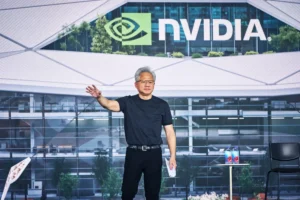
A cornerstone of this IPO is the participation of key strategic partners who have committed to purchasing $26 billion in non-voting stock at the IPO price. Among these entities are Google and Nvidia, both of which have been foundational to Anthropic’s ability to scale. This move acts as a "vote of confidence" that serves to stabilize the stock price against the volatility currently plaguing the broader tech sector.
For Nvidia, this investment aligns with its objective to ensure that its hardware ecosystem remains the preferred infrastructure for the world’s most advanced AI models. For Google, the investment provides a critical hedge in the competitive landscape of search and generative AI, ensuring that its strategic interests remain diversified across multiple industry-leading model providers.
The Broader AI Industry Barometer
Anthropic occupies a unique space as the first "pure-play" frontier AI company to enter the public markets. Unlike competitors such as Alphabet (Google) or Meta, which derive the bulk of their revenue from advertising and search, Anthropic’s valuation is tethered almost entirely to the future of AI model capabilities and their enterprise application.
Market observers are viewing this IPO as a critical stress test for the AI sector. The broader market has recently experienced significant turbulence, fueled by concerns over the "AI bubble," the sustainability of data center energy consumption, and leadership transitions at major hardware providers like Nvidia. The success of the ANT ticker will likely determine whether the "AI gold rush" continues to draw capital or if institutional investors will shift toward more defensive, cash-flow-positive sectors.
Economic and Organizational Implications
The IPO is expected to create a new generation of wealth for the company’s employees and early backers. With a $1.5 trillion valuation, the seven co-founders and early team members see their stakes reach levels that rival the most successful technology founders in history.
However, the transition to being a public company brings with it the burden of quarterly earnings calls, rigorous SEC reporting, and the demands of short-term-focused shareholders. Managing this transition while maintaining the company’s original mission of AI safety will be the primary challenge for the executive team.
Industry analysts have noted that the sheer scale of the $68.5 billion raised (a figure that may rise depending on the final share count) provides Anthropic with an "unprecedented runway." In an industry where model training costs are scaling into the tens of billions of dollars per cycle, this capital is not a luxury—it is an operational necessity. To maintain its competitive edge against other labs, Anthropic must invest heavily in compute power, specialized hardware, and the high-end talent required to maintain its technological lead.
Expert Analysis and Future Outlook
Financial experts suggest that while the initial excitement surrounding the IPO is high, the coming months will be defined by the company’s ability to demonstrate consistent path-to-profitability metrics. The "backlash" against AI infrastructure—specifically regarding the environmental and capital costs of massive data centers—is a headwind that the company must navigate through transparency and technological efficiency.
"Anthropic is essentially betting that the enterprise demand for generative AI will not just continue, but accelerate," noted a senior analyst at a major financial institution. "They are selling the promise of a total transformation of the workplace. If they can prove that their models are driving genuine ROI for their customers, the $1.5 trillion valuation will be seen as an entry point. If they falter on revenue growth, however, the market will be unforgiving."
As the trading bell rings on Thursday morning, the eyes of the global financial world will be fixed on the Nasdaq. The debut of Anthropic is more than just a stock listing; it is an inflection point for the era of artificial intelligence. It represents the maturation of an industry that, until now, has been largely confined to private equity and venture capital. Whether the market confirms the $1.5 trillion thesis or initiates a correction, the event serves as a defining moment in the history of 21st-century technology.
Investors, regulators, and the general public remain focused on whether this infusion of capital will accelerate the "intelligence explosion" or if it marks a point of peak irrational exuberance. For now, the sentiment remains cautious but expectant, with the company’s performance in the coming weeks set to provide the first real data point in a new, high-stakes chapter for the global economy.