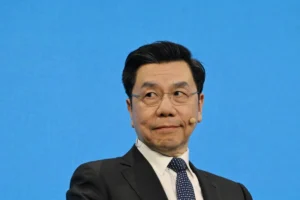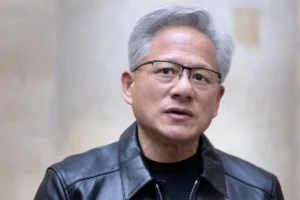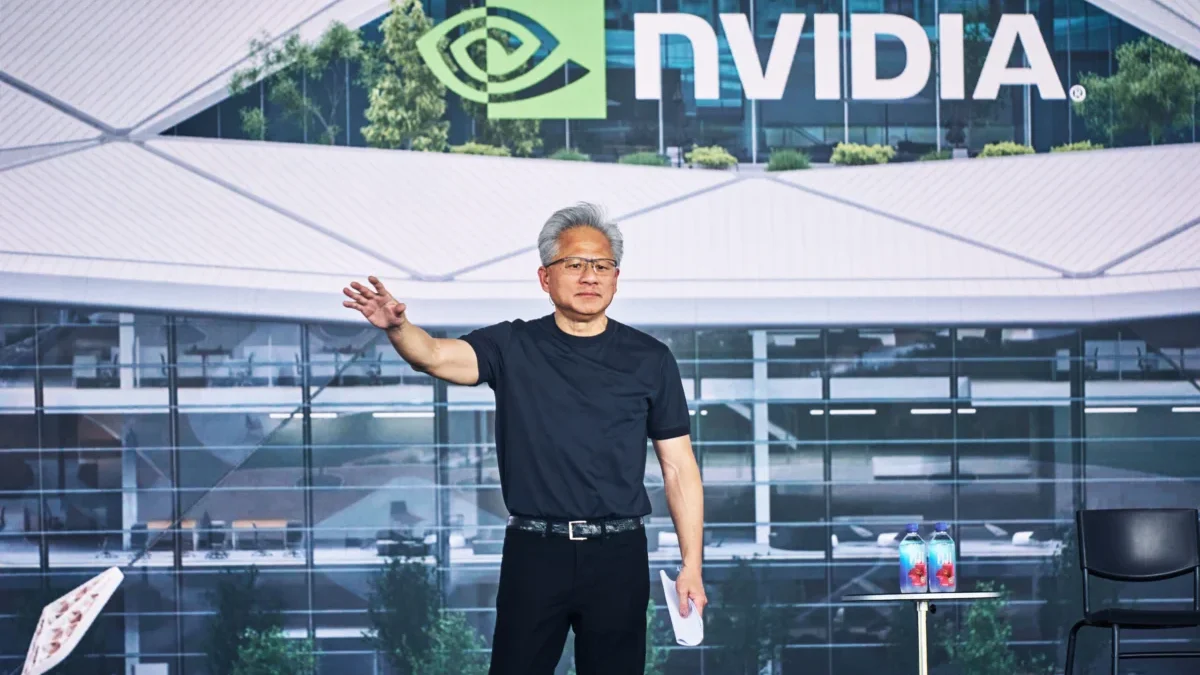
The tech industry is currently navigating a period of profound uncertainty following the transition of leadership at Nvidia, the world’s most valuable semiconductor manufacturer. On Thursday, the company officially appointed Colette Kress, who has served as chief financial officer since 2013, to the position of interim CEO. Kress will manage the company’s day-to-day operations while the board of directors embarks on what is expected to be the most scrutinized executive search in Silicon Valley history.
The departure of Jensen Huang marks the end of a transformative era. Since co-founding Nvidia in 1993, Huang steered the company from a niche graphics card manufacturer into the backbone of the global artificial intelligence infrastructure. Under his stewardship, Nvidia’s market capitalization surged, reflecting the company’s dominance in high-end data center GPUs and its pivotal role in the generative AI revolution. Replacing a visionary founder who became synonymous with the company’s culture and technical trajectory presents a monumental challenge for the board.
A Period of Transition: The Immediate Outlook
Colette Kress’s appointment as interim CEO is viewed by analysts as a stabilizing move. Having served as CFO for over a decade, Kress has been instrumental in the company’s financial planning, capital allocation, and investor relations. Her tenure has coincided with Nvidia’s most aggressive growth phase, providing her with an intimate understanding of the firm’s operational mechanics and its complex supply chain.
“Colette is very much the right interim CEO,” noted Scott W. Simmons, co-managing partner of the executive search firm Crist Kolder Associates. Simmons, who has nearly three decades of experience in high-level executive recruitment, emphasizes that Kress’s deep institutional knowledge makes her the ideal candidate to hold the reins while the board identifies a long-term successor. However, industry experts largely expect the board to look for a permanent replacement who possesses both a deep technical pedigree and the executive gravitas to manage a multi-trillion-dollar entity.
The Search for a Successor: Potential Candidates and Profiles
The search for a permanent CEO is expected to span several months, if not longer. While internal candidates are often evaluated in such scenarios, the sheer complexity of Nvidia’s current market position—balancing hardware innovation with massive software ecosystems—has led many observers to look toward high-profile external leaders.
The Arm Connection: Rene Haas
One of the most frequently cited candidates is Rene Haas, the current CEO of Arm. Haas’s candidacy is rooted in his deep familiarity with Nvidia’s organizational DNA; he spent seven years at the company prior to his departure in 2013. His supporters argue that his current leadership at Arm—a company whose architecture is central to Nvidia’s Grace and Vera CPUs—provides him with a unique, industry-wide perspective.
Shay Boloor, chief market strategist at The Futurum Group, recently highlighted Haas’s candidacy, noting that his experience running a public company and his deep understanding of CPU architecture make him a formidable contender. However, skeptics suggest that while Haas is a proven leader, scaling his experience at Arm to manage the multifaceted, hyper-growth demands of Nvidia is a significant leap.
The Semiconductor Peer: Lisa Su
AMD CEO Lisa Su has also emerged as a subject of intense speculation. Su is widely credited with engineering the miraculous turnaround of AMD, transforming it from a struggling chipmaker into a primary competitor to both Intel and Nvidia. Her technical background—a PhD in electrical engineering—aligns with the profile of a leader who can continue to drive innovation.
The ironic familial connection to Huang has added a layer of narrative intrigue to her candidacy. Yet, analysts point to the practical reality of such a move: persuading a CEO who has spent over a decade rebuilding a competitor into a powerhouse would require an extraordinary offer and a unique set of circumstances.
The Visionary Outsider: Cook, Kurian, and Arora
Industry observers, including Dan Ives of Yorkville Ives & Co., have cast a wider net, identifying three high-profile names as the top external candidates: Tim Cook, Tom Kurian, and Nikesh Arora.
- Tim Cook: As the former CEO of Apple, Cook possesses perhaps the most relevant experience for this specific vacancy: succeeding a legendary founder. His expertise in supply chain logistics—a critical component of the semiconductor business—combined with his experience overseeing Apple’s in-house silicon development, makes him a compelling, if unlikely, candidate. His recent transition to executive chairman at Apple adds a layer of complexity to any potential recruitment efforts.
- Tom Kurian: The CEO of Google Cloud brings a different type of expertise. His background at Oracle and his current leadership at Google Cloud have placed him at the center of the AI infrastructure deployment. He has worked closely with Nvidia, giving him a buyer’s-side view of the product, though questions remain regarding his ability to pivot from a cloud-service provider to a hardware-manufacturing leader.
- Nikesh Arora: The CEO of Palo Alto Networks offers a blend of enterprise software, global sales, and investment experience. His tenure at SoftBank and Google provides him with a global perspective on tech markets, which could be an asset as Nvidia navigates increasingly complex geopolitical waters.
Challenges and Macroeconomic Factors
Whoever ultimately fills the position will inherit a company under immense pressure. Nvidia is currently the focal point of a global race for AI supremacy, a position that invites regulatory scrutiny, supply chain volatility, and the constant threat of technological disruption.
The board’s decision will likely be guided by two competing requirements: the need for a technical visionary who can anticipate the next wave of computing architecture, and the need for a seasoned executive who can manage the company’s massive scale and its relationships with international governments and stakeholders.
"There’s such a small pool to fish in when you think about people capable of stepping into this," Simmons observed. The scarcity of executives who have successfully managed a company of Nvidia’s market cap and complexity is the primary hurdle the board faces.
Timeline of Leadership and Growth
The history of Nvidia is marked by long-term stability in leadership, which makes this transition period particularly significant for the market.
- 1993: Nvidia is founded by Jensen Huang, Chris Malachowsky, and Curtis Priem.
- 1999: The company releases the GeForce 256, widely considered the world’s first GPU.
- 2013: Colette Kress joins Nvidia as CFO, beginning a decade of transformation.
- 2023: Nvidia achieves a trillion-dollar market valuation, fueled by the demand for H100 chips.
- 2026 (November): Jensen Huang steps down, and Colette Kress is appointed interim CEO.
Conclusion: The Road Ahead
The appointment of an interim CEO has provided the market with a temporary sense of continuity, but the true test for Nvidia lies in the coming months. The board’s selection process will reflect the company’s priorities for the next decade. Whether they choose a veteran technologist to keep the company on its current path or a strategic operator to guide it through the next stage of corporate maturation, the choice will have far-reaching implications for the global technology landscape.
For now, the industry remains in a state of watchful waiting. Investors, competitors, and partners are closely monitoring the board’s search criteria, as the outcome will signal how Nvidia plans to navigate the post-Huang era. The "guessing game" is not merely about a name; it is about the future direction of the engine that powers the world’s most advanced artificial intelligence. The successor will not only inherit a company; they will inherit the challenge of maintaining dominance in an industry that moves faster than almost any other sector in the global economy.