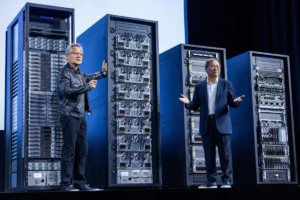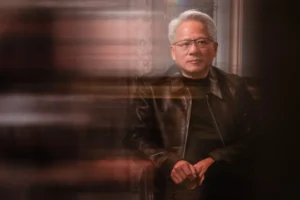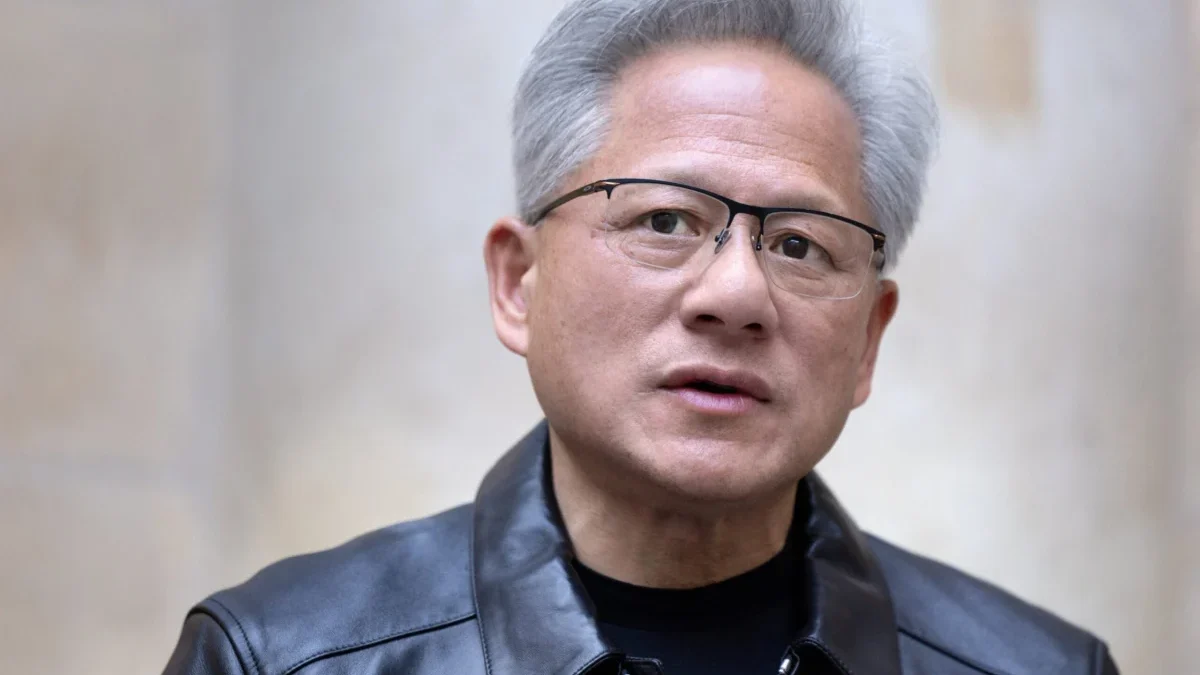
The Silicon Valley landscape is facing an unprecedented tremor as Nvidia Corporation, the $4 trillion titan of the artificial intelligence revolution, prepares for the potential ouster of its longtime chief executive officer, Jensen Huang. This seismic shift in corporate governance follows a cascade of revelations, beginning with Mr. Huang’s admission of an extramarital affair with an individual identified by U.S. intelligence agencies as a Chinese operative. The impending board action, first reported by the Wall Street Journal, threatens to terminate a 33-year tenure that transformed a graphics chip startup into the primary engine of the global AI economy.
The crisis deepened on Wednesday as reports emerged in the New York Times regarding a secondary entanglement involving Kimberly Powell, the company’s vice president of healthcare. As the board of directors convenes to deliberate on the future of the company’s leadership, Nvidia shares have experienced significant volatility, shedding more than 9% in after-hours trading. This uncertainty underscores the unique, personality-driven governance model that has defined the chipmaker’s meteoric rise but now poses a substantial existential risk.
A Chronology of the Disclosure
The collapse of confidence in the CEO’s tenure began in earnest on Sunday, November 9, 2026, when Jensen Huang issued a public acknowledgement of infidelity. The admission, which surfaced during a weekend of intense scrutiny, was immediately followed by a formal announcement from Nvidia that the board had initiated an independent investigation. The mandate of this inquiry is to determine whether the CEO’s personal conduct resulted in the exposure of sensitive proprietary information or national security assets.
While the board stated earlier this week that there was "no reason to believe that either national security or Nvidia secrets were compromised," the situation deteriorated rapidly as federal investigators provided additional intelligence regarding the nature of the primary contact. The subsequent disclosure involving Ms. Powell—a 20-year veteran of the company who has served as a pivotal architect of its AI healthcare and research divisions—has further complicated the internal investigation, forcing the board to consider the broader implications of executive conduct on corporate culture and operational security.
The Huang Era: Unprecedented Growth and Centralized Power
To understand the scale of the potential fallout, one must consider the sheer magnitude of the company under Mr. Huang’s leadership. Co-founding Nvidia in 1993, Huang steered the company through the transition from gaming hardware to the specialized GPUs that now power the world’s most advanced large language models.
The fiscal performance of the company in recent years has been historic. For the fiscal year ending in January 2026, Nvidia reported $215.9 billion in revenue, a staggering 65% increase over the previous year. This trajectory accelerated into the first half of fiscal 2027, with the company posting $96 billion in revenue—an 85% year-over-year climb. Prior to the current crisis, the firm had guided investors toward a third-quarter revenue target of $108 billion, with Chief Financial Officer Colette Kress projecting a robust 70% growth rate for fiscal 2028.
However, the company’s success has been inextricably linked to a governance structure that is highly idiosyncratic. Unlike most S&P 500 corporations, Nvidia operates without a board chair, and Mr. Huang has maintained a flattened hierarchy where approximately 60 executives report directly to him. This structure has allowed for lightning-fast decision-making, but it has left the company with no clear succession plan or designated intermediary to bridge the gap between the CEO and the operational heads.
Institutional Analysis and Market Reactions
Market analysts have moved quickly to digest the implications of a leadership vacuum at the center of the AI ecosystem. Gil Luria, an analyst at D.A. Davidson & Co., noted that the current turmoil "hastens a transition the company is not prepared for."
The concern among investors is not merely the loss of a CEO, but the loss of a visionary who has functioned as the company’s primary strategist and chief diplomat. Mr. Huang’s hands-on approach—which included direct communication with even the smallest clients—was a cornerstone of the company’s sales strategy and brand identity.
"The challenge for the board is not whether they can find a successor who understands semiconductor manufacturing," said one industry consultant who requested anonymity due to the sensitivity of the situation. "The challenge is finding someone who commands the absolute trust of the massive cloud service providers and governments that rely on Nvidia for their sovereign AI infrastructure. Jensen was the industry’s north star. Without him, the narrative of constant, aggressive innovation becomes much harder to sustain."
Security Implications and Regulatory Scrutiny
The involvement of U.S. intelligence agencies elevates this scandal far beyond the bounds of typical corporate ethics violations. Given Nvidia’s status as a critical supplier for military-grade AI, supercomputing clusters, and national defense research, any association with a foreign intelligence asset—however tenuous—invites rigorous oversight from the Department of Commerce and the Committee on Foreign Investment in the United States (CFIUS).
The board’s internal investigation is currently tasked with answering several high-stakes questions:
- Did the unauthorized access or influence exerted by the alleged foreign operative gain entry into the company’s R&D roadmap?
- Were trade secrets, specifically regarding next-generation chip architectures (such as the successor to the Blackwell platform), exposed?
- To what extent did the secondary relationship with internal leadership compromise the internal compliance protocols meant to detect foreign influence operations?
The Road Ahead for Nvidia
As of Wednesday, the board of directors remains in emergency sessions. The lack of a formal succession plan means that any appointment of an interim CEO would likely be a stopgap measure, intended to stabilize the stock price and provide a sense of continuity to major customers like Microsoft, Meta, and Amazon.
However, the company’s culture, which has been molded by three decades of Huang’s leadership, may prove difficult to manage under a traditional, bureaucratized executive structure. The tension between maintaining the company’s aggressive, high-growth "startup" mentality and the need for institutional stability will be the defining challenge of the coming weeks.
Employees at Nvidia’s Santa Clara headquarters are reportedly grappling with the sudden shift in atmosphere. Internal communications, which previously focused on the next quarter’s benchmarks and technological breakthroughs, have been largely replaced by uncertainty regarding the future of the company’s leadership and the potential for federal intervention.
For the global technology sector, the outcome of the board’s decision will have ripple effects for years to come. Nvidia is not merely a chip manufacturer; it is the infrastructure provider for the modern era of artificial intelligence. If the company’s leadership transition is handled poorly, the impact on global AI development—and the broader markets that depend on it—could be profound.
The next few days will be critical. Should the board proceed with the removal of Huang, they must move with unprecedented speed to appoint a leader who can reassure both Wall Street and the national security apparatus that the company remains a secure, stable, and transparent actor in the global supply chain. For now, the "magnificent" rise of Nvidia faces its most significant test in its history, proving that even the most powerful companies are not immune to the volatility of human error and the complexities of international geopolitical rivalries.