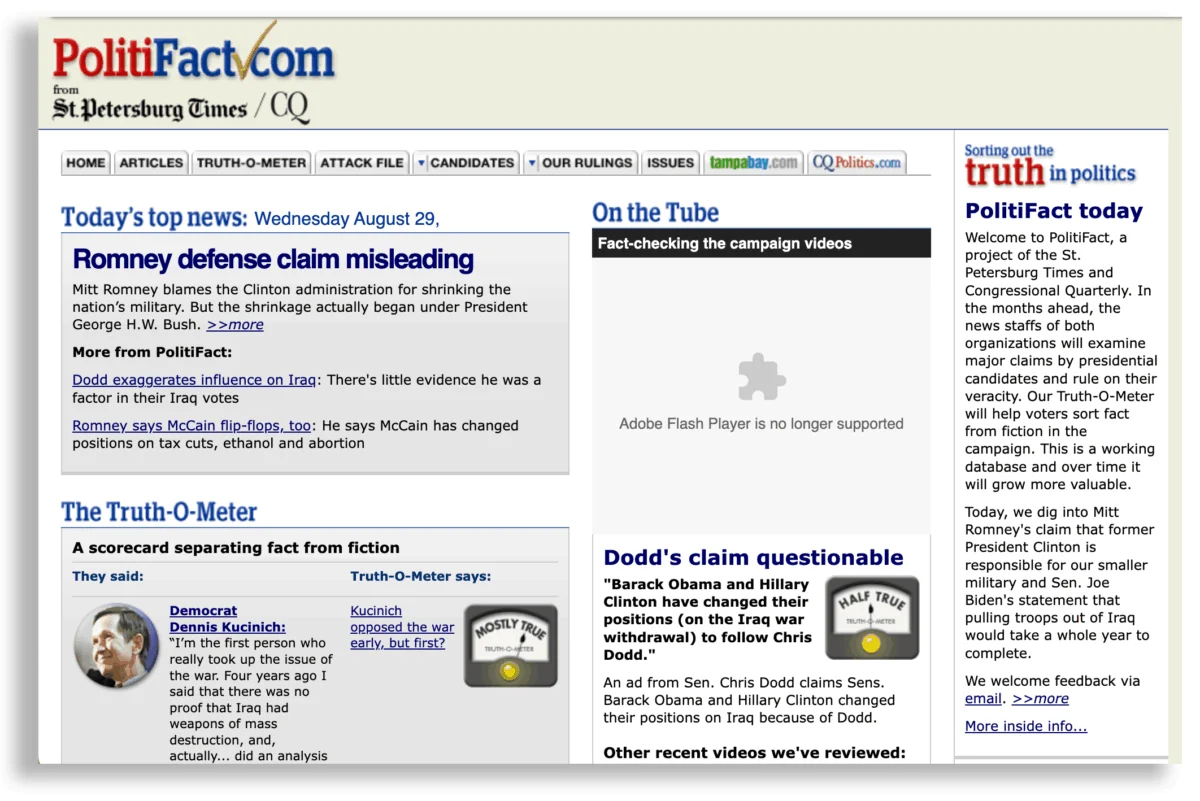
The foundational content management system (CMS) that powered PolitiFact, the pioneering fact-checking website, for nearly two decades has been officially retired, signaling a significant moment in the history of digital journalism. The announcement, conveyed via text message to Matt Waite, the architect of the original system, marks the end of an era for a platform that not only redefined political reporting but also set new standards for how digital tools could serve public enlightenment. Launched in 2007, the custom-built Django-based CMS was the engine behind a journalistic endeavor that would go on to win a Pulitzer Prize, demonstrating the profound impact of agile development and an idea-driven approach in a rapidly evolving media landscape.
The Genesis of a Digital Pioneer: PolitiFact’s Unconventional Birth
The story of PolitiFact’s CMS begins in the spring of 2007, a period when the digital transformation of newsrooms was still in its nascent stages. Bill Adair, then the Washington Bureau Chief for the Tampa Bay Times (formerly St. Petersburg Times), reached out to Matt Waite, a news technologist at the paper, with an ambitious concept: to create a website dedicated to rigorously fact-checking political claims. This initial conversation in late May 2007 sparked an unconventional development process that defied traditional corporate protocols.
Waite, embracing an ethos of "build first, ask permission later," embarked on the project with remarkable resourcefulness. He famously salvaged a computer from the trash, installed a Linux operating system, and initiated the development by running django-admin startproject. This grassroots approach, devoid of formal managerial approvals or extensive budgeting, underscores the innovative spirit that characterized PolitiFact’s inception. The team, primarily Waite and Adair, operated with a lean, iterative methodology, focusing on demonstrating functionality rather than drafting lengthy proposals. "We told them about it when it was working and they could see a page and click on it," Waite recounted, highlighting a pragmatic strategy that prioritized tangible results over bureaucratic hurdles. Within a mere two months of that initial discussion, PolitiFact officially launched in August 2007, a breathtaking speed for a news organization at the time. This rapid deployment showcased the power of small, dedicated teams empowered to experiment and execute.
A Landmark Achievement: The Pulitzer Recognition and its Impact
Less than two years after its launch, PolitiFact achieved an unprecedented milestone, cementing its place in journalistic history. In April 2009, the website was awarded the Pulitzer Prize for National Reporting, becoming the first-ever website to receive the prestigious honor. The award citation lauded PolitiFact for its innovative use of "probing reporters and the power of the World Wide Web to examine more than 750 political claims, separating rhetoric from truth to enlighten voters." This recognition was not just a testament to the journalistic integrity and meticulousness of the PolitiFact team, but also a powerful validation of the potential of digital-first initiatives to contribute meaningfully to public discourse.
The Pulitzer underscored several critical shifts occurring within the media industry. Firstly, it legitimized the nascent field of dedicated fact-checking, elevating it from a niche activity to a core component of accountability journalism. PolitiFact’s "Truth-O-Meter," with its distinctive visual ratings (True, Mostly True, Half True, Mostly False, False, Pants on Fire!), became an iconic and easily digestible mechanism for assessing political statements, resonating with a public increasingly wary of partisan rhetoric. Secondly, it demonstrated that online platforms were not merely supplementary to print or broadcast but could be primary vehicles for groundbreaking journalism. The award signaled a paradigm shift, recognizing that the "World Wide Web" was not just a distribution channel but an integral part of the journalistic process itself, enabling new forms of engagement and transparency. This recognition paved the way for numerous other digital news organizations to gain mainstream acceptance and compete for top journalistic honors.
Nineteen Years of Unseen Service: The CMS’s Enduring Legacy
For 19 years, PolitiFact’s original CMS diligently served as the backbone of its operations. Matt Waite’s direct involvement with the code ceased in 2011 when he transitioned to academia at the University of Nebraska-Lincoln. However, the system continued to function, undergoing patches, maintenance, and modernizations by subsequent teams. Crucially, the core functionality and the "original guiding idea" remained fully intact, a testament to the robustness of its initial architecture and the foresight embedded in its design. The longevity of this bespoke system, particularly in the fast-paced world of web technology, is remarkable. Most digital platforms undergo complete overhauls or migrations every few years, making PolitiFact’s CMS an anomaly of sustained functionality.
The enduring nature of the system reflects not just technical competence but also a profound understanding of the problem it sought to solve. Waite, reflecting on the system’s retirement, observed the passage of time through a deeply personal lens: "We were still counting the months since my son was born when PolitiFact started. He’s starting his sophomore year of college next month. It’s been that long." This perspective highlights the CMS’s role not just as a piece of software, but as a silent, steadfast companion to a significant chapter in digital journalism. Its retirement, though long anticipated by Waite, offers an opportunity to reflect on the enduring lessons it imparts, particularly in an era dominated by artificial intelligence and rapid technological change.
Shifting Paradigms: Lessons from a Digital Veteran
The retirement of PolitiFact’s original CMS prompts a critical examination of the principles that guided its creation and sustained its longevity. Matt Waite distills these into three key lessons, profoundly relevant for contemporary journalism, technology, and education.
Beyond the Code: The Primacy of the Idea
Waite emphatically states, "It’s not about the code. It never was." For nearly two decades, he has emphasized that the code itself is "unimportant." The true innovation lay in the "idea and the architecture" – the philosophical approach to journalism. PolitiFact’s genius was in conceptualizing journalism, specifically the fact-check, as data. By breaking down a journalistic unit into its "atomic elements" – who said it, what was said, when, where, about what, and most importantly, its veracity – the system could establish connections and generate new insights. This "journalism as data" approach allowed for the systematic categorization and analysis of political claims, facilitating the "Truth-O-Meter" and enabling a structured, verifiable presentation of information.
This insight is particularly prescient in the current technological climate. In 2007, a human (Waite) had to meticulously write the code. Today, generative AI tools, such as Anthropic’s Claude, can "vibecode" a functional CMS in minutes or hours. One could prompt an AI: "make me a CMS using Django for a fact-checking website that rates things politicians say on a scale of factuality," and receive a working prototype swiftly. However, Waite argues, this AI-generated solution would not be "the same thing." The distinction lies not in the technical output but in the "idea. It’s a philosophy, expressed one human decision at a time." The core value remains the conceptual framework, the strategic design, and the journalistic integrity embedded within the system, not merely the lines of code. As Waite observes, "Journalism needs more ideas that take the essence of what we do and put it into new and different containers for new and different ways of consuming information and reaching audiences. You can vibecode your way into a demo, but if the idea sucks, it doesn’t matter how good of a coding model you used." This underscores a fundamental truth: technology is merely a tool; its effectiveness is entirely dependent on the quality and thoughtfulness of the underlying concept.
The Age of Rapid Prototyping: Demos Over Memos Revisited
Another critical lesson, first articulated by Waite in 2009, is the power of "Demos, not memos." This philosophy posits that demonstrating a working concept is far more effective than presenting a theoretical proposal. In 2007, building PolitiFact’s demo in weeks and launching in months was considered "breathtaking speed" for a newspaper. Today, with the advent of AI and low-code/no-code platforms, the cost of creating a demo has plummeted. Demos that once took weeks can now be produced in hours. Waite jokingly rephrases his earlier adage for the AI era as "slop demos, not slop memos," suggesting that even imperfect prototypes offer more value than verbose, theoretical documents.
This reduced barrier to entry for prototyping holds immense implications for innovation in journalism and beyond. Ideas can be tested and iterated upon with unprecedented speed and minimal investment. Waite shares a personal anecdote: an idea that "sounded great" at the water cooler was built into a complete, functional demo with AI assistance in just "six whole hours." The result? "And holy crap did it suck." The actual user experience was "insufferably boring and nerdy." This rapid prototyping allowed Waite to swiftly identify a flawed concept without dedicating weeks or months to its full development. The lesson is clear: AI has "removed the excuse to not make the demo." The ability to quickly visualize, interact with, and discard ideas accelerates the innovation cycle, enabling organizations to invest resources only in concepts that demonstrate genuine promise. This approach minimizes risk and maximizes the potential for discovering truly impactful solutions.
Embracing the ‘Punk Rock’ Ethos in Journalism Innovation
Waite’s third lesson is a call for a more rebellious, entrepreneurial spirit: "More punk rock, less music class." He reflects on his own journey with PolitiFact, admitting he "didn’t know how to do any of this when I started." He learned on the fly, pre-dating ubiquitous resources like Stack Overflow or large language models (LLMs). His method involved "making scores of mistakes, reading documentation, pestering friends over instant messaging, begging a lifetime of favors from people." The team started "without asking permission," and the success of the demo meant "forgiveness never came up." They iterated, experimented, and solved problems as they arose, embracing uncertainty and an "too stupid to know what we didn’t know" mindset. "We didn’t have a sheet of music to play from, and couldn’t read it if we did. We had an idea, some power chords and some amplifiers. It was punk rock. No one taught us how to do this. We just did it."
This ethos is a direct challenge to what Waite perceives as a growing aversion to ambiguity, confrontation, and failure among current generations of students. He observes that many prefer "very specific instructions" and are "completely allergic to trying the things they’ve learned in class outside of it," often driven by the fear of failure. Waite implores students and aspiring innovators to move beyond the confines of structured learning: "What you do in class will never be enough. I’m telling you this as someone who teaches classes. What you do outside of it — on your own, with only your grit and guts — is the whole game." The message is a powerful endorsement of independent initiative, courage, and resilience. Great innovations rarely emerge from strictly following established rules; they often arise from challenging norms, taking risks, and persevering through trial and error. The "punk rock" approach champions self-reliance, experimentation, and the belief that bold ideas, backed by sheer determination, can lead to lasting impact, even when the path is unclear.
The Future of Fact-Checking and Digital Journalism
The retirement of PolitiFact’s original CMS, while marking an end, simultaneously illuminates the path forward for digital journalism and fact-checking. The lessons articulated by Matt Waite — the primacy of the idea, the low cost of demos, and the necessity of a "punk rock" attitude — are more relevant than ever.
The field of fact-checking has grown exponentially since PolitiFact’s launch. According to the Duke Reporters’ Lab, the number of active fact-checking organizations worldwide has expanded from a handful in 2007 to over 400 in more than 100 countries today. This growth underscores the increasing demand for verified information in an age of rampant misinformation and disinformation, often amplified by social media and increasingly sophisticated AI-generated content. For these organizations, the emphasis on robust, flexible architectures that treat "journalism as data" will be crucial for scaling operations, fostering collaboration, and adapting to new platforms and consumption habits. The ability to quickly integrate new data sources, employ advanced analytical tools, and deliver nuanced assessments will depend less on proprietary code and more on well-defined journalistic methodologies translated into adaptable digital frameworks.
Moreover, the acceleration of technological change, particularly with generative AI, means that newsrooms must adopt a culture of continuous experimentation. The "demos, not memos" philosophy becomes not just a preference but a survival imperative. News organizations, often criticized for their slow adoption of technology, now have the tools to rapidly prototype solutions for engagement, content creation, and verification. This means fostering environments where failure is seen as a learning opportunity, and where small, cross-functional teams are empowered to test new ideas quickly.
Ultimately, the enduring legacy of PolitiFact’s original CMS is not just about a successful piece of software but about the pioneering spirit it embodied. It represents a watershed moment where digital tools were leveraged not merely to disseminate news faster, but to fundamentally alter how journalism was conceived and executed, serving the public good with unprecedented rigor and transparency. The challenges facing journalism today — from trust erosion to economic pressures and the proliferation of synthetic media — demand a renewed commitment to that "punk rock" ethos: a willingness to question assumptions, build fearlessly, and champion groundbreaking ideas, even without a clear roadmap or explicit permission. PolitiFact’s first CMS may be retired, but the spirit of innovation it represents continues to resonate, inspiring future generations to harness technology to uphold the vital mission of journalism.