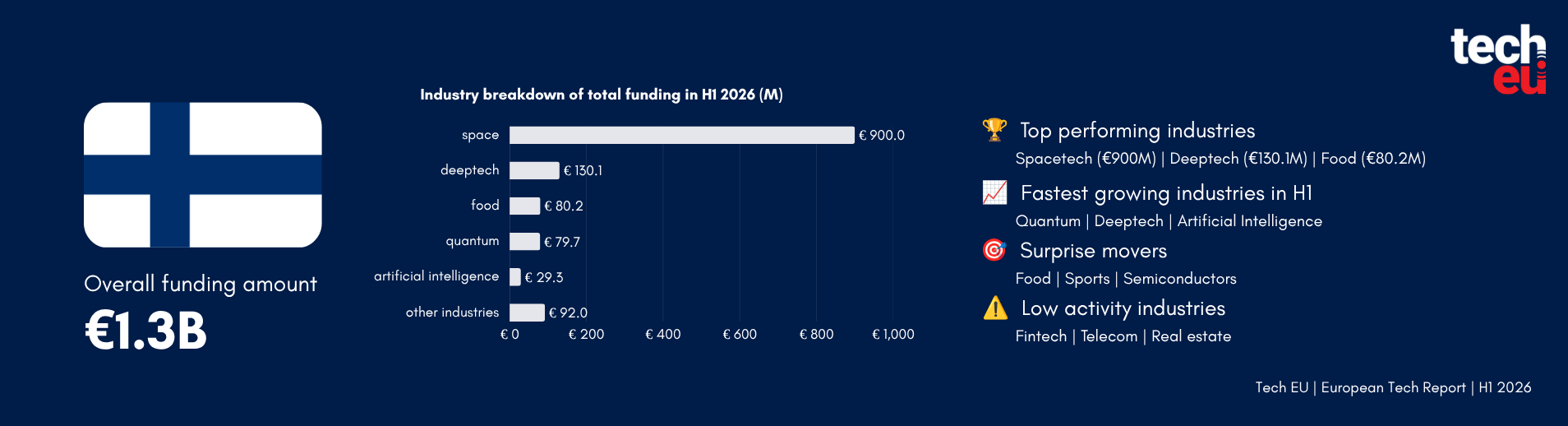
The Finnish technology ecosystem demonstrated robust capital attraction during the first half of 2026, pulling in approximately €1.3 billion across 53 distinct funding transactions. While the aggregate figure highlights a thriving innovation landscape, a granular look at the market reveals a distinct top-heavy concentration. Spacetech alone accounted for a staggering €900 million—representing nearly 69 percent of all capital deployed during the six-month period. This massive influx underscores Finland’s rising prominence as a European powerhouse for high-complexity, engineering-intensive, and research-heavy industries.
Beyond aerospace ventures, the H1 2026 funding environment showcased a diversified portfolio of technological strengths. Capital flowed heavily into foundational and frontier sectors, including deeptech, quantum computing, AI infrastructure, renewable energy, semiconductors, and cleantech. Simultaneously, a high volume of early-stage, smaller-ticket rounds were distributed across software, healthcare, foodtech, cybersecurity, e-commerce, and sports tech. This dual-track funding dynamic—defined by mega-rounds at the top and consistent venture creation at the bottom—points to an exceptionally resilient and vertically integrated domestic tech economy.
A Chronological Overview of H1 2026 Funding Milestones
The opening months of 2026 set a rapid pace for venture capital and strategic investments across Finland. The market activity kicked off early in February and maintained steady momentum through the end of June, punctuated by several landmark financing rounds.
The investment timeline began to take serious shape in February 2026, when Capalo AI secured €11 million to scale its AI-powered software for optimizing battery energy storage systems across European electricity markets. Momentum accelerated rapidly in late March as quantum computing pioneer IQM locked down a €50 million financing package from funds managed by BlackRock, positioning the company to expand its global R&D and market footprint.
April brought substantial capital injections into infrastructure and autonomous systems. Verda (formerly DataCrunch) closed a major $117 million equity and debt financing round on April 24 to scale its clean-power AI cloud infrastructure. Concurrently, on April 14, autonomous airship developer Kelluu raised €15 million to scale its aerial intelligence platform for civilian and defense monitoring.

May was a particularly active month for strategic rounds and high-profile valuations. On May 6, Peter Sarlin’s AI and quantum venture Qutwo hit a €325 million valuation following a €25 million angel-backed raise. Days later, on May 11, Algorithmiq secured €19.7 million—featuring Italy’s largest quantum VC round and a Wellcome Leap prize—before shifting its global headquarters to Milan. Late May also saw Quanscient close a €10 million Series A round on May 26 to advance its cloud-native multiphysics simulation and quantum engineering software.
The half-year closed out with historic transactions in June. On June 9, ICEYE completed a massive €450 million capital raise, culminating in a €900 million total haul across three distinct rounds for H1 2026, driving its valuation to an impressive €10 billion. Shortly after, on June 17, sustainable food innovator Solar Foods secured a €77.8 million grant and R&D loan package to fund its critical Factory 02 expansion.

Detailed Breakdown of the Top 10 Funded Finnish Tech Companies
The scale and scope of Finland’s H1 2026 capital raise are best illustrated by the ten companies that captured the lion’s share of the investment.
-
ICEYE (€900M)
Operating the world’s largest synthetic aperture radar (SAR) satellite constellation, ICEYE provides all-weather, day-and-night Earth observation data. Its technology is heavily utilized in defense, intelligence, environmental monitoring, and disaster response, alongside providing sovereign satellite infrastructure directly to national governments. The company’s €900 million accumulation across three separate rounds in H1 2026—including a €450 million raise at a €10 billion valuation in June—will supercharge satellite manufacturing and global mission scaling.
-
Verda ($117M)
Formerly known as DataCrunch, Verda specializes in high-performance cloud infrastructure tailored for AI development and heavy compute loads. Powered primarily by renewable Nordic energy, Verda’s vertically integrated stack spans physical data centers to developer-facing software. The $117 million raised in April 2026 is funding the expansion of its team by over 100 employees and supporting international rollouts in the UK, the US, and broader Asian markets. -
Solar Foods (€77.8M)
Tackling the future of nutrition, Solar Foods produces Solein—a nutrient-rich, single-cell protein cultivated via a natural microorganism process completely independent of traditional agriculture, weather, and arable land. The €77.8 million secured in June 2026 via grants and R&D loans is earmarked entirely for the construction and commissioning of Factory 02, pushing the company closer to widespread commercial viability.
-
IQM Quantum Computers (€50M)
A European leader in superconducting quantum systems, IQM designs and builds quantum computers for academic institutions, supercomputing centers, and enterprise applications. Backed by a €50 million injection from BlackRock-managed funds in March 2026, IQM is accelerating its hardware roadmap and expanding its global footprint to meet the growing demand for fault-tolerant quantum computing architectures. -
Qutwo (€25M)
Founded by prominent tech entrepreneur Peter Sarlin, Qutwo bridges classical artificial intelligence, high-performance computing, and quantum systems. Its proprietary Qutwo OS platform enables businesses to integrate quantum-enhanced workflows smoothly. Following a €25 million angel round in May 2026 that pushed its valuation past €325 million, the company is spearheading the creation of a dedicated European AI laboratory tailored for the quantum era.
-
Algorithmiq (€19.7M)
Specializing in the intersection of quantum computing and life sciences, Algorithmiq develops advanced algorithms designed to solve complex challenges in quantum chemistry and drug discovery. The company secured €19.7 million in H1 2026—combining an €18 million investment round with a €1.7 million Wellcome Leap prize—enabling the commercial scaling of its quantum-enabled drug discovery pipeline. -
Kelluu (€15M)
Kelluu builds and operates autonomous, hydrogen-powered airships designed for persistent aerial surveillance and data collection. Offering high-resolution digital twins and real-time change detection, its platform serves critical infrastructure, environmental agencies, and defense clients. The €15 million raised in April 2026 is driving fleet expansion and accelerated deployment across European security sectors.
-
Capalo AI (€11M)
Addressing the complexities of modern green grids, Capalo AI provides AI-driven software that optimizes the trading and operation of battery energy storage systems (BESS). By synthesizing advanced forecasting models, the platform helps aggregate decentralized assets into virtual power plants. The €11 million secured in February 2026 is fueling the company’s expansion into broader European electricity markets. -
Quanscient (€10M)
Quanscient is revolutionizing hardware engineering through its cloud-native multiphysics simulation platform, Allsolve. By integrating automated workflows, AI-driven design optimization, and developing quantum-native algorithms for engineering, Quanscient allows enterprises to run hyper-complex simulations at scale. Its €10 million Series A secured in May 2026 will accelerate international expansion and technological depth.
-
Vexlum (€10M)
A successful spin-off from Tampere University, Vexlum designs and manufactures high-power, narrow-linewidth semiconductor laser systems using proprietary VECSEL technology. These lasers are critical components in quantum technology labs, advanced manufacturing plants, and scientific research facilities. The €10 million funding package secured in H1 2026 combines equity, grants, and debt to expand Finnish chip-manufacturing lines.
Strategic Implications and Macroeconomic Impact
The data from H1 2026 illustrates a structural maturation within the Finnish technology sector. While historical funding waves in the region were frequently dominated by consumer software and gaming, the current landscape is fundamentally anchored in deep-tech industrial assets. The massive capital concentration in spacetech, quantum computing, and AI infrastructure reflects a broader European strategic push toward technological sovereignty and critical infrastructure resilience.

Furthermore, the diversity of funding instruments—ranging from traditional venture capital equity and major private equity backing to institutional debt, EU-backed grants, and R&D loans—indicates a sophisticated financial ecosystem capable of supporting capital-intensive hardware ventures through multiple phases of growth.
Despite economic headwinds across the broader continent, the steady pipeline of pre-seed and seed investments guarantees that early-stage startup formation remains active. As these emerging ventures graduate into later stages of development, Finland’s strategic focus on engineering and research-heavy disciplines positions its tech sector to play a disproportionately influential role in shaping Europe’s industrial and digital future.