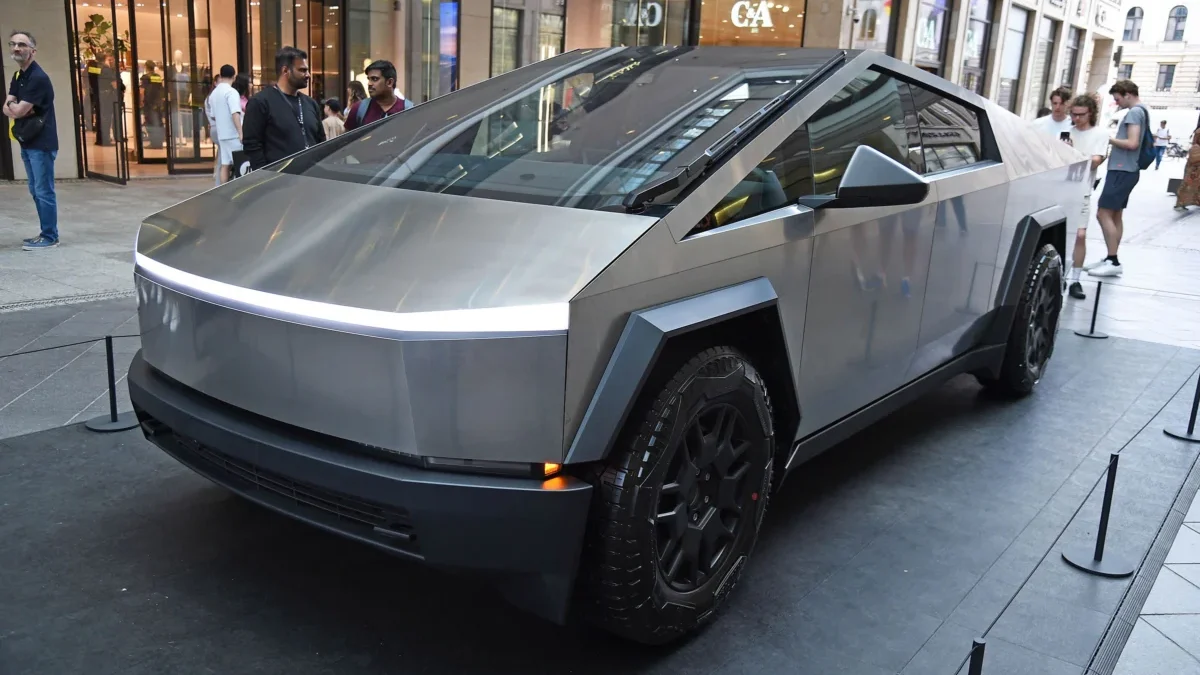
Tesla’s impending decision to halt production of the Cybertruck at its Texas Gigafactory next year marks a watershed moment for the global electric vehicle market. First introduced amid immense hype and delayed for years, the polarizing stainless-steel pickup has struggled under the weight of severe safety recalls, a soft luxury demand curve, and a unique brand toxicity linked closely to CEO Elon Musk’s political and public profile.
However, the winding down of the Cybertruck is not an isolated corporate failure. It is part of a broader, systemic retreat by major automakers from the era of oversized electric vehicles, particularly heavy-duty trucks and massive SUVs. Within a span of twelve months, the automotive landscape has undergone a seismic shift. Major manufacturers are quietly shelving their largest battery-electric flagships in favor of smaller, more efficient, and significantly more affordable models. This strategic pivot carries profound implications for pedestrian safety, supply chain optimization, and the economic accessibility of zero-emission transportation.
The Anatomy of Excess: Battery Weight and Resource Allocation
To understand why the automotive sector is moving away from vehicles like the Cybertruck and Ford’s discontinued F-150 Lightning, one must examine the fundamental engineering constraints of battery chemistry. The Cybertruck relies on a massive 123-kilowatt-hour battery pack that tips the scales at approximately 1,600 pounds—accounting for roughly a quarter of the vehicle’s total weight.
This footprint mirrors the battery capacity of the Ford F-150 Lightning, which featured power packs ranging from 98 kilowatt-hours to 131 kilowatt-hours before Ford canceled the electric truck line late last year, alongside plans for a three-row electric vehicle.
These colossal batteries create severe bottlenecks in the global battery supply chain. Lithium, cobalt, nickel, and manganese are finite resources. Dedicating 1,600 pounds of raw materials to a single vehicle that primarily serves suburban commuting and grocery runs is an inefficient use of industrial capacity. By contrast, a standard-range Hyundai Ioniq 5 accomplishes the exact same daily utility utilizing a battery roughly half the size of the Cybertruck’s.
Furthermore, the physics of mass present inherent safety hazards. Vehicles weighing upwards of three to four tons pose disproportionate risks to pedestrians and cyclists in urban environments, pushing road safety advocates to sound alarms over the proliferation of supersized passenger vehicles.
A Rapid Chronology of Industry Retrenchment
The strategic contraction of the large-EV market has unfolded with surprising swiftness across the automotive sector:
- Late 2024: Ford officially shelves its three-row electric vehicle project, signaling a retreat from large-scale family haulers to focus on hybrid and more efficient powertrain architectures.
- Late 2024: Ford announces the cancellation of the all-electric F-150 Lightning, pivoting instead toward hybrid technologies and laying the groundwork for a smaller, more accessible electric pickup.
- 2025: Rivian officially launches the R2 platform. While still a capable mid-size SUV featuring an 88-kilowatt-hour battery weighing 1,200 pounds, it represents a substantial downscaling from the company’s flagship R1S. Rivian simultaneously teases the even smaller R3 and R3X lines.
- Late 2025 / Early 2026: Industry analysts note a distinct pivot in capital expenditure. Startups and legacy automakers alike begin prioritizing sub-$30,000 compact form factors, extended-range electric vehicles (EREVs), and urban-friendly configurations.
- Upcoming 2026–2027: Tesla announces plans to phase out Cybertruck manufacturing in Texas to retool production lines for the Cybercab, a dedicated autonomous vehicle featuring a modest 48-kilowatt-hour battery. Ford prepares to launch the Fathom, a sub-$30,000 compact electric pickup modeled after the size of the gas-powered Maverick.
The Economics of Affordability and the Consumer Price Reality
The pivot toward smaller form factors is driven by raw economics as much as resource management. According to data from Cox Automotive, the average transaction price for a new electric vehicle sits at a prohibitive $55,800. For mainstream consumers grappling with broader inflation and the high cost of living, six-figure luxury trucks are increasingly out of reach.
Because the battery pack remains the single most expensive component of an electric vehicle, reducing physical dimensions directly correlates with reduced manufacturing costs. By trimming battery size, manufacturers can shed thousands of dollars from the final sticker price.
Startups are already capitalizing on this white space. Emerging manufacturer Slate is currently rolling out a minimalist, highly configurable tiny electric pickup with a base model starting under $25,000. While early pre-order volumes for new automotive concepts must always be viewed with a degree of skepticism—reminiscent of the speculative millions who once reserved Cybertrucks—the consumer appetite for affordable, practical EVs is undeniable.
The Regulatory and Political Landscape
External market forces have further complicated the adoption curve for high-end EVs. Following the implementation of anti-climate policy shifts by the administration of President Donald Trump, federal EV tax credits and consumer incentives were systematically dismantled, causing an immediate cooling effect on national sales figures.
However, macroeconomic pressures have introduced counterbalancing dynamics. Escalating geopolitical tensions in the Middle East and subsequent disruptions to global oil markets have driven up gas prices, renewing consumer interest in fuel-efficient alternatives. This has triggered a significant secondary market surge in used hybrid sales, as drivers seek immediate relief at the pump.
With federal incentives unlikely to return under the current political configuration, automakers realize that long-term viability depends on organic market competitiveness rather than government subsidies. Designing vehicles that are natively affordable without tax credits is now an operational imperative. If political power shifts in future election cycles—potentially bringing back progressive climate initiatives—manufacturers pivoting to smaller, cost-effective models will be uniquely positioned to capture pent-up demand without running into manufacturing bottlenecks.
The Road Ahead: Downscaling for the Future
The retreat from oversized electric trucks does not signal the absolute death of large vehicles. Premium models like the Kia EV9 and Rivian’s R1S continue to maintain steady sales figures within the top tier of the US market, and a robust resale market persists for early-generation vehicles like the F-150 Lightning.
Nevertheless, the center of gravity in the EV market has definitively shifted downward. The remainder of the top-selling electric models are overwhelmingly crossovers, sedans, and mid-sized SUVs equipped with moderately sized batteries.
Even Elon Musk’s rationale for ending the Cybertruck points directly toward this horizon. Tesla has confirmed that the factory floor space currently dedicated to the stainless-steel pickup will be repurposed to scale production of the Cybercab. Powered by a compact 48-kilowatt-hour battery, the Cybercab represents the antithesis of the heavy-duty, resource-intensive luxury truck.
Ultimately, the transition away from mega-EVs reflects a maturing industry. Automakers are moving past the novelty phase of electrification—where sheer size and brute-force battery specs served as marketing gimmicks—and entering a phase defined by efficiency, affordability, and practical utility. For consumers, cities, and the global supply chain, that evolution cannot come soon enough.